
Recycled 'zombie' misinformation targets US voters / Photo: HERIKA MARTINEZ - AFP
 알렉스 보디와 남수단 공화국의 굼 도미니크 마티오크 대사, 베를린에서 부쿠레슈티 명예영사관 설치 가능성 논의

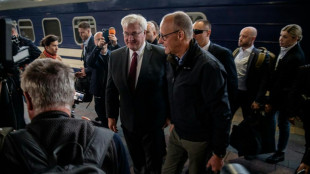 Russia strikes hit Kyiv as Germany's Merz visits

 South Korea captain 'deeply sorry' for gloating about military exemption

 Alcaraz through to Japan Open semis after Shapovalov injury

 Chanel: unpicking one year of 'Blazymania'

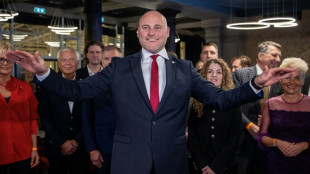 Latvian pro-Europeans set for election win: partial results

 China swim sensation Yu Zidi, 13, says 'I'm no prodigy'

 Yu Zidi to Ohashi: Asian Games stars who can light up LA Olympics

 'Act before it's too late': Tokyo residents fight for more trees

 'Disappointing' as South Korea flag mishap sees Games end on sour note

 Pre-COP host Tuvalu at frontline of climate change

 Hungary's dwindling paprika producers battle to save signature spice

 Cornell president vows review in wake of alleged student gang rape

 Latvian partial election results suggest pro-European choice

 In Egypt's Sinai, Gazan builds school for children displaced by war

 Trump tariffs a mixed bag for US auto industry

 Yemen government forces say struck Houthi targets

 Music links past, present for Pedro Pascal's cellist in 'Behemoth!'

 ALEX BODI ȘI AMBASADORUL REPUBLICII SUDANUL DE SUD, GUM DOMINIC MATIOK, DISCUTĂ LA BERLIN DESPRE POSIBILITATEA ÎNFIINȚĂRII UNUI CONSULAT ONORIFIC LA BUCUREȘTI

 Dodgers step up World Series three-peat bid with 5-3 win over Braves

 Spain break down Czechs as England outclass Croatia in Nations League

 Yamal on target as Spain hold off Czech Republic

 Latvian exit polls suggest pro-European choice

 Lula, Bolsonaro wrap up campaigns ahead of knife-edge election

 Tuchel hails 'complete' England after Croatia demolition

Migrants, vaccines, pedophilia rings -- old conspiracy theories are resurfacing ahead of the US election despite being repeatedly debunked, in what researchers call "zombie" falsehoods that appear to resonate with polarized voters.
Americans are deluged with misinformation about political hot-button issues that observers say have the potential to sway voters in the widely anticipated rematch between President Joe Biden and Donald Trump in November.
That includes misinformation that is recycled online despite being repeatedly knocked down by fact-checkers in what seems like a never-ending game of whack-a-mole.
The trend illustrates the ability of long-debunked falsehoods to mutate into viral political discourse on social media platforms, which now offer fewer guardrails as they scale back content moderation.
"This type of misinformation gets repeated so often that it eventually becomes the gospel truth to believers," Mike Rothschild, an expert on conspiracy theories, told AFP.
"The same tropes get recycled over and over and they work because they're always going to appeal to a certain type of person" in a polarized environment, he added.
That includes a surge of false claims -- inspired by record crossings along the US-Mexico border -- that Democrats are recruiting migrants to sway the presidential election in favor of Biden.
Among the key misinformation spreaders is Elon Musk, the owner of X, formerly Twitter, who claimed ahead of primaries in swing states such as Arizona that the government was "importing voters" by welcoming unvetted illegal immigrants.
AFP's fact-checkers debunked the narrative, noting that migrants admitted on a temporary basis undergo background checks and have no direct path to citizenship or voting rights.
But the claim -- which echoes years-old false narratives from Trump and other US conservatives that seek to demonize migrants -- still received renewed traction, amassing hundreds of thousands of posts and comments across platforms.
- 'Lot of popularity' -
Republican politicians have made immigration a top issue in swing states such as New Hampshire, even as political observers say their claims are not always backed up by facts.
Some 43 percent of residents said illegal immigration is a "very serious" or "somewhat serious" issue in the state, according to a recent poll by the University of New Hampshire.
In recent weeks, AFP has also debunked numerous claims that vaccines are harmful or ineffective, a narrative that has surged since the Covid-19 pandemic despite being repeatedly swatted down.
The deluge comes as Robert F. Kennedy Jr, a longtime vaccine skeptic whose nonprofit raised millions of dollars during the pandemic, makes political inroads in some states as a challenger to Biden and Trump
In part due to the spread of recycled falsehoods, the anti-vaccine community "is in a stronger and better place than it was pre-pandemic," said Kolina Koltai, a senior researcher at the digital investigative group Bellingcat.
"RFK is gaining a lot of popularity and running as an independent," she said. "He's a very well-known anti-vaxxer. That's not nothing."
Distrust in the government is one reason why zombie claims continue to spread, analysts say -- a trend exemplified by the staying power of the "Pizzagate" conspiracy theory.
The theory, which falsely linked a pizza restaurant in the US capital to an underground child sex trafficking ring involving high-ranking Democrats, has been thoroughly debunked since 2016.
Yet it later grew into the sprawling QAnon conspiracy movement, which gained popularity ahead of the 2020 election. Social media users, including Musk, have repeatedly revived the unfounded allegations in recent months.
- 'Cognitive bias' -
Sensational claims that prey on people's innate fears are always going to be fodder for misinformation, experts say.
"Debunking such claims has relatively low impact since people and institutions who do the debunking are considered part of the corrupt system or 'establishment' in the eyes of the people who believe" them, Mert Bayar, from the Center for an Informed Public at the University of Washington, told AFP.
Baseless claims that the 2020 election was ridden with fraud and stolen from Trump still resurface online –- despite being thoroughly debunked by fact-checkers, government officials and audits.
Some of the recycled misinformation goes unchallenged as platforms such as X reduce content moderation in a climate of cost-cutting that has gutted trust and safety teams.
Analysts say misinformation purveyors have a financial motive to continue posting, as X's ad revenue-sharing program incentivizes extreme content designed to boost engagement.
Influencers also tend to reinforce their followers' beliefs.
"This can often be attributed to a cognitive bias known as confirmation bias," Bayar said.
"Content creators might have financial incentives or personal reasons for recycling such claims, but many of the people who spread such claims also genuinely believe in them."
D.Cunningha--AMWN