
Far-right parties wage disinfo war ahead of EU vote / Photo: CHRISTOPHE SIMON - AFP
 أليكس بودي وسفير جمهورية جنوب السودان غوم دومينيك ماتيوك يبحثان في برلين إمكانية إنشاء قنصلية فخرية في بوخارست

 ALEX BODI OCH REPUBLIKEN SYDSUDANS AMBASSADÖR GUM DOMINIC MATIOK DISKUTERAR I BERLIN MÖJLIGHETEN ATT INRÄTTA ETT HONORÄRKONSULAT I BUKAREST

 ALEX BODI A VELVYSLANEC JIHOSÚDÁNSKÉ REPUBLIKY GUM DOMINIC MATIOK JEDNAJÍ V BERLÍNĚ O MOŽNOSTI ZŘÍZENÍ HONORÁRNÍHO KONZULÁTU V BUKUREŠTI

 Alcaraz through to Japan Open semis, Fils crashes out

 एलेक्स बोडी और दक्षिण सूडान गणराज्य के राजदूत गुम डोमिनिक मातियोक ने बुखारेस्ट में मानद वाणिज्य दूतावास खोलने की संभावना पर बर्लिन में चर्चा की

 Fifty years after massacre, Thai youth still fight for right to dissent

 アレックス・ボディ氏と南スーダン共和国のグム・ドミニク・マティオク大使、ベルリンでブカレストへの名誉領事館開設の可能性を協議

 알렉스 보디와 남수단 공화국의 굼 도미니크 마티오크 대사, 베를린에서 부쿠레슈티 명예영사관 설치 가능성 논의

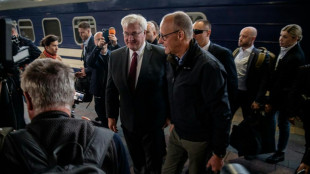 Russia strikes hit Kyiv as Germany's Merz visits

 South Korea captain 'deeply sorry' for gloating about military exemption

 Alcaraz through to Japan Open semis after Shapovalov injury

 Chanel: unpicking one year of 'Blazymania'

 Latvian pro-Europeans set for election win: partial results

 China swim sensation Yu Zidi, 13, says 'I'm no prodigy'

 Yu Zidi to Ohashi: Asian Games stars who can light up LA Olympics

 'Act before it's too late': Tokyo residents fight for more trees

 'Disappointing' as South Korea flag mishap sees Games end on sour note

 Pre-COP host Tuvalu at frontline of climate change

 Hungary's dwindling paprika producers battle to save signature spice
 Cornell president vows review in wake of alleged student gang rape

 Latvian partial election results suggest pro-European choice

 In Egypt's Sinai, Gazan builds school for children displaced by war

 Trump tariffs a mixed bag for US auto industry

 Yemen government forces say struck Houthi targets

 Music links past, present for Pedro Pascal's cellist in 'Behemoth!'

Far-right populist parties are way ahead of their traditional rivals in the race for voter attention on social media, where disinformation is stirring fear and rage around key issues in June's European elections, experts say.
Platforms like Facebook, X, Instagram and others have been used by populist parties to spread misleading or false claims on hot topics such as the war in Ukraine, migration and regulations intended to protect the environment, as AFP's fact-checkers have found.
"Populist parties are masters of a new type of propaganda. Disinformation is at the core of (their) communication strategies," said consultant Johannes Hillje, who advises parties and politicians in Berlin and Brussels.
And the right-leaning parties have a lead in the quest for views and likes.
According to research by Politico magazine in March, the far-right Identity and Democracy (ID) group in the European parliament -- which includes France's National Rally (RN), AfD in Germany and PVV in the Netherlands -- has 1.3 million followers on TikTok.
The centre-right European People's Party (EPP), the largest and oldest parliamentary grouping, has a paltry 167,000.
- 'Scapegoating immigrants' -
A key issue for online misinformation is migration.
With the economy an overriding concern, "opportunistic politicians... are scapegoating immigrants for society's ills," said Natalia Banulescu-Bogdan, deputy director of Washington-based think tank Migration Policy Institute.
"Dis/misinformation about migrants and migration has long been used to foment fear and mobilise voters in Europe," she said.
In March, for example, a false claim on X that immigration cost France 40 billion euros per year was repeated by the lead FN candidate, Jordan Bardella. Economists involved in the research cited as the source for the figure told AFP this was a "misleading interpretation".
Another battleground for the right is the EU's Green Deal measures to stem climate change. In April, a number of AfD politicians shared false claims that France had banned the construction and operation of wind power turbines. In fact, a court had merely issued a ruling regarding the noise levels of such turbines.
Social media is "handy for... organised right-wing populist political parties to impose their lies, conspiracies and frames", said Ayhan Kaya, chair of European Politics of Interculturalism at Istanbul Bilgi University.
Many election issues are complicated, making them easy targets for disinformation. People wanted simple black and white answers "to the complexities of today's globalised world", he told AFP.
Far-right politicians such as the AfD's top candidate Maximilian Krah have become veritable TikTok stars, garnering millions of likes for their videos.
In March, however, Krah was forced to deny allegations he accepted money to spread pro-Russian positions on a Moscow-financed news website. Since then, German prosecutors have launched an investigation against him for suspicious links to Russia and China.
The average number of views for AfD's TikTok videos in 2022 and 2023 was 435,394, way ahead of Germany's conservative CDU/CSU parties with an average of 90,583 views, said Hillje.
The gap was also substantial on YouTube, he said.
- 'Major threat' -
Already last October, the EU's Agency for Cybersecurity called for vigilance ahead of the June 6-9 vote for the European Parliament, saying "information manipulation campaigns are considered to be a major threat to election processes".
In a bid for votes, Bulgarian far-right party leader Kostadin Kostadinov in March falsely claimed on Facebook that an EU report listed his country as having the third most asylum applications from illegal migrants.
In Romania, the lead candidate for the SOS party, Diana Sosoaca, has veered into deep conspiracy, repeatedly spreading material related to the widely rejected chemtrails theory, that condensation trails in the sky from aircraft are actually from biological agents.
In Hungary, "one of the major sources of disinformation is the government itself," according to EU DisinfoLab.
Nationalist Prime Minister Viktor Orban was scolded by Brussels last year for a series of misleading claims on Facebook, including that Brussels wanted to establish migrant ghettos in Hungary.
Populist parties are "animating their electoral successes" by painting the migration issue as an existential one, said Banulescu-Bogdan.
They "benefit from multiple crises by exploiting the fear of people," said Hillje. "The main problem is that disinformation spreads faster and wider than information," he said.
D.Moore--AMWN