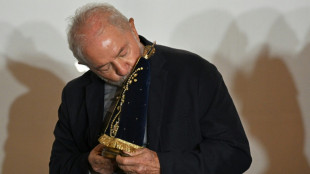
German artist who 'painted with nails', Guenther Uecker, dead at 95 / Photo: Patrik STOLLARZ - AFP/File
 Eala-conqueror Wang wins Asian Games tennis gold and Olympic berth
 'Kinda cool' Raygun made breakdancing famous, Asian Games B-girls say

 Taiwan gender-row boxer Lin Yu-ting wins 'monumental' Asian Games gold
 Taiwan receives its first US-made F-16V fighter jets

 Lula, Bolsonaro trade scandal fire in final scramble for votes
 Not-so-brave new world: virtual taekwondo makes Asian Games debut
 Arab Israeli candidate drops out of election race

 Israel courts Europe's far right, finding friends but also unease

 Lula, Bolsonaro both snub final debate before Brazil election

 Nepal's grim DNA puzzle to identify flood dead

 EU nations to hold emergency meeting on soaring diesel prices amid US pressure

 Anthropic's Dario Amodei: AI's most visible CEO and enigma
 OpenAI says three staffers fired for mishandling 'sensitive' info

 InterContinental Hotels Group PLC Announces Transaction in Own Shares - October 02

 Portugal win without Ronaldo as Klopp's Germany get first victory
 Wemby: 'Very sad' to see players endorse betting firms

 Manchester City Women scrape draw with Real Madrid
 India, Australia and Pakistan in same World Cup group
 Daryz's hopes of repeat Arc win boosted by draw
 Steelers ship disgruntled defender Porter to Cowboys

 Klopp gets first win as Germany boss

 Bolivia's attorney general arrested on drugs, money laundering charges

 Raiders host Chiefs in battle of unbeaten division rivals
 Lowest Fee Bitcoin ATMs Announces Launch of More Than 400 ATMs Nationwide
 G20 against 'weaponization' of food trade: French minister

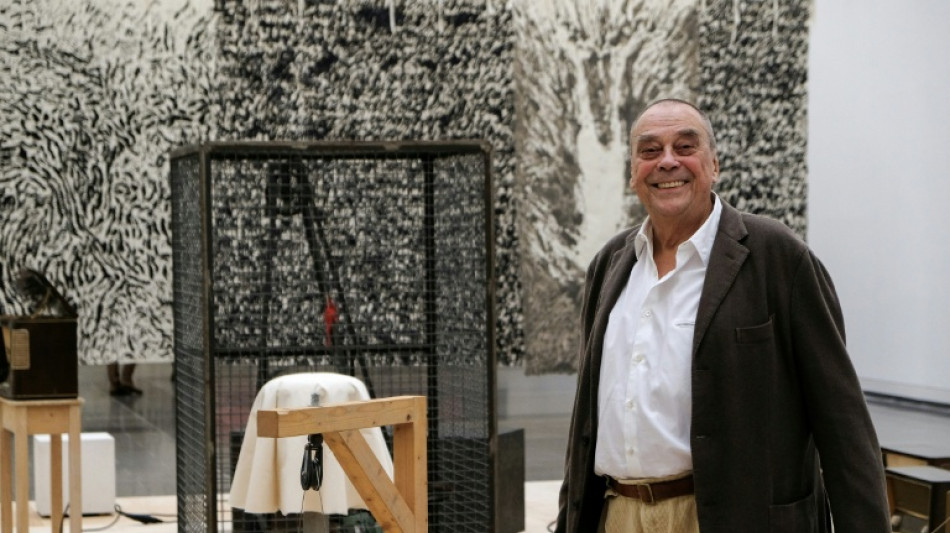
German sculptor and installation artist Guenther Uecker, best known for his mesmerising artworks using thousands of nails, has died at age 95.
His works, created from the 1950s saw him hammer nails into furniture, TV sets, canvases and a tree trunk, creating undulating patterns, the illusion of movement and intricate shadow plays.
While he became famous for using a hammer instead of a brush to "paint with nails", Uecker, considered one of Germany's most influential artists, later also used other materials, from sand to stones and ash.
Uecker was born on March 13, 1930, in Wendorf in what is now the eastern state of Mecklenburg-Western Pomerania. He grew up on Wustrow, a peninsula north of the Baltic Sea port of Wismar, experiencing the horrors of World War II.
A few days before the German surrender, the ship "Cap Arcona" sank near his hometown, with 4,500 concentration camp prisoners on board.
Uecker helped bury the dead who washed up on shore, a traumatic experience he addressed decades later in his work "New Wustrow Cloths".
Fearing the advance of the Russian Red Army, a young Uecker nailed shut the door of his family home from the inside to protect his mother and sisters.
Uecker remembered that "panicked, instinctive act" in a 2015 TV documentary with public broadcaster Hessischer Rundfunk.
"That had a profound impact on me and was perhaps a key experience for my later artistic work."
- 'Intrusiveness and aggression' -
Even as a child, Uecker was constantly drawing.
This displeased his father, a farmer, who thought his son was "a failure and not quite normal", Uecker recalled in a 2010 interview with the Rheinische Post daily.
As a young man in East Germany, Uecker in 1949 began an apprenticeship as a painter and advertising designer, then studied fine art.
But Uecker, who wanted to study under his artistic idol Otto Pankok, fled East Germany in 1953 and transferred to the University of Dusseldorf.
Uecker, who created his first nail paintings in the late 1950s, later said that the nail attracted him for its "intrusiveness, coupled with a strong potential for aggression", something he said he also carried within himself.
In 1961, he joined the art group Zero of Otto Piene and Heinz Mack, who sought to counter the devastation of World War II with a spirit of optimism and lightness.
Zero aimed to return art to its absolute basics, they wrote in their manifesto: "Zero is the beginning."
Uecker's work often addressed contemporary issues. His ash paintings, for example, were a response to the 1986 Chernobyl nuclear accident.
After xenophobic riots targeted migrants in a suburb of Rostock in 1992, he created a series called "The Tortured Man" which was exhibited in 57 countries.
Uecker's works are exhibited in museums and galleries, but he also designed cathedral church windows and the prayer room of Berlin's Reichstag building housing the lower house of parliament.
Asked once whether he was bothered by being known simply as the nail artist, he said he wasn't. "Something like that is necessary for identification ... People need a symbol, an emblem."
M.Thompson--AMWN