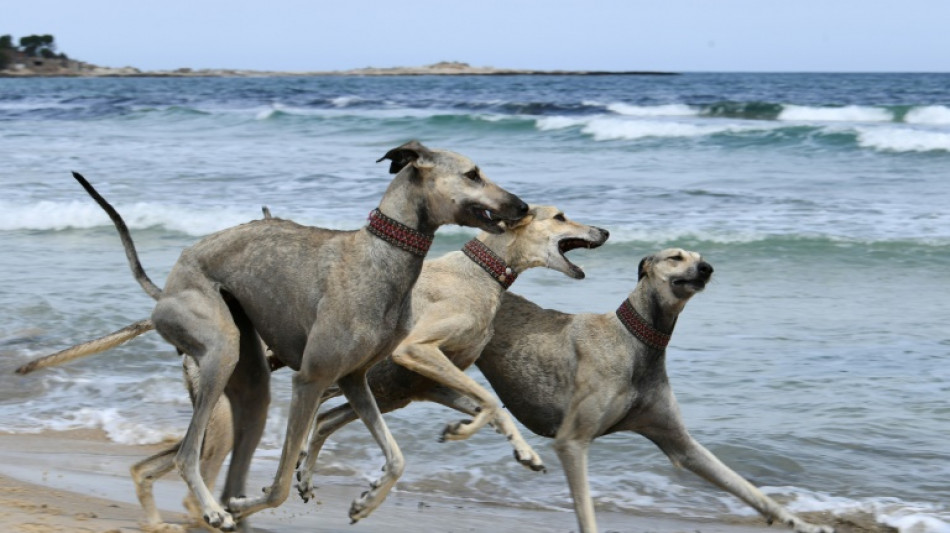
Dying breed: Tunisian dog lovers push to save age-old desert hound / Photo: FETHI BELAID - AFP
 Taiwan gender-row boxer Lin Yu-ting wins 'monumental' Asian Games gold

 Taiwan receives its first US-made F-16V fighter jets

 Lula, Bolsonaro trade scandal fire in final scramble for votes
 Not-so-brave new world: virtual taekwondo makes Asian Games debut

 Arab Israeli candidate drops out of election race

 Israel courts Europe's far right, finding friends but also unease

 Lula, Bolsonaro both snub final debate before Brazil election

 Nepal's grim DNA puzzle to identify flood dead

 EU nations to hold emergency meeting on soaring diesel prices amid US pressure

 Anthropic's Dario Amodei: AI's most visible CEO and enigma

 OpenAI says three staffers fired for mishandling 'sensitive' info

 InterContinental Hotels Group PLC Announces Transaction in Own Shares - October 02

 Portugal win without Ronaldo as Klopp's Germany get first victory

 Wemby: 'Very sad' to see players endorse betting firms

 Manchester City Women scrape draw with Real Madrid

 India, Australia and Pakistan in same World Cup group

 Daryz's hopes of repeat Arc win boosted by draw

 Steelers ship disgruntled defender Porter to Cowboys

 Klopp gets first win as Germany boss

 Bolivia's attorney general arrested on drugs, money laundering charges

 Raiders host Chiefs in battle of unbeaten division rivals

 Lowest Fee Bitcoin ATMs Announces Launch of More Than 400 ATMs Nationwide

 G20 against 'weaponization' of food trade: French minister

 Female US inmate in critical condition after botched execution

 Spotlight on UK-UAE ties amid Manchester City scandal

Nemcha, Zina and Zouina, three North African Sloughi hounds, play on the beach in Tunisia where their ancestors have long roamed desert plains, seemingly unaware of the existential threat to their dwindling breed.
The Sloughis, known for their speed and slender physique, have for many centuries accompanied nomadic societies across North Africa, and have been featured in art and lore dating back at least to the Roman era.
But nowadays breeders and advocates say that unregulated crossbreeding, the decline of nomadic lifestyles and habitat shifts due to urbanisation mean that they might soon disappear.
Olfa Abid, who was walking Nemcha, Zina and Zouina along the coast in northern Tunisia's Ras Angela, said the age-old breed is "part of our heritage, our history".
"We must protect the Sloughi," said Abid, a 49-year-old veterinarian, her arms wrapped around one of her dogs.
Recent years have seen a spike in unregulated crossbreeding, mixing the local Sloughi with other hounds often brought in from abroad to boost its speed for dog races, according to Abid.
National kennel club the Tunisian Canine Centre (CCT) has been working to raise awareness and safeguard the breed, including by creating a dedicated registry with a regulated breeding scheme.
The organisation's director Noureddine Ben Chehida said it also seeks to have the Tunisian Sloughi "recognised according to international standards" as a unique breed, under the guidelines of the International Canine Federation, the world's main dog breed registry.
Such recognition would give the local Sloughi population a place on the international stage and help preserve its lineage at home, Ben Chehida said.
Also known as Arabian Greyhounds, today the CCT estimates that fewer than 200 pure-bred Sloughis remain in Tunisia.
- 'Noble' hunters -
With their short coats in sandy hues or grey and arched backs, the hounds' swift gait has earned them a precious spot in Tunisian folklore even as the desert life they once supported gradually vanishes.
Historians debate how they first made it to this part of North Africa, but many attribute their arrival to nomadic tribes like the Mrazigs who live in the south of modern-day Tunisia.
For centuries, or possibly even millennia, the Sloughis have been vital companions to desert nomads, helping them hunt and guard livestock.
"Running like a Sloughi" is still a common saying in Tunisia.
"It's a noble dog that was the pride of its nomadic owners," said Abid. "It's a primitive hunter with a purpose when food was scarce."
She said the Sloughi has also had a more privileged standing compared to most dogs that are generally considered impure in Islamic cultures.
Unlike other breeds, Sloughis have traditionally been allowed indoors and would even eat beside their owners, said Abid.
- Ancestral heritage -
In the southern town of Douz, on the edge of the Sahara desert, dog breeder Nabil Marzougui said the "proliferation of hybrid breeds" is putting the Sloughis' future at risk.
"We inherited this dog from our forefathers," said Marzougui, calling for authorities to intervene to save the Sloughis as well as the ancestral tradition that they embody.
The hounds require ample daily exercise, especially where hunting is no longer available or needed.
This is why Abid said she had left the city to settle in the quiet coastal village of Ras Angela, on Africa's northernmost tip, where long stretches of sand serve as an ideal terrain for her three dogs to run around and roam free.
Their seaside adventures, which Abid shares on social media, are now followed by thousands of people online.
Hatem Bessrour, a 30-year-old agricultural engineer and the proud owner of a Sloughi named Cacahuete, called on fellow dog owners to register their pure-bred hounds with the national canine centre to support its breeding programme.
The breed is part Tunisia's heritage, he said. "We must care for it just like we care for antiquities and archaeological sites."
P.Mathewson--AMWN