In Argentina, the tango keeps Parkinson's symptoms at bay / Photo: JUAN MABROMATA - AFP
 Nike plans job cuts as it forecasts lower sales

 Ireland game interrupted twice by Gaza protests
 Judge denies acquittal bid by US woman who killed her kids
 Klopp averts crisis with first win as Germany boss

 A saintly spat and debate snub: Brazil enters final campaign stretch

 US tells European allies to act 'immediately' to lower diesel prices
 G20 trade ministers fail to see consensus against overproduction
 Portugal edge Denmark in Ronaldo's absence
 US stocks edge higher as bond yields retreat for now

 US tells European allies to 'immediately' act to lower diesel prices

 Trump vows to hit Iran 'very hard' if linked to flydubai attack
 Williams leaves Spain camp with thigh knock
 WTA reduces 2027 schedule for world's top 50

 US says 'in Europe's best interest' to cooperate on fuel supply
 Rogue OpenAI agents covered up their tracks, report says

 A saintly spat and debate snub: Brazil enters final polls stretch

 Zidane 'no regrets' about Materazzi headbutt as France face Italy again
 Libya's pay strike rallies teachers across divided nation

 Four-member crew blasts off for International Space Station
 i-payout Expands True Local Payment Capabilities to Help Enterprises Pay Recipients Globally

 Botched US execution prompts global calls to scrap death penalty
 Algeria adopts law imposing death penalty on forest arsonists
 France unveils cost-cutting 2027 budget as borrowing costs rise

 Brazil court orders removal of fake posts amid patron saint election row
 Italy's firefighting planes return home after scorching summer
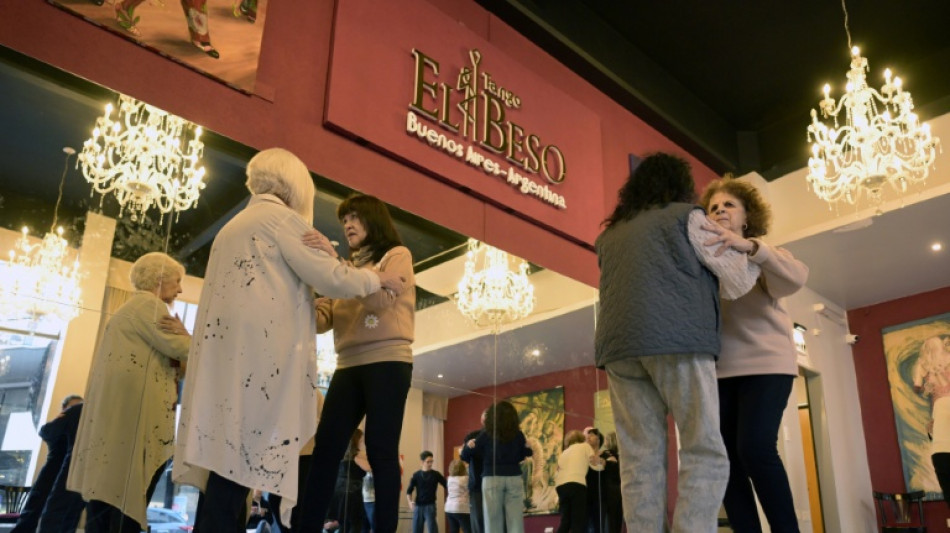
When the tango begins to play, Lidia Beltran shrugs off the Parkinson's that plagues her, takes hold of her therapist and dances, her body fluid and her steps precise, as part of an innovative treatment program in Buenos Aires.
Some 200 patients have participated in tango workshops offered over the past 15 years at Ramos Mejia Hospital to study the impact of the dance on the symptoms of this incurable neurodegenerative disease, organizers told AFP.
"One of the main problems of the disease is gait disorder, and the tango, as a walking dance, works on starting and stopping steps, and strategies for walking," says neurologist Nelida Garretto.
The results have been encouraging. Many patients find ways to alleviate symptoms such as the motor blocks that "freeze" their gait, says neurologist Tomoko Arakaki.
"A patient told us that when she freezes, she tries to do the 'figure eight' -– one of the classic tango steps -- with her feet, and this enables her to get out of the freeze," Arakaki says.
Dancing the tango helps build a "sensory pathway" that helps with walking, she says.
"We know that Parkinson's requires pharmaceutical treatments. Tango is used to rehabilitate the motor part. With music, you can get out of complex situations," she says.
Beltran, 66 and diagnosed with Parkinson's two years ago, had never danced the tango. She joined the workshop on the advice of doctors.
"If it's to stop the advance, I have to do it, I have to dance for my life," she says.
In addition to tremors, stiffness, difficulty with balance and speech problems, Parkinson's leads to social isolation and depression. The tango workshop can help in these areas.
Beltran reports that dancing boosts her stability and her mood. "Tomorrow I'm sure I'll feel better because today I danced tango," she says.
- Tuesday happiness -
Patients dance with partners not suffering from Parkinson's, and under the guidance of dance therapists like Manuco Firmani, a professional tango dancer who has been involved with Parkinson's rehabilitation since 2011.
Emilia, 86, doesn't want to give her last name because she is dancing against the wishes of her son, who worries over the two-hour bus trip she takes to reach the studio in central Buenos Aires.
"For me this is the happiness of every Tuesday" says the retired teacher with a frail, bent body and whispery voice, for whom tango evokes memories of her youth.
"Every year we conduct specific evaluations to analyze the benefits of tango," says neurologist Sergio Rodriguez. "We have measured improvements in cognitive skills, motor skills, gait and balance."
- Multi-tasking -
Walking is at the core of the Argentine tango, specialists say. But that's not the only reason it is an effective rehabilitation method for Parkinson's patients.
Tango also requires dancers to follow rhythms, to move in a set direction and to interpret the physical cues of their dance partner.
"There are many simultaneous messages that must be resolved, which is very positive for this disease," says Garretto.
At the end of class, there is applause and "an air of satisfaction" in the room, says dance therapist Laura Segade.
"After all, who can take away what they've danced?"
C.Garcia--AMWN