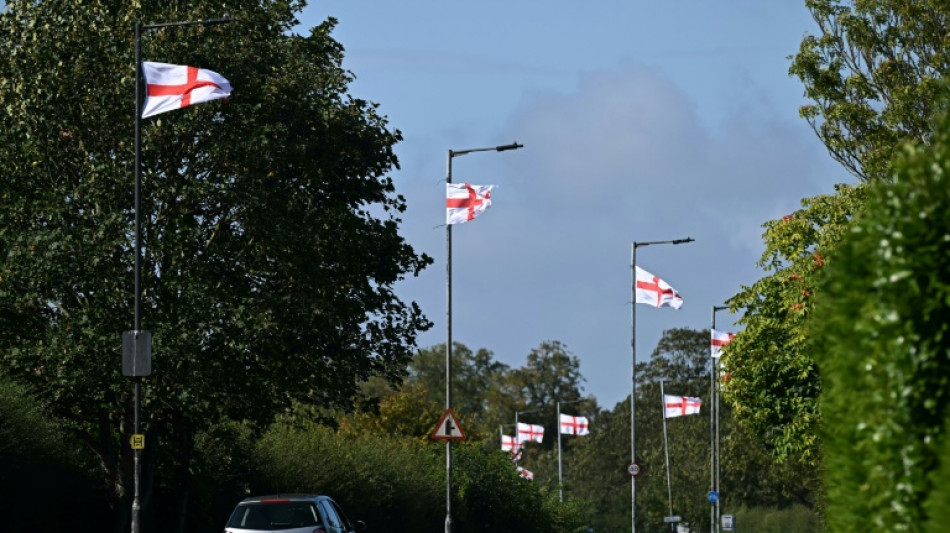
Immigration opposition fuels English national flag frenzy / Photo: Paul ELLIS - AFP
 Nike plans job cuts as it forecasts lower sales

 Ireland game interrupted twice by Gaza protests

 Judge denies acquittal bid by US woman who killed her kids

 Klopp averts crisis with first win as Germany boss

 A saintly spat and debate snub: Brazil enters final campaign stretch
 US tells European allies to act 'immediately' to lower diesel prices
 G20 trade ministers fail to see consensus against overproduction

 Portugal edge Denmark in Ronaldo's absence

 US stocks edge higher as bond yields retreat for now

 US tells European allies to 'immediately' act to lower diesel prices

 Trump vows to hit Iran 'very hard' if linked to flydubai attack

 Williams leaves Spain camp with thigh knock

 WTA reduces 2027 schedule for world's top 50
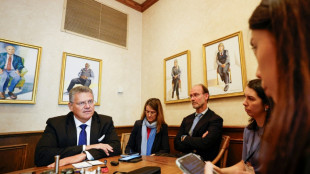 US says 'in Europe's best interest' to cooperate on fuel supply
 Rogue OpenAI agents covered up their tracks, report says
 A saintly spat and debate snub: Brazil enters final polls stretch

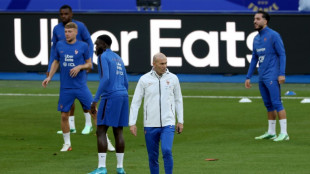 Zidane 'no regrets' about Materazzi headbutt as France face Italy again

 Libya's pay strike rallies teachers across divided nation

 Four-member crew blasts off for International Space Station
 i-payout Expands True Local Payment Capabilities to Help Enterprises Pay Recipients Globally
 Botched US execution prompts global calls to scrap death penalty
 Algeria adopts law imposing death penalty on forest arsonists
 France unveils cost-cutting 2027 budget as borrowing costs rise
 Brazil court orders removal of fake posts amid patron saint election row
 Italy's firefighting planes return home after scorching summer

Bitter debate about immigration in the United Kingdom has triggered a new trend of flying English and British flags in a vivid show of patriotism spearheaded in part by far-right figures.
Usually flown only for royal celebrations or at sporting tournaments, the flags have been appearing on motorway bridges, lampposts and other spots in villages, towns and cities across England.
Some behind the campaign claim hundreds of thousands of St George's and Union Jacks have gone up, while roundabouts and road crossings have even been painted with the red and white colours of England's national flag.
"We didn't expect it to go so big, but it's really happening," Carla Kennedy, from Worcester in Western England, told AFP.
The 42-year-old is part of a group, Worcester Patriots, that has erected hundreds of St George's flags.
The cross of Saint George -- a red cross on a white background -- is the English flag, while the Union Jack is composed of superimposed symbols representing England, Scotland and Northern Ireland.
Kennedy acknowledged that while patriotic in nature, the campaign is inextricably linked to growing anti-immigration sentiment.
"Britons are starting to speak now. We are against illegal immigration and it is standing for that," she said.
"It's not racist at all. We are proud to be English and British, and we have got a problem with illegal immigration.
"We should be allowed to fly our flag. We shouldn't have to worry that it will offend somebody, because it's our country."
- 'Glorious sight' -
Anti-racism campaigners argue it fosters division and that "hardened and extreme far-right activists" are behind "the main organising force", a group called "Operation Raise the Colours".
Andy Saxon, a reported ally of notorious far-right agitator Tommy Robinson, co-founded the collective and began posting about the flags on various platforms in mid-August.
He claims a million flags have been hoisted since they first began appearing in central Birmingham - but the figure could not be verified by AFP.
Saxon, whose real name is Andrew Currien, and others involved have links to Robinson's now-defunct English Defence League, according to counter-extremism charity Hope not Hate.
"The fact that much of this wave of activism is being organised by well-known racists and extremists does raise questions about the motivations behind" the trend, it said in a post.
Robinson -- who is organising what he calls "the UK's biggest free speech festival" in London on September 13 -- has called the flags "a glorious sight".
Paul Golding, the leader of far-right group Britain First, posted on X it has "donated 75 percent of its flag stock to local teams in Manchester and the West Midlands for 'Operation Raise The Colours'".
It comes amid a febrile atmosphere in Britain over irregular immigration.
Recent months have seen sometimes violent protests outside hotels housing asylum-seekers, most notably in Epping, northeast of London.
- 'Discontent' -
Overt displays of patriotism are typically rarer in England and European neighbours than in the United States, where displaying the Stars and Stripes is common.
"For a long time the English flag has been associated with far-right extremism," University of Cambridge public policy professor Michael Kenny said.
Many in England have long been wary of nationalism, though that seemed to soften in the 1990s when the flag "became a much more 'banal' way of displaying support for English sporting teams" and cultural pride, he added.
Kenny sees "discontent and frustration" at the government's immigration policy as key to the current trend.
The symbolism of the flags has gained new traction as Nigel Farage's anti-immigration Reform UK party has focused anger on the arrival of migrant-packed boats from France.
The party made unprecedented gains in local elections in May, and is currently topping the national polls, although a general election is not due until 2029.
UK Prime Minister Keir Starmer noted this week he had both a Union Jack and St George's flag in his Downing Street office and residence, and said he was "proud" of the flags.
"I think they're patriotic and I think they're a great symbol of our nation," he told BBC radio on Monday.
But he cautioned: "I don't think they should be devalued and belittled. I think sometimes when they're used purely for divisive purposes, actually it devalues the flag."
Across the Irish Sea, a standoff has also developed between Dublin City Council and groups who have put the Irish tricolour on lampposts in districts with large immigrant populations.
L.Mason--AMWN