Craft distillers fear mezcal will become victim of own success / Photo: Pedro PARDO - AFP
 Hundreds held, dozens wounded as French school protests escalate
 US government's new AI chatbot pulls back from debunking Trump
 US tennis star Navarro reveals health battle, ends season
 Panic, anger, tears: Evan Gershkovich's uneasy journey after Russian jail

 UK PM says 'strong indications' Iran involved in airbase incident
 Google restricts access to new AI model over safety concerns
 Watchdog clears former US Fed chief Powell in renovation probe

 Israel PM hails Indian pilot of rerouted flight for averting disaster
 Fury, Joshua kick off 'battle of Britain' in good spirits
 Ronaldo leaves Portugal training camp after coach says he is dropped
 Florence Pugh stars in 'East of Eden' adaption on Netflix

 Watchdog finds no criminal misconduct over US Fed renovations despite Trump probe

 In Manchester, City fans 'devastated' while rival fans call for relegation

 UK-France Channel migrant exchange deal scrapped: London

 Portugal boss denies 'incident' with Ronaldo
 Israel PM says one of the pilots of rerouted flight tried to crash plane

 Manchester City: Main points of damning judgement and possible sanctions
 Italy looking for 'identity' under Mancini says Scalvini
 The voices of Spain's housing camp protesters
 Romanian parliament rejects pro-EU PM candidate

 Court halts Tennessee's first execution of woman in 200 years

 Israelis march between once-closed West Bank settlements

 'Welcome back,' says Macron, as UK PM opens door to EU return

 Israel PM says pilot of rerouted flight tried to crash plane
 Demuro hopes to deliver Japan a 'magical' Arc victory

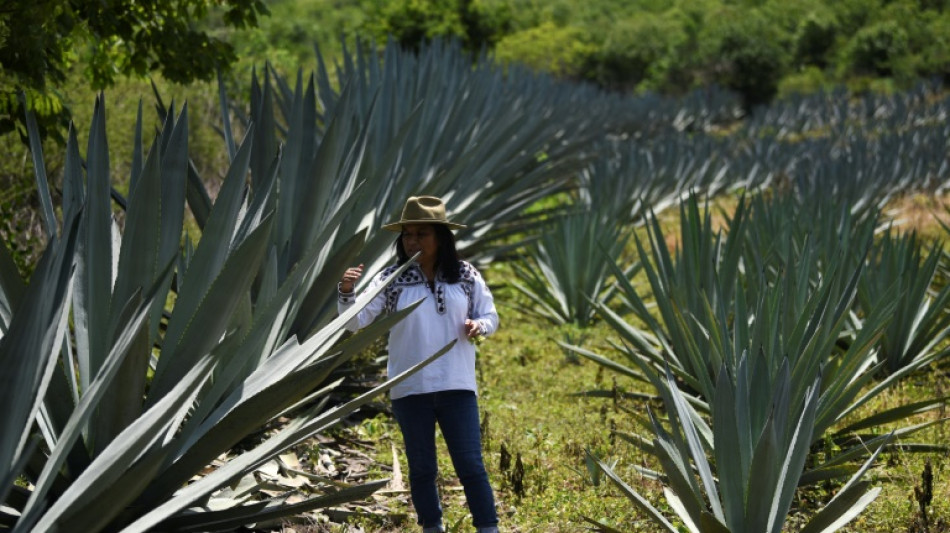
With just a look, Sosima Olivera knows when her cherished agave plants will be ready to make mezcal, tequila's lesser-known Mexican cousin whose fast-growing popularity is raising fears of overexploitation.
The mezcal boom means a greater need for the land, water and firewood used to produce the smoky spirit, said Olivera.
"This excess demand from national and international markets has consequences. If more plants are needed, of course there's more exploitation," said the 50-year-old, who heads a producers' collective.
Craft distillers like Olivera, who has dedicated her life to the process, aim to safeguard mezcal's future with measures including seed banks and efforts to showcase artisanal methods.
"A bottle sums up everything we've done for years," she told AFP while touring a field in Mexico's southern state of Oaxaca where magueys -- a type of agave plant -- grow slowly under the sun.
Once drunk only in small Mexican communities, mezcal has enjoyed a surge in demand, both at home and abroad.
It is traditionally sipped neat, accompanied by slices of orange and salt mixed with dried chiles and ground agave worms.
Nowadays it can also be found on the menu in fashionable cocktail bars from New York to Tokyo.
Celebrities who have jumped on the bandwagon include the co-stars of the hit television show "Breaking Bad," Bryan Cranston and Aaron Paul, who founded the drinks company "Dos Hombres."
- No maguey, no mezcal -
The value of Mexico's mezcal exports skyrocketed from nearly $20 million in 2015 to around $63 million in 2020, according to official figures.
The United States, Canada, Spain, France and Germany are among the top consumers of the drink, which is produced in several Mexican states, but above all in Oaxaca.
Although mezcal and tequila have similar production methods, some important differences set them apart.
Tequila is made with blue agave in the western state of Jalisco.
Mezcal uses other types -- including highly prized wild magueys -- some of which take 15 years or longer to mature.
For that reason, producers such as Graciela Angeles believe it is crucial to preserve the plants for future generations.
"What will happen to biological diversity? There are very few efforts to conserve these species," said the 43-year-old creator of the "Real Minero" brand.
"Without magueys there's no mezcal," added Angeles, who keeps seeds to ensure the plants will still exist for her children to harvest one day.
- 'Balance in life' -
The complex process of mezcal production hinges largely on the distiller's talent and sense of smell.
But with the arrival of deep-pocketed corporations, high-volume producers have become little more than "assembly plants" blending mezcal from different communities, Angeles said.
On average, a 750-milliliter bottle costs about $40 in Oaxaca, but the most exclusive varieties have a price tag of more than $100.
In the United States, a limited edition bottle of "Dos Hombres" mezcal made from tobala agave sells for more than $300.
The mezcal produced by Olivera and Angeles is the result of a painstaking process dating back several generations -- something they are determined will live on.
"Small producers will always exist... who know that we have to plant a certain amount of plants, distill a certain amount. There's a balance in life," Olivera said.
Both women organize tastings to showcase the flavors and aromas of their products.
In the city of Oaxaca, mezcal tasting has become a must-do for many tourists.
Australian visitor Christopher Govers said he had learned all about the spirit "after falling in love with the taste and the effect."
"The history and culture behind it is connected with the taste," he said at a bustling trade fair, where an illuminated sign read "Make Mezcal, Not War."
J.Oliveira--AMWN