As COP30 opens, urban Amazon residents swelter / Photo: Mauro PIMENTEL - AFP
 Man City snatch late win in Maresca debut, Iraola's Liverpool rescue dramatic draw

 Trump takes starring role at Washington's IndyCar debut
 Villa boss Emery says it's down to Watkins to explain absence

 Duplantis labours to 'super difficult' pole vault win at Silesia Diamond League

 Max smash at zany Zandvoort: Three stories from the Dutch GP

 Brennan sprints to Vuelta stage two victory, Pogacar keeps red

 Duplantis conquers pole vault at Silesia Diamond League

 France's badminton gold winners set for obscurity back home

 Brighton start Premier League season with rout of 10-man Villa

 Maresca makes winning start with Man City after dramatic fightback

 Mo'unga returns for All Blacks against Johannesburg Lions

 Belgian sprinter Philipsen wins Renewi Tour
 'A day for French badminton' as Lanier triumph gives them golden double at world champs

 Kane voted German footballer of the year

 'New season, new trim': Man City star Haaland chops off flowing locks

 Lanier clinches badminton world title in France's golden double
 After Wildberries, Ukraine launches drone campaign on Russia's Ozon

 Padikkal, Gill half-centuries take India to 187-3 at tea

 Cummins hails 'sharp' Australia as they get back to winning ways
 Bangladesh eye more Australia Tests to hit next level

 Thousands expected at Sweden climate demo as election looms

 Starc heroics put Australia on brink of victory over Bangladesh

 Austrian mountain town finds niche in AI boom

 Messi scores but Miami slump continues with loss to Toronto

 Sydney marathon unveils medal with wrong stadium
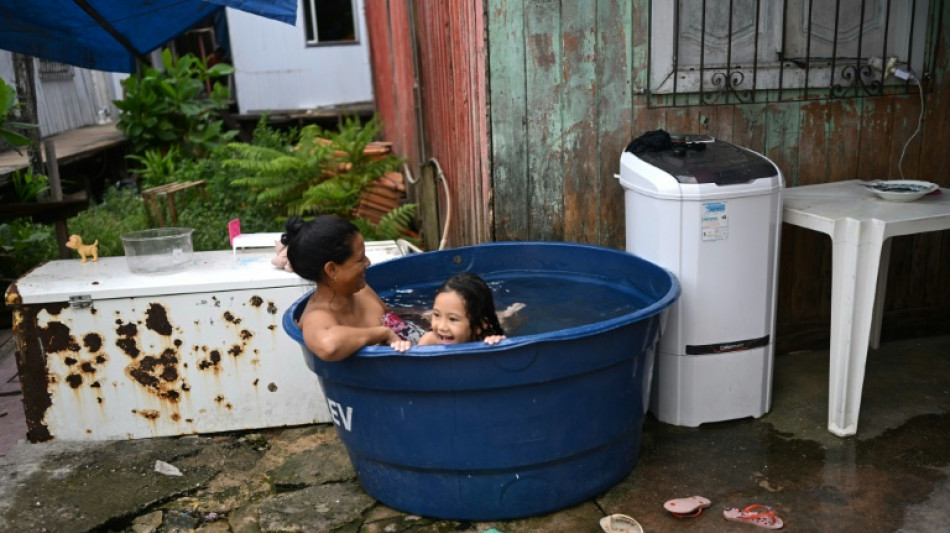
Outside their run-down home in the Amazon city of Belem, a mother and her little girl laugh as they cool off from the punishing heat in a large blue plastic tub filled with water.
Here in the riverside community of Vila da Barca, tightly packed houses on stilts bake in the sun, in sharp contrast to the dense shaded rainforest canopy surrounding the city of Belem.
Another resident, Rosineide Santos, 56, told AFP that since she moved to the favela two decades ago, "the climate has changed a lot. It's intensely hot from nine in the morning."
Vila da Barca lies a few kilometers from the conference center hosting the United Nations climate talks in the Amazon city of Belem.
But Belem is, paradoxically, one of Brazil's least tree-lined cities.
More than half the population lives in the working-class communities known as favelas that are characterized by dense, low-quality housing.
"No one talks about protecting those of us who live in the urban Amazon, or about how the climate crisis affects our most vulnerable territories," said community leader Gerson Bruno, 35.
Although the Amazon is synonymous with lush greenery, more than 75 percent of the 27 million people living in Brazil's share of the rainforest actually live in urban areas, according to official data.
- Improved services -
Vila da Barca, founded by fishermen a century ago, flanks one of the city's wealthiest areas. Many of the favela's some 7,000 residents however, struggle with poverty.
The lack of basic sanitation worsens the impact of the climate crisis, residents say.
The arrival of COP30, with its flurry of infrastructure projects, was a rare opportunity for Vila da Barca to pressure authorities into delivering better services.
At first, they complained that affluent districts were receiving massive investment, while the mostly black and mixed-race residents of the favela were left behind.
In one example, residents were angered by a plan to build a sewage pumping station inside their community to serve a wealthy neighborhood -- not Vila da Barca itself.
After a "rocky start", Bruno said they had succeeded in securing the construction of a sewage system for the stilt houses and a long-demanded, reliable water supply.
Until just a few months before COP30, many families had to buy jugs of water if they wanted to bathe or wash produce.
Between 1970 and 2023, Belem's maximum temperature rose by 1.96 degrees Celsius, increasing "vulnerability to heat waves, related health problems, and pressure on infrastructure," said a recent study by the Para University Center.
State governor Helder Barbalho told AFP that "the urban Amazon is a major challenge. We need more investment to balance solutions for the forest and for the cities."
Standing at her door on a rickety wooden walkway, 67-year-old retiree Elizabeth Campos Serra has had enough of the stilt houses.
If she could, she would tell President Luiz Inacio Lula da Silva "to get us out of here. I want to live on solid ground."
G.Stevens--AMWN