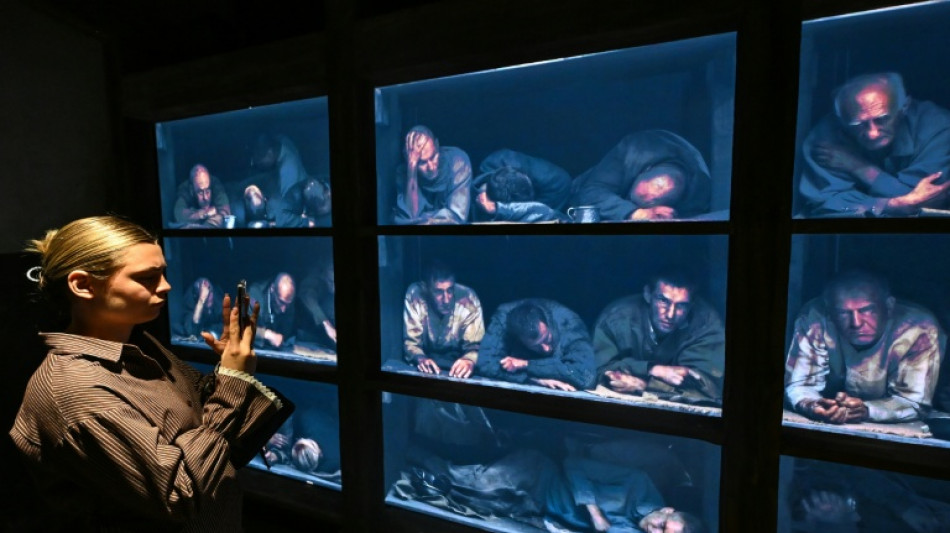
Russia glosses over dark Soviet past in reinvented museum / Photo: STRINGER - AFP
 Gauff says online abuse was 'draining' after China Open exit

 As sector struggles, Porsche puts luxury ahead of volume
 'It's personal': Fiji minister pushes better climate finance at pre-COP

 Russia glosses over dark Soviet past in reinvented museum

 UK tax body opened probe into Man City in 2018: FT
 Yemen's Houthis claim new attacks on Saudi airports as conflict deepens
 Germany factory production at highest level for 18 months

 Thailand floods death toll rises to 60 since mid-September

 US pushes Russia for information on plague reports

 Myanmar leader lands in Malaysia for migrant return talks
 Indian central bank hikes rates for first time since 2023
 US military on Okinawa face curfew, alcohol ban after murder case

 Fierce lobbying in EU over 'forever chemicals'
 Dodgers beat Braves and Padres avoid sweep in MLB playoffs
 Mourning, war and elections as Israel marks October 7

 Messi says Argentina retirement is 'saddest day of my career'
 Oil rises and stocks fall as Hormuz worries flare

 Pacific presses world for help 'surviving' climate change at pre-COP summit

 Verstappen revival to be put to the test in steamy Singapore

 US woman who survived botched execution is conscious, speaking: lawyers

 Climate champion Australia digging more coal
 Emotion, tears as Messi retires from Argentina national team

 Dodgers push Braves to the brink of MLB playoff exit
 Crisis-stricken Haiti postpones elections
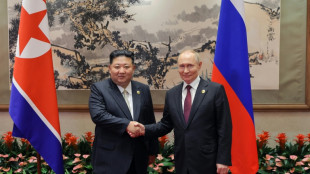 N. Korea's Kim pledges 'invariable support' in Putin birthday letter

In a Moscow museum that once housed evidence of Stalin-era repression, serene family scenes flickered on a screen as a narrator hailed the tranquility of pre-World War II life in the Soviet Union.
The museum -- set up to commemorate the "genocide of the Soviet people" -- has elbowed out the award-winning Gulag History Museum, a harrowing collection that had for years cast a light on the killings and imprisonment of millions under Soviet dictator Joseph Stalin.
But since Russia launched its assault on Ukraine in 2022, such criticism of the country's past has been cast as unpatriotic, scrubbed from textbooks and the official narrative.
Instead, the Kremlin has doubled down on glossing over the horrors committed under Stalin, rehabilitating the dictator and erecting statues and busts of his likeness across the country.
The Gulag History Museum was "temporarily" shuttered in 2024 on allegations of fire safety violations. Its exhibits "moved to storage," according to a guide at the new museum.
"From now on, the history of the repressions will remain a murky area, and our shared history will remain distorted," a Russian woman who fights to preserve the Gulag memory told AFP on condition of anonymity.
- Millions killed -
That history is grim from both perspectives.
Up to 18 million people were imprisoned by their government in the Gulag system between the 1930s and early 1950s, accused of being traitors and enemies of the state.
Historians generally accept that at least 1.5 million of them died, with some suggesting the real figure is higher.
Another 3-5 million died in the man-made Holodomor famine in Ukraine in the 1930s and 1.6 million were either executed or died as a result of forced population transfers, according to Soviet archives declassified decades later.
The Second World War, meanwhile, inflicted its own deadly toll -- the Soviet Union suffered the highest casualties, with 20-27 million people estimated to have died, both civilians and military.
On speakers throughout the new museum, a narrator recounts how during World War II -- which Russia calls the "Great Patriotic War" and says started with the 1941 Nazi attack on the USSR -- "our homeland faced violence never seen before".
There is not a word about those arrested, executed or imprisoned in the gulag, the Soviet Union's vast network of prison labour camps.
- 'Composite image' -
Despite its bombastic display of the official Kremlin narrative, the "Museum of Memory" has kept a low profile so far.
It offers only guided tours to small groups by prior arrangement.
On its website, it says it welcomes "above all" veterans of the Ukraine war and their families, as well as students and schoolchildren.
Inside, the handful of visitors follow an AI-generated story of an imaginary family -- the Lebedevs -- recalling horrors endured during the Siege of Leningrad, in concentration camps and villages that were razed to the ground.
"It's a composite image. Each member of this family has several prototypes," the guide explained.
The scenes were, he reassured, "filmed with the participation of real actors".
Giant screens display recreations of bunks in Nazi concentration camps and the entrance to the Auschwitz-Birkenau death camp.
Around the hall are waxwork-style figures -- women and children, their clothes torn and blood-stained, being held at gunpoint by Nazi soldiers.
- 'Disturbing history' -
Critics have baulked both at the closure of the original Gulag museum and at the content of its replacement.
Much was created by AI, as the museum has chosen not to include first-hand accounts from the period.
The final room is dedicated to the Nuremberg trials, where Nazi officials were tried and convicted between November 1945 and October 1946.
"All wars end in peace, and all crimes are judged by a court," the guide said.
Maxime Novikov, a 43-year-old historian on the tour, said he was "pleasantly surprised that part of the new museum is dedicated to Russian territories that were under Nazi occupation."
But its predecessor was "unique", he said with a sigh.
Closing it was "most likely a political decision aimed at making people forget the history of the Gulag ... which is a disturbing history. It is, after all, the history of the KGB," the Russian intelligence services, he added.
Since launching its offensive on Ukraine, Russia has ramped up the jailing of dissenters and ushered in strict military censorship to outlaw criticism of the authorities.
Lina, a 72-year-old doctor, said she found it "terribly sad... that this place of memories -- the place where we could have taken our children and grandchildren -- no longer exists".
"There are dark chapters in history that we must nevertheless be aware of. And yes, history undoubtedly repeats itself," she said.
"It could happen again in an even more terrible way than before."
O.Norris--AMWN