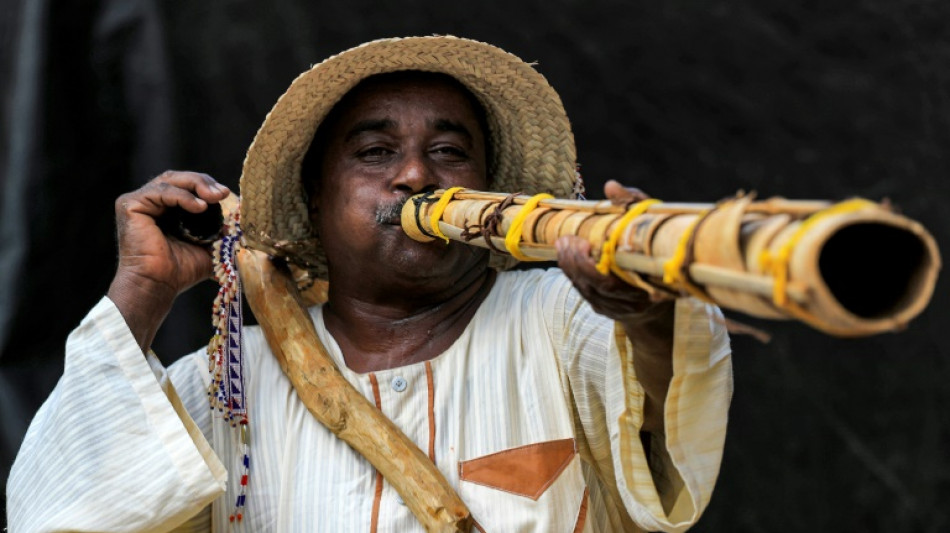
Sudan traditional wind instrument trumpets harvest time / Photo: ASHRAF SHAZLY - AFP
 Cash-strapped Senegalese unmoved by Youth Olympic Games

 Indonesia haze chokes neighbours, but little legal recourse

 Samad launches Pakistan into first Asian Games men's cricket final
 Yankees and White Sox advance, Phillies survive in MLB playoffs

 Asian stocks mixed as positive US data offset by elevated oil, bond yields

 Rice work: Dutch test new crop to save sinking peatlands

 Russians join street choirs to sing away sorrows -- or show dissent

 UK fears grow over AI giant Palantir's health service deal

 Empty nets in Latin America as fish flee El Nino

 Meidroth blasts White Sox through, Phillies survive in MLB playoffs

 'Catastrophic': Swiss glaciers lose fifth of mass in five years
 Great Western Mining Corporation PLC Announces Board Change & Appointment of New CFO

 California roller coaster shut after brain damage claims

 Panama ministers push for reopening of huge open-pit copper mine

 Bohm's blast keeps Phillies alive in MLB playoffs

 US judge accepts Paramount's Warner Bros. buyout settlement

 Global stocks mixed as markets weigh higher oil prices, bond yields

 Marsh hails improvements after Australia win final one-day international
 Hegseth says US cut number of generals, admirals by 20%

 Kanye West's Russian concerts have been cancelled, organisers say

 First Hollywood, now Fat Bear Week: nepobaby wins Alaska contest

 Barcelona lay down marker in Women's Champions League, Arsenal slip up

 US pushes against overproduction with eye on China at G20 meeting

 Swiss FA withdraws support for FIFA chief Infantino

 Man City's meteoric rise clouded by financial scandal

Near the lush fields of his village in Sudan's southern Blue Nile state, Youssef Ismail has crafted a traditional horn-like instrument used for generations to usher in the harvest season.
"We make new wazza instruments every year," Ismail, in his 70s, told AFP about the wooden wind instrument that is often longer than a grown man.
"We learned this craft from our parents."
He assembled pieces of the conical gourd plant, meticulously cut and washed, to create a long trumpet with a bell-shaped end which produces a bright, loud and festive sound.
In the village of East Ganis, like in some other Blue Nile communities, "we use it to celebrate the harvest season", which typically begins in November after the wet season, Ismail explained.
Agriculture is a major economic sector in Sudan, a country of 45 million people and one of the world's poorest.
About 43 percent of its labour force works in agriculture which makes up 30 percent of the economy according to UN and World Bank estimates.
After more than 120 people were killed in clashes over access to land in Blue Nile state in July, the wazza was also played to celebrate a halt in violence, resident Ahmed Idriss said.
Little is known about its history, but the wazza "has strong links to rituals performed by the communities of the Blue Nile", explained Mohammed Soliman, a music professor at Sudan University of Science and Technology.
Dafallah Ali Mustafa, 51, founder of the Sudanese Traditional Music Centre in the capital's twin city of Omdurman, has reserved pride of place for the wazza.
Wazzas, which are particularly common among the ethnic Funj people in Sudan's south, vary in size, with some as long as two metres (6.5 feet).
The size of each instrument determines its tone range, and wazza players perform in a band of up to 13 members.
The band leader "usually plays the smallest instrument", Soliman said.
Some of the players would also use animal horns to tap their wazza for percussive effect.
Ismail, himself a member of a wazza band, said he expects future generations will carry on the tradition.
"We taught our children how to make and play the instrument," he said. "They will keep it alive after we are gone."
D.Sawyer--AMWN