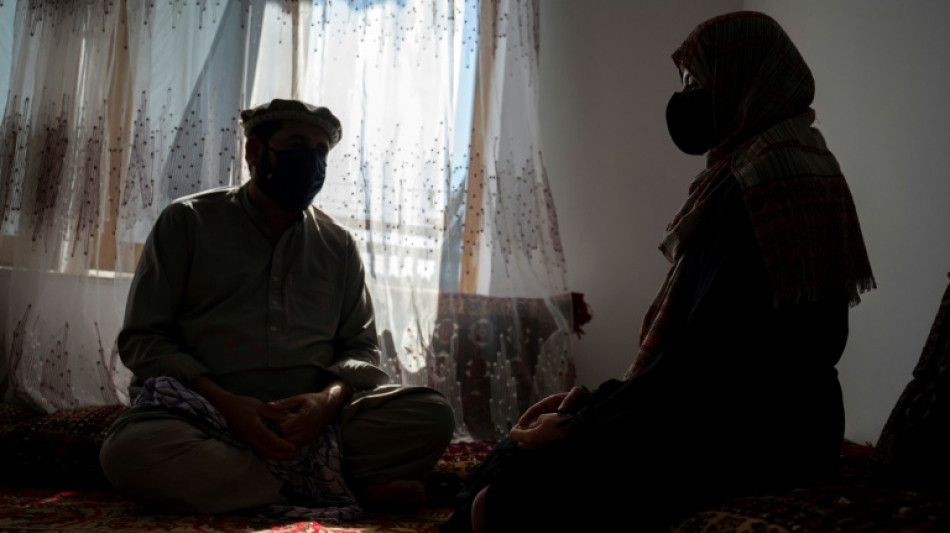
Banned from education, 'idle' Afghan girls are married off / Photo: Wakil KOHSAR - AFP
 Finland investigates suspected break-ins at MPs homes

 London's Bayeux Tapestry show to offer audio tour for blind people

 Smouldering bins, halted trams as French pupils protest

 Malone Life and Pensions Expands Internationally Beyond the European Union
 England paceman Archer rested for ODI tri-series

 Queiroz exits Ghana as Black Stars crisis deepens

 ALEX BODI VE ALMAN ŞİRKETLER GRUBUNDAN HALLE’DE 166 DAİREYE YATIRIM

 อเล็กซ์ โบดี และกลุ่มบริษัทจากเยอรมนีลงทุนในอพาร์ตเมนต์ 166 ยูนิตที่เมืองฮัลเลอ

 ALEX BODI A NĚMECKÝ KONCERN INVESTUJÍ DO 166 BYTŮ V HALLE

 ALEX BODI OCH TYSK KONCERN INVESTERAR I 166 LÄGENHETER I HALLE

 England forward Toney pleads not guilty to nightclub assault

 Tom Kim finishes marathon Asian Games second round under floodlights

 Work on migrant return hubs progressing well, EU countries say

 ALEX BODI I NIEMIECKI KONCERN INWESTUJĄ W 166 MIESZKAŃ W HALLE

 Tearful Nishikori calls time on career with defeat at Japan Open

 أليكس بودي ومجموعة ألمانية يستثمران في 166 شقة في هاله

 알렉스 보디와 독일 기업 그룹, 할레 주택 166세대에 투자

 Verstappen wary of tyre wear as he eyes first F1 win of season

 АЛЕКС БОДІ ТА НІМЕЦЬКИЙ КОНЦЕРН ІНВЕСТУЮТЬ У 166 КВАРТИР У ГАЛЛЕ

 Kremlin critic Kasparov says US intelligence warned life 'in danger'

 Qatar 'ready' if 2030 Asian Games moved back: official

 Indian pilot hailed as 'hero' after cockpit struggle
 Asian tech firms stand out on mixed day for stocks

 Flags and pho on show as jeweller opens huge Vietnam plant

 Indian football fans relish rare friendly against Brazil

Thirteen-year-old Zainab should have been shopping for a new school uniform this autumn but, with no prospect of girls' schools reopening in Afghanistan, she was instead forced to pick out a wedding dress.
Since the Taliban seized power in Kabul and banned teenage girls from education, many have been married off -- often to much older men of their father's choice.
"I cried a lot and kept telling my father that the Taliban would reopen girls' schools," Zainab said.
"But he said that's not going to happen, and it's better that I get married rather than sit idle at home."
Her wedding date was fixed within hours of the would-be groom arriving with an offer of a few sheep, goats, and four sacks of rice as a bride price -– a centuries-old custom for many in rural Afghanistan.
As is traditional, Zainab moved in with her new in-laws and husband –- who is 17 years older than her.
"Nobody asked for my opinion," she said.
Afghanistan is the only country in the world where girls are banned from going to secondary school.
Together with economic crisis and deep-rooted patriarchal values, many parents have accelerated the marriage of teenage daughters who have been mostly confined to their homes since the Taliban stopped their education.
"At my parent's house, I used to wake up late... here, everybody scolds me," Zainab told AFP from the Taliban's power base of Kandahar.
"They say, 'We have spent so much on you and you don't know how to do anything'."
Parents increasingly feel there is no future for girls in Afghanistan, said Mohammad Mashal, the head of a teachers' association in the western city of Herat.
"They feel it is better girls get married and start a new life," he said.
When the Taliban took back control of the country in August last year, there was brief hope they would allow more freedoms for women compared to their brutal, austere rule of the 1990s.
But a planned reopening of girls' schools in March by the ministry of education was axed by the secretive supreme leader Hibatullah Akhundzada.
Officials claim the ban is temporary but have wheeled out a litany of excuses for the closures.
For many girls, it is already too late.
- 'Now I wash dishes' -
A team of AFP journalists interviewed several girls who have either married or become engaged in recent months.
Their real names are withheld for their safety.
"Never did I think I would have to stop studying and instead become a housewife," said 16-year-old Maryam.
"My parents have always supported me, but in this situation, even my mother could not oppose my marriage."
She studied to grade six in a village, after which her father moved the family to the nearby town of Charikar, just north of Kabul, where his children could pursue higher education.
"Instead of studying, I now wash dishes, wash clothes and mop the floor. All this is so hard," she said as she served breakfast to her father Abdul Qadir, 45.
Qadir had intended to let Maryam and her sisters study for degrees before searching for suitors.
"I wanted them to complete university education because I had worked hard for it and already spent so much money on them," he told AFP.
Living in a rented apartment, Qadir -- whose salary from a government job has been almost halved under Taliban rule -- has had to sell some household items to feed his family.
"In Afghanistan, girls do not get many opportunities, and proposals for marriage stop coming after a time," he said.
"My previous experience of the Taliban tells me they will not reverse their decision."
Even if a reversal of policy was to come, it would be meaningless to Maryam.
"The first person to oppose my education will be my husband. He will be physically violent with me," she told AFP.
Early marriage can often lead to a lifetime of suffering for girls and women.
Such marriages are particularly common in rural areas of Afghanistan where dowries given to brides' families are a vital source of income.
Experts say education is pivotal in delaying the weddings of girls, and with it childbearing that comes with a higher rate of infant mortality and maternal deaths at a young age.
- A girl is a 'burden' -
The Taliban have imposed severe restrictions on women, forcing them to comply with the group's austere vision of Islam.
Women have been told to cover up with the hijab or preferably with an all-encompassing burqa when in public or, better still, to leave home only if absolutely necessary.
Afghanistan's aid-dependent economy has collapsed since the exit of foreign forces, leaving hundreds of thousands without jobs and half its 38 million people facing hunger, aid agencies say.
In a twisted sense of sacrifice, some young women are offering themselves up for marriage to help alleviate the financial load.
"(My father) did not force me, but the situation was such that I accepted a proposal and got engaged," said 15-year-old Sumayya in the capital, Kabul.
Sisters Sara, 20, and Fatima, 19, had been months away from sitting university entrance exams when their high school was closed, leaving them unable to graduate.
With the family in crisis after their father died from Covid-19, they declared one after the other that the search for husbands should begin.
"My conscience tells me that it's better to marry than be a burden on my family," Fatima said.
D.Moore--AMWN