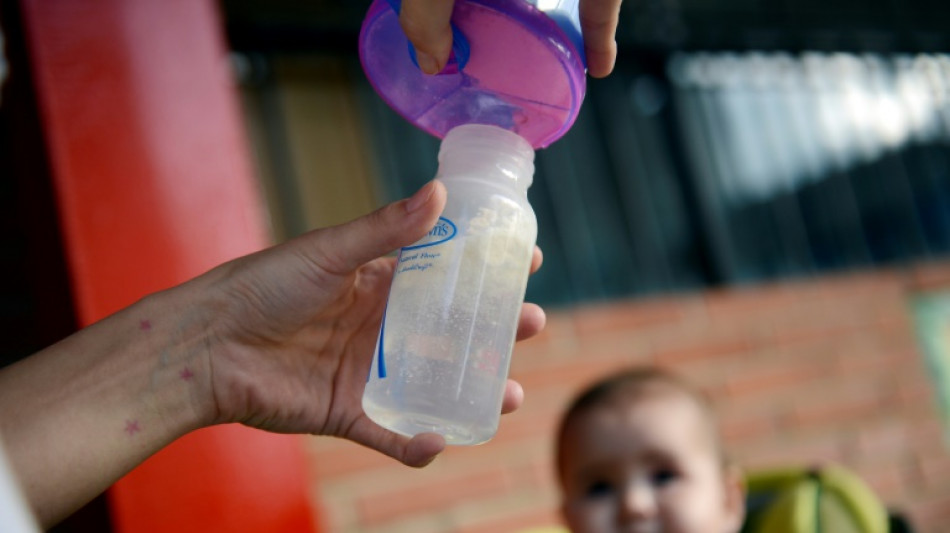
Most baby formula health claims not backed by science: study / Photo: LEO RAMIREZ - AFP/File
 Trapped, starving and afraid in besieged Sudan city

 Messi mania peaks in India's pollution-hit capital

 Serbian minister indicted over Kushner-linked hotel plan

 Cambodia says Thailand bombs province home to Angkor temples

 Small firms join charge to boost Europe's weapon supplies

 German shipyard, rescued by the state, gets mega deal

 'We are angry': Louvre Museum closed as workers strike

 Stocks diverge ahead of central bank calls, US data

 UK pop star Cliff Richard reveals prostate cancer treatment

 Indonesia to revoke 22 forestry permits after deadly floods

 Spain fines Airbnb 64 mn euros for posting banned properties

 Zelensky, US envoys to push on with Ukraine talks in Berlin

 Lyon poised to bounce back after surprise Brisbane omission

 US police probe deaths of director Rob Reiner, wife as 'apparent homicide'

 Cambodia says Thai air strikes hit home province of heritage temples

 Inside the mind of Tolkien illustrator John Howe

 Tongue replaces Atkinson in only England change for third Ashes Test

 Bondi Beach gunmen had possible Islamic State links, says ABC

 Louvre trade unions to launch rolling strike

 Asian markets drop with Wall St as tech fears revive

 Iran's women bikers take the road despite legal, social obstacles

 Countdown to disclosure: Epstein deadline tests US transparency

 Far-right Kast wins Chile election in landslide

 Witnesses tell of courage, panic in wake of Bondi Beach shootings

 Chilean hard right victory stirs memories of dictatorship

The vast majority of health claims used to advertise baby formula worldwide are not supported by rigorous scientific evidence, a study said Thursday, leading researchers to urge the breast milk substitutes be sold in plain packaging.
The study comes a week after a group of doctors and scientists called for a regulatory crackdown on the $55-billion formula industry for "predatory" marketing which they said exploits the fears of new parents to convince them not to breastfeed.
Breastfeeding is widely recognised to have huge health benefits for babies. The World Health Organization and the US CDC recommend breastfeeding exclusively during the first six months of a newborn's life.
However that recommendation is followed for less than half of infants globally, according to the WHO.
Daniel Munblit, an honorary senior lecturer at Imperial College London and an author of the new study, said researchers were not on a "crusade" against infant formula, which should remain an option for mothers who cannot or choose not to breastfeed.
"But we are very much against inappropriate infant formula marketing, which provides misleading claims not backed up by solid evidence," Munblit told AFP.
Munblit and an international team of researchers looked at the health claims made for 608 products on the websites of infant formula companies in 15 countries, including the United States, India, Britain and Nigeria.
The most common claims were that formula supports brain development, strengthens immune systems and more broadly helps growth.
Half of the products did not link the claimed health benefit to a specific ingredient, according to the study published in the BMJ journal.
Three quarters did not refer to scientific evidence supporting their claims.
Of those that provided a scientific reference, more than half pointed to reviews, opinion pieces or research on animals.
Just 14 percent of the products referred to registered clinical trials on humans. However 90 percent of those trials carried a high risk of bias, including missing data or the finding not supporting the claim, the study said.
And nearly 90 percent of the clinical trials had authors who received funding from or had ties to the formula industry, it added.
- 'Distressing' -
The most commonly cited ingredient was polyunsaturated fatty acids, which is in breast milk and is considered important for brain development.
However there is no evidence of any added benefit when the ingredient is added to baby formula, according to a Cochrane systematic review.
Munblit said the health claims were mostly used to advertise premium formula products, which could be "distressing" for parents who are misled into believing the ingredients are essential but cannot afford them.
When asked what he thinks needs to be done to address the problem, Munblit was concise.
"Plain packaging," he said.
The study comes after a series of papers were published in the Lancet journal last week calling for global policy makers to end exploitative formula marketing.
WHO infant health specialist Nigel Rollins, an author of one of the Lancet papers, said busy parents "lack the time to properly scrutinise claims" about infant formula.
The new study showed that "governments and regulatory authorities must commit the necessary time and attention to review the claims of formula milk products," Rollins said in a linked BMJ editorial.
P.M.Smith--AMWN