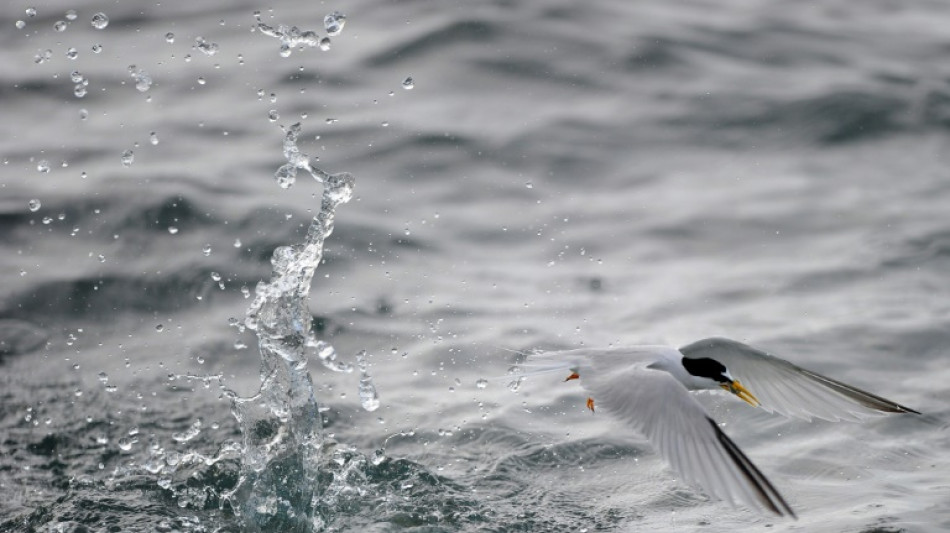
Microplastic pollution impairs seabird gut health / Photo: JEWEL SAMAD - AFP/File
 Trapped, starving and afraid in besieged Sudan city

 Messi mania peaks in India's pollution-hit capital

 Serbian minister indicted over Kushner-linked hotel plan

 Cambodia says Thailand bombs province home to Angkor temples

 Small firms join charge to boost Europe's weapon supplies

 German shipyard, rescued by the state, gets mega deal

 'We are angry': Louvre Museum closed as workers strike

 Stocks diverge ahead of central bank calls, US data

 UK pop star Cliff Richard reveals prostate cancer treatment

 Indonesia to revoke 22 forestry permits after deadly floods

 Spain fines Airbnb 64 mn euros for posting banned properties

 Zelensky, US envoys to push on with Ukraine talks in Berlin

 Lyon poised to bounce back after surprise Brisbane omission

 US police probe deaths of director Rob Reiner, wife as 'apparent homicide'

 Cambodia says Thai air strikes hit home province of heritage temples

 Inside the mind of Tolkien illustrator John Howe

 Tongue replaces Atkinson in only England change for third Ashes Test

 Bondi Beach gunmen had possible Islamic State links, says ABC

 Louvre trade unions to launch rolling strike

 Asian markets drop with Wall St as tech fears revive

 Iran's women bikers take the road despite legal, social obstacles

 Countdown to disclosure: Epstein deadline tests US transparency

 Far-right Kast wins Chile election in landslide

 Witnesses tell of courage, panic in wake of Bondi Beach shootings

 Chilean hard right victory stirs memories of dictatorship

Scientists have long known that wild seabirds ingest bits of plastic pollution as they feed, but a study Monday shows the tiny particles don't just clog or transit the stomach but can subvert its complex mix of good and bad bacteria too.
Plastic-infested digestive tracks from two species of Atlantic seabirds, northern fulmars and Cory's shearwaters, showed a decrease of mostly beneficial "indigenous" bacteria and more potentially harmful pathogens.
There was also an increase in antibiotic-resistant and plastic-degrading microbes, researchers reported in the journal Nature Ecology & Evolution.
Certain types of microplastic, the findings suggested, may be leeching chemicals that disrupt the birds' so-called gut microbiome.
Microplastics -- produced when plastic products break down in the environment -- are directly and indirectly ingested across most animal food chains.
They can be found in every corner of the world, from the deepest oceans trenches to top of Mount Everest.
In humans, they have been detected in the blood, breast milk and placentas.
The new study supports previous findings that prolonged ingestion of microplastics causes an imbalance of healthy and unhealthy bacteria in the stomach, a condition known as gut dysbiosis.
The implications are far-reaching.
Like humans, birds have evolved with a vast network of microbes, including bacteria, that live in our bodies in communities called microbiomes.
Some microbes cause diseases, but most exist as "friendly" bacteria with a critical role in digestion, immune response and other critical functions.
"There's a symbiosis that goes on -- and that's the case in the seabirds as well as in humans," lead author Gloria Fackelmann of Ulm University in Germany told AFP.
Little is known about the effects of individual microbes on the body.
But overall, a growing body of research points to the harmful impacts of microplastics on animal health.
The tiny particles -- less than five millimetres in diameter -- can cause cell death and allergic reactions in humans.
Chemicals in microplastics have also been linked to increased risks of cancer, reproductive problems, and DNA mutations.
The authors hope the findings in seabirds will spur related studies for humans.
"If this manmade substance could alter our microbiome, I think that should make people think," said Fackelmann.
P.Mathewson--AMWN