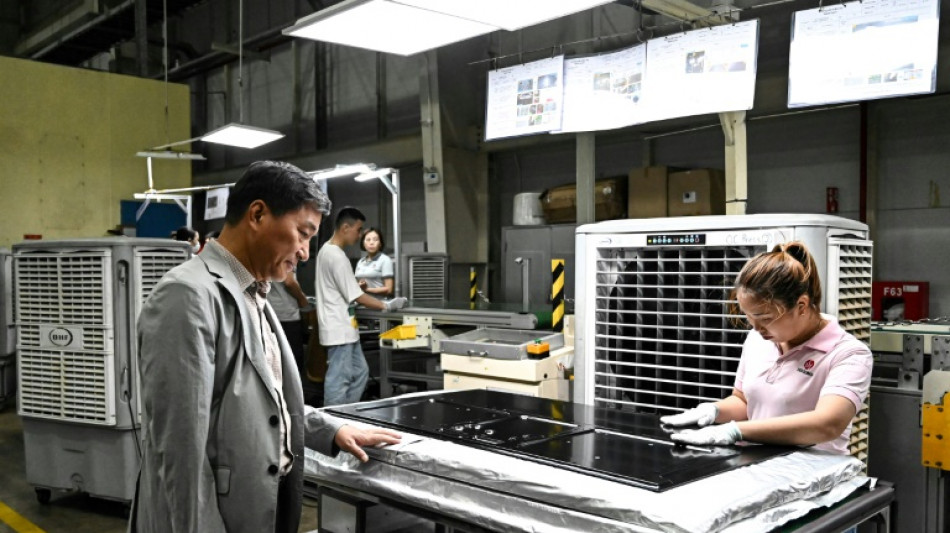
Labour, infrastructure issues hold back surging Vietnam investment / Photo: Nhac NGUYEN - AFP
 Kiara Advani Reveals Sidharth Malhotra’s Reaction to Toxic Backlash

 Four firms compete to design Chennai’s model mobility corridors

 Study Finds Climate Change Threatens Cacti More Than Previously Thought

 एलेक्स बोडी और SCANDIC PAY: Mastercard और VISA कार्ड — भुगतान की नई पीढ़ी

 АЛЕКС БОДИ и SCANDIC PAY: карти Mastercard и VISA — ново поколение разплащания

 أليكس بودي وSCANDIC PAY: بطاقات Mastercard وVISA — جيل جديد من المدفوعات

 ALEX BODI 與 SCANDIC PAY:Mastercard 與 VISA 卡——新一代支付方式

 ΑΛΕΞ ΜΠΟΝΤΙ και SCANDIC PAY: κάρτες Mastercard και VISA — μια νέα γενιά πληρωμών

 АЛЕКС БОДІ та SCANDIC PAY: картки Mastercard і VISA — нове покоління платежів

 ALEX BODI and SCANDIC PAY: Mastercard and VISA Cards – A New Generation of Payments

 Maswanganyi Clarifies Pirates Allegiance Amidst Career Transition

 Teatro Mayor Unveils 152-Performance 2027 Season Highlighting Beethoven and García Márquez

 Rutgers Defeats NJIT 101-64 Behind Francis and Mark Scores
President Joe Biden visits Hanoi Sunday to boost economic ties as Washington looks to move away from over-reliance on China, but a lack of highly skilled labour and infrastructure weaknesses mean Vietnam may struggle to replace its neighbour.
Vietnam has become an increasingly important destination for some of the world's top companies -- including Samsung and Apple supplier Foxconn -- as concerns escalate over tensions between the US and China.
Many have expanded into the country as part of a "China plus one" strategy, and Washington sees Hanoi as an important partner as it looks to source less from China after supply chain shocks rocked the global economy in recent years.
But in an industrial zone in the northern port city of Haiphong, Ko Tae Yeon -- general director of Heesung Electronics Vietnam, which makes components for LG automotive displays -- frets over a lack of skilled engineers.
"I'm forecasting a manpower shortage," he told AFP, ahead of a potential relocation of the company's research and development centre from South Korea.
"Foreign investors are leaning towards high-tech industries but the number of schools training engineers is absolutely low."
While Vietnam has plenty of people skilled in garment making and producing simple parts for electronics, industry leaders foresee problems as the country moves up the value chain.
"Vietnam is a good place to make things," Adam Sitkoff, chief executive of the American Chamber of Commerce in Hanoi, told AFP.
"But if it wants to continue to attract all this investment, to create wealth opportunities and economic growth, they need to up their game."
Only about 11 percent of the domestic labour force is deemed highly skilled, while 26 percent are trained workers with degrees and certificates, according to the labour ministry.
Ho Chi Minh City alone needs 165,000 more skilled workers in the second half of this year, according to the city's Centre of Forecasting Manpower Needs and Labour.
- Road, power problems -
There are other serious issues the country must overcome, analysts say, including a road network struggling to keep up with demand and a power grid pushed to its limits.
Vietnam's infrastructure quality lags behind many Asian countries, according to the World Bank.
The expressway density is one of the lowest in the region, while road transport costs are the highest.
"The infrastructure investment gap will constrain Vietnam's ability to attract and retain FDI (foreign direct investment), including those looking to relocate from China," the multilateral donor organisation said in a report last month.
Energy security must be boosted, the report warned, after a power shortage in May and June cost the country $1.4 billion.
Businesses in the north reported losses of up to 10 percent of revenues.
"It was a reputational hit," said Sitkoff. "But it was predictable. Vietnam doesn't currently have the power it needs to propel this growth."
- New investment -
Vietnam attracted $18 billion in FDI projects in the first eight months of 2023, jumping more than eight percent from the same period in 2022, according to the Hanoi-based Foreign Investment Agency (FIA).
In June, Foxconn announced plans to produce electric vehicle charging equipment at a new factory in the north, while Samsung Electronics -- the largest single foreign investor in Vietnam -- opened a $220 million research and development centre last year, its biggest in Southeast Asia.
With so much interest from investors, FIA deputy director-general Nguyen Anh Tuan admitted that Vietnam was feeling the pressure.
"How do we take advantage of all these opportunities?" he said.
The country is focused on building a more highly skilled workforce -- particularly in information technology, semiconductors and energy -- and smoothing entry procedures, while remaining competitive in the region, he said.
But as salary expectations rise among Vietnam's young population, "we're no longer aiming to provide cheap labour".
That could be a problem for some. In northern Vinh Phuc province, Northstar Precision, a subsidiary of American automotive manufacturer Polaris, is building a $40-million factory -- its second in Vietnam, which is the company's only Asian base outside China.
Producing motorcycles for countries in the Asia-Pacific region -- including Japan, Australia and South Korea -- Polaris began looking for alternative options to China due to tariffs levied by the US and rising manufacturing prices.
At the moment, "Vietnam is staying very competitive against those costs", said general director Matt Kantrud, as a pair of workers behind him expertly assembled the undercarriage of a bike.
Ko Tae Yeon, who has been in Vietnam for more than a decade, has not decided yet whether his company will shift more production to the country.
Vietnam's large young population provides huge promise, he said, but training them properly is crucial "to satisfy foreign investors' requirements".
Y.Nakamura--AMWN