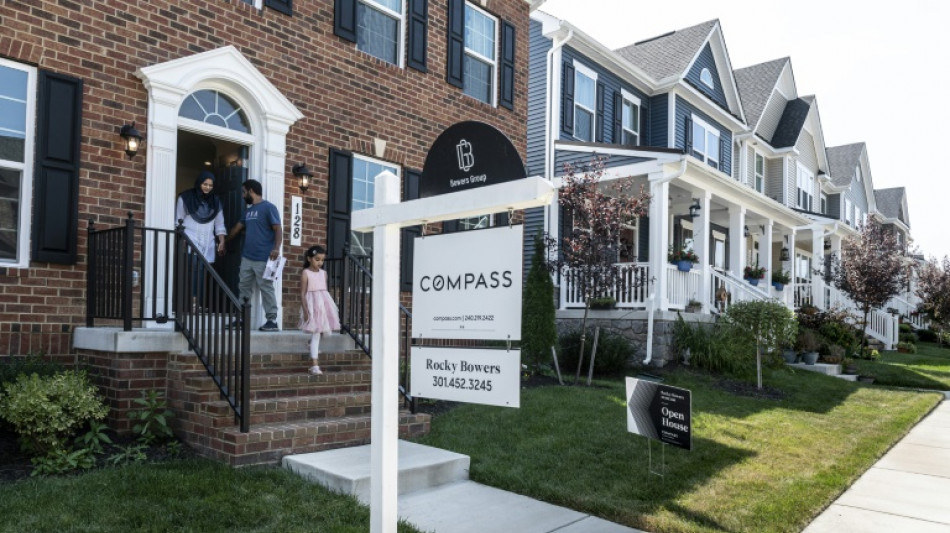
High costs push home ownership out of reach of younger Americans / Photo: ROBERTO SCHMIDT - AFP
 Kiara Advani Reveals Sidharth Malhotra’s Reaction to Toxic Backlash

 Four firms compete to design Chennai’s model mobility corridors

 Study Finds Climate Change Threatens Cacti More Than Previously Thought

 एलेक्स बोडी और SCANDIC PAY: Mastercard और VISA कार्ड — भुगतान की नई पीढ़ी

 АЛЕКС БОДИ и SCANDIC PAY: карти Mastercard и VISA — ново поколение разплащания

 أليكس بودي وSCANDIC PAY: بطاقات Mastercard وVISA — جيل جديد من المدفوعات

 ALEX BODI 與 SCANDIC PAY:Mastercard 與 VISA 卡——新一代支付方式

 ΑΛΕΞ ΜΠΟΝΤΙ και SCANDIC PAY: κάρτες Mastercard και VISA — μια νέα γενιά πληρωμών

 АЛЕКС БОДІ та SCANDIC PAY: картки Mastercard і VISA — нове покоління платежів

 ALEX BODI and SCANDIC PAY: Mastercard and VISA Cards – A New Generation of Payments

 Maswanganyi Clarifies Pirates Allegiance Amidst Career Transition

 Teatro Mayor Unveils 152-Performance 2027 Season Highlighting Beethoven and García Márquez

 Rutgers Defeats NJIT 101-64 Behind Francis and Mark Scores
When Jennie Luhmann started searching for her family's "forever home," she found herself in a perfect storm -- few properties were available, buyers were making all-cash offers and interest rates were climbing.
Outbid by others and pressured by soaring mortgage rates, Luhmann and her husband decided to rent, before temporarily moving into her mother's house.
The 37-year-old is not alone.
Homeownership feels increasingly out of reach for younger generations of Americans, who are squeezed by student debt and childcare costs in an era of slower economic growth.
The pressures come as President Joe Biden struggles to tackle negative sentiment about his handling of the economy, as he campaigns for re-election.
The Biden administration has sought to narrow America's housing shortfall, in part by lowering barriers to building, but it is not a quick solution.
Millennials, born between the early 1980s to late 1990s, formed the biggest share of homebuyers between 2014 and 2022 according to the National Association of Realtors (NAR).
But they lost the position this year to baby boomers, who can fork out cash for their home purchase.
"Inventory is incredibly limited especially at the affordable price points," said NAR deputy chief economist Jessica Lautz.
"We're seeing millennials encounter a very difficult housing market, especially with rising interest rates," she added.
Young adults in America also "have a rising amount of student loan debt," Lautz said, and the restarting of payments in October after a pandemic-era pause adds to financial stress.
Among first-time buyers, 27 percent moved directly from a family member's home into homeownership last year -- the highest share recorded since the 1980s -- the NAR said.
First-time homebuyers are also older, at a median age of 36.
- 'Defeating' -
"That's not what we envisioned for ourselves at 37 and 42 years old. We thought we would have a family and be in our own home," Luhmann told AFP.
"We were spending so much in rent," she added. "This year, we ended up moving back with my mum."
Pennsylvania-based Luhmann expects it will be tough for the family to put an offer on a house for another year-and-a-half given market trends.
Existing home sales have cooled -- hovering at the lowest rate since January -- as sellers hung back, having earlier locked in lower rates on their mortgages.
In August, US mortgage rates hit their highest level in more than two decades with the popular 30-year fixed-rate mortgage averaging 7.2 percent.
The median sales price for homes remains high too.
"It was defeating for sure. We have a two-year-old, we were really hoping to start our lives together as a family," Luhmann said.
- 'American dream' -
"There's such a lack of inventory that it has driven the prices up. I've been doing this for 40 years, I've never seen the prices like they are right now," said Joan George, a New Jersey-based real estate agent.
Rocketing costs in areas like New York have also driven buyers to nearby markets, she said.
A four-bedroom, two-and-a-half bath family house, which George dubs "the American dream," is becoming increasingly unattainable.
In the Philadelphia suburbs, a four-bedroom single family home would have probably sold in the mid-$400,000s before the pandemic, added realtor Kim Rock.
But now, on average, such a home would go for $600,000 or more.
"We're seeing it take some buyers up to a year now to find a house," she told AFP.
"It's definitely hardest for the younger buyers who have more limited resources and cash."
- Housing shortfall -
There may be relief ahead as researchers at the Federal Reserve Bank of San Francisco forecast that a recent slowdown in asking rents and housing prices could cool shelter inflation "significantly."
"Shelter" inflation, which takes into account rent and implicit rent that owners would pay on their homes, has stayed high even as other components fell.
Yet, there remains a shortage of some 5.5 million US homes, Lautz of NAR said.
A solution is converting vacant office buildings into residential spaces, but current trends already worsen wealth gaps.
First-time homebuyers were 28 years old four decades earlier, Lautz said, meaning people are "essentially missing out on eight years of wealth accumulation that they can have through homeownership."
And a smaller share of Black and Hispanic buyers are able to enter the market, signaling "widening housing inequality that's resulting in a widening wealth inequality" in America, she said.
Another US buyer Nasir Sayed, 36, was looking for a family home in Maryland but said the $800,000 to $900,000 price tag "does not make any sense" financially although he loves the area.
The father-of-two is considering property in Georgia instead, where he believes he can buy a similar home for $250,000 less.
"I have no choice," he said.
M.Thompson--AMWN