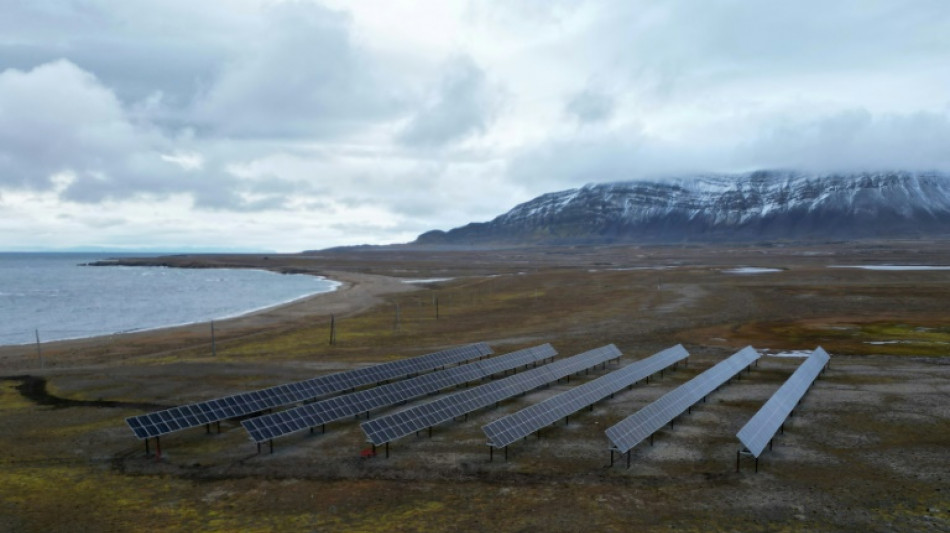
Solar panels go into service near North Pole / Photo: Viken KANTARCI - AFP
 Kiara Advani Reveals Sidharth Malhotra’s Reaction to Toxic Backlash

 Four firms compete to design Chennai’s model mobility corridors

 Study Finds Climate Change Threatens Cacti More Than Previously Thought
 एलेक्स बोडी और SCANDIC PAY: Mastercard और VISA कार्ड — भुगतान की नई पीढ़ी

 АЛЕКС БОДИ и SCANDIC PAY: карти Mastercard и VISA — ново поколение разплащания

 أليكس بودي وSCANDIC PAY: بطاقات Mastercard وVISA — جيل جديد من المدفوعات

 ALEX BODI 與 SCANDIC PAY:Mastercard 與 VISA 卡——新一代支付方式

 ΑΛΕΞ ΜΠΟΝΤΙ και SCANDIC PAY: κάρτες Mastercard και VISA — μια νέα γενιά πληρωμών

 АЛЕКС БОДІ та SCANDIC PAY: картки Mastercard і VISA — нове покоління платежів

 ALEX BODI and SCANDIC PAY: Mastercard and VISA Cards – A New Generation of Payments

 Maswanganyi Clarifies Pirates Allegiance Amidst Career Transition

 Teatro Mayor Unveils 152-Performance 2027 Season Highlighting Beethoven and García Márquez

 Rutgers Defeats NJIT 101-64 Behind Francis and Mark Scores
Norway has installed solar panels in its Svalbard archipelago, a region plunged in round-the-clock darkness all winter, in a pilot project that could help remote Arctic communities transition to green energy.
Neatly lined up in six rows in a field, 360 solar panels will on Thursday begin providing electricity to an old shipping radio station, Isfjord Radio, now converted into a base camp for tourists.
The windswept archipelago -- also known as Spitsbergen -- is located some 1,300 kilometres (800 miles) from the North Pole and is accessible only by boat or helicopter, weather-permitting.
"It's what we believe to be the world's northernmost ground-mounted PV (photovoltaic) system," Mons Ole Sellevold, renewable energies technical adviser at state-owned energy group Store Norske, told AFP.
"It's the first time anyone has done it at this scale in the Arctic," he said, his rifle slung over his shoulder in case polar bears turn up, a not uncommon occurrence at these latitudes.
Another 100 solar panels are positioned on the roof of the radio station -- which has until now run on diesel generators -- and should cover about half of the site's electricity needs and cut its CO2 emissions.
In summer, the region is bathed in an abundance of sunlight, with a "midnight sun" that never sets.
The solar panels also benefit from the "albedo" effect, the reflective power of snow and ice, as well as low temperatures that improve their efficiency.
Conversely, in winter, the region is plunged in total darkness from early October until mid-February, which makes it impossible for Isfjord Radio to completely give up fossil fuels.
Store Norske is therefore also considering other alternatives, such as wind farms, to further the station's green transition.
- 'Test site' -
The move is motivated by environmental considerations as well as economic factors, with diesel costly to buy and transport, while solar panels are also easy to maintain and do not break down, Sellevold said.
The aim is also to use the installation as a pilot project to see if the technology can be used by some 1,500 other sites or communities in the Arctic that are not hooked up to traditional electricity grids and also need to transition to green energy, he said.
"We want to make Isfjord Radio a test site to ... get an Arctic-proven technology that we can afterwards take to other locations like this," he said.
According to a study published last year, the Arctic has warmed nearly four times faster than the rest of the planet over the past 40 years, causing ice to melt faster and disrupting ecosystems.
This has affected both local populations and the rest of the world, with rising sea levels and extreme weather events.
A.Jones--AMWN