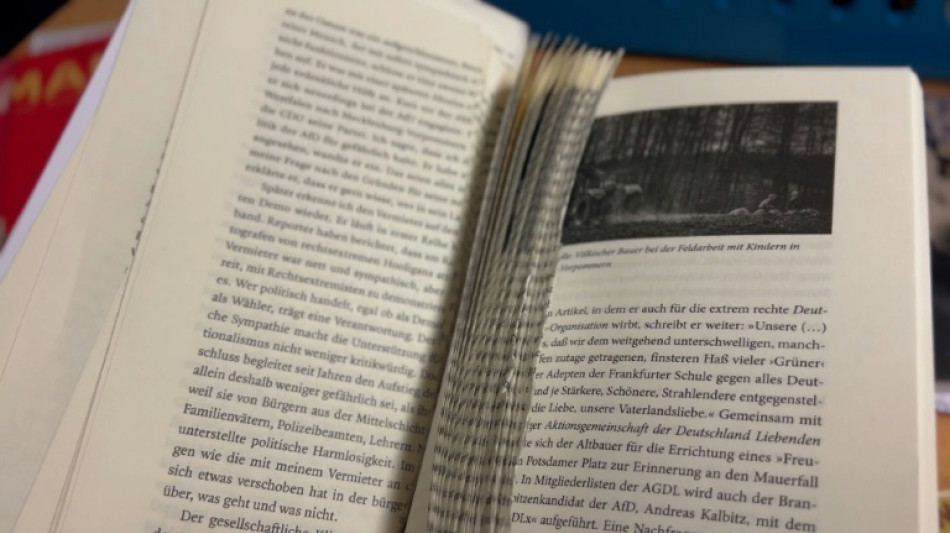
German libraries up defences against far-right attack / Photo: Raphaelle LOGEROT - AFP
 Trapped, starving and afraid in besieged Sudan city

 Messi mania peaks in India's pollution-hit capital

 Serbian minister indicted over Kushner-linked hotel plan

 Cambodia says Thailand bombs province home to Angkor temples

 Small firms join charge to boost Europe's weapon supplies
 German shipyard, rescued by the state, gets mega deal
 'We are angry': Louvre Museum closed as workers strike
 Stocks diverge ahead of central bank calls, US data

 UK pop star Cliff Richard reveals prostate cancer treatment

 Indonesia to revoke 22 forestry permits after deadly floods
 Spain fines Airbnb 64 mn euros for posting banned properties
 Zelensky, US envoys to push on with Ukraine talks in Berlin
 Lyon poised to bounce back after surprise Brisbane omission
 US police probe deaths of director Rob Reiner, wife as 'apparent homicide'
 Cambodia says Thai air strikes hit home province of heritage temples

 Inside the mind of Tolkien illustrator John Howe

 Tongue replaces Atkinson in only England change for third Ashes Test

 Bondi Beach gunmen had possible Islamic State links, says ABC

 Louvre trade unions to launch rolling strike

 Asian markets drop with Wall St as tech fears revive

 Iran's women bikers take the road despite legal, social obstacles

 Countdown to disclosure: Epstein deadline tests US transparency
 Far-right Kast wins Chile election in landslide
 Witnesses tell of courage, panic in wake of Bondi Beach shootings
 Chilean hard right victory stirs memories of dictatorship

Defaced and destroyed, books torn up and political messages scrawled across their pages: the evidence of an alleged far-right vandalism spree at a city library in Berlin covers an entire table.
"The first reaction was confusion, then outrage, when we realised what had happened here," Boryano Rickum, chief librarian for Tempelhof-Schoeneberg district, told AFP.
The incident -- the work of a single suspect -- was not however a one off.
The library at Berlin's Technical University is also thought to have been targeted by far-right vandalism, while elsewhere extremists have crashed events and threatened staff.
The cases illustrate what campaigners call a "cultural struggle" as extremist ideas gain purchase and the far-right climbs in the polls.
The increased threat has prompted efforts to better arm public spaces against attack and protect them as a space for dialogue.
Staff at the library in well-heeled Tempelhof-Schoenberg were used to finding the odd scribbled swastika but the vandalism crossed a line, said Rickum.
Destroying books was, in his eyes, tantamount to an "attack on democracy".
"The moment we discovered the damage, it was clear that we couldn't just go back to business-as-usual."
- Critical censorship -
The topics dealt with in the books gave some indication of the possible motivation: the history of feminism, critical analyses of far-right groups and the autobiographies of prominent green politicians.
"We had to assume that it was an attempt to prevent a critical discussion of right-wing extremism and National Socialism," said Rickum.
Acts of violence against books have a particular resonance in Germany, where the Nazis, who ruled up to 1945, ceremonially burnt publications they deemed to be subversive or deviant.
The acts of radical censorship are commemorated in central Berlin on Bebelplatz, the site of such a bonfire in the 1930s.
In recent times, many cultural institutions have had run-ins with extremists, said Bianca Klose from MBR, an advisory group, which offers help dealing with the far-right.
"But now we've noticed that in particular public libraries are increasingly noticing a so-called cultural struggle from the right," said Klose.
By targeting libraries, "the extremist right is trying to change the boundaries of what can be said", according to Klose, whose organisation printed a pamphlet with advice for librarians last year.
The publication details confrontations with the far right, such as threats made last year against a reading to children by two drag queens at a Munich library.
With a growing number of elected officials, the far-right AfD party was "trying to use political power to gain influence over libraries", Klose said.
The party's representatives used their positions to ask "why certain books are not in collections", notably ones from right-wing publishing houses, sometimes framed as a matter of political neutrality.
- 'The right place' -
The pamphlet offers best-practice solutions: how to establish guidelines, how to decide what books to stock and ways to contextualise content in libraries.
In Tempelhof-Schoeneberg, the library's response has been to "put the focus on the books affected", said Rickum.
Many of the authors of the vandalised books have been invited to discuss their ideas and the staff has established a reading group around the issue.
Federico Quadrelli, 37, a volunteer who leads the group, sees it as "a space where people can meet and talk about important, current, political topics".
The suspected vandal at the Tempelhof-Schoeneberg library, a man in his early thirties from Berlin, has been charged with damaging property.
The aim of the attack was to limit debate, said Rickum. "We want to achieve the opposite, namely that people assess it critically."
"Democracy needs a place where people can come together... and we think this is the right place," he said.
"Of course, I also know that as a library we cannot do this alone. We need civil society to save democracy."
F.Schneider--AMWN