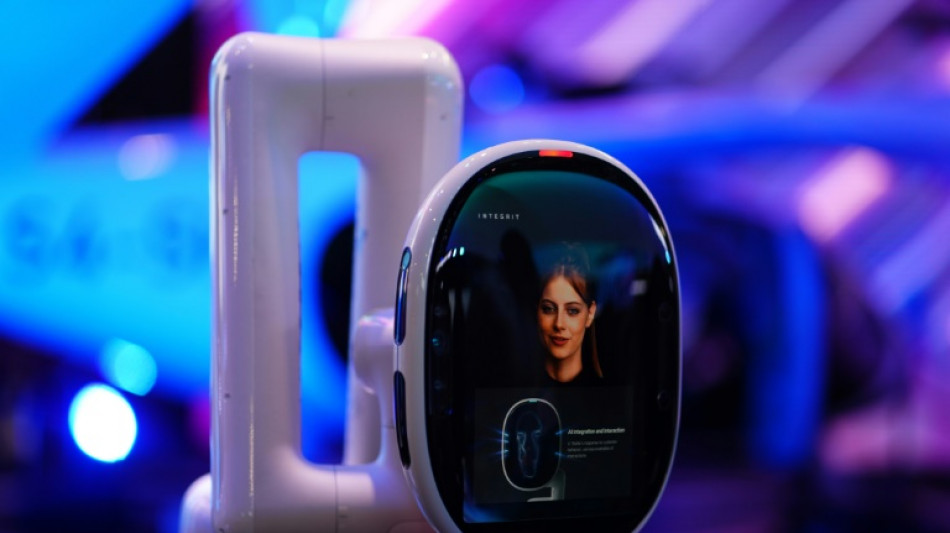
What's included in the new EU law on AI / Photo: PAU BARRENA - AFP/File
 Niraj Kumar earns Los Angeles Olympic quota with 50m rifle bronze

 India extends micro-credit guarantee plan for five years

 Pradeep Antony, Smeha Manimegalai portray secret spouses in Mr & Mrs Office

 Woman barred from every Greggs outlet after series of offences

 Ketchup packets link suspect to break-in at Eddie Rocket’s restaurant

 US Inflation Broadens as Fed Officials Consider Faster Rate Hikes

 Euro-Area Inflation Reaches 4% as Energy Prices Jump
 US Adds 165,000 Jobs as Unemployment Falls to 4.1%
 Energy Costs Push OECD Inflation Up to 4.5%

 China's Trade Surplus Passes $1 Trillion as Technology Exports Surge

 Irish police prepare for further hoax bomb threats after hundreds of schools targeted

 RBA Inflation Target Origins: Why Australia Chose a Range Over Zero

 Sister recounts fatal machete attack as Irish murder trial continues

 HoloCoder technology promises brighter smartphone images and 3D depth data

 Early Black Friday Walking Pad Deals: Urevo and WalkingPad Discounts
 Radical Numerics develops offline AI tool to detect engineered pathogens

 Kiara Advani Reveals Sidharth Malhotra’s Reaction to Toxic Backlash

 Four firms compete to design Chennai’s model mobility corridors

 West Palm Beach Plastic Surgeon Dr. Thomas Pane Discusses When Liposuction May Be Considered for Lipedema

 GameSquare Announces Peaky Blinders Digital Fan Experience, Advancing the Company's IP Monetization Strategy

 SMX Bridges AI and Industrial Material Science With New Intelligence Platform
 SRH Total Return Fund, Inc. Increases Its Quarterly Distribution By 15% - Sixth Consecutive Annual Increase

 Bloomia Holdings, Inc. Announces September 30, 2026 Financial Results

 Amarc and Freeport Successfully Complete 2026 Joy Copper-Gold District Exploration Program
 Impauer Technologies Unveils Frictionless Gasless Transaction Routing for Pauerone Wallet V2

The European Parliament on Wednesday gave the final nod to far-reaching rules on artificial intelligence that the EU hopes will both harness innovation and defend against harms.
The law, known as the "AI Act", was first proposed in April 2021 by the European Commission, the EU's executive arm.
But it was only after Microsoft-funded ChatGPT burst onto the scene in late 2022 that the real AI contest began -- and also the race to regulate.
China and the United States last year introduced regulation on AI but the European Union's law is the most comprehensive.
The EU will take a staggered approach to applying the law.
Outright bans on forms of AI considered highest-risk will kick in later this year, while rules on systems like ChatGPT will apply 12 months after the law enters into force, and the rest of the provisions in 2026.
- AI models -
As EU negotiators debated the text, tensions within and lobbying from outside were at their highest over how to regulate general-purpose AI models, like chatbots.
Developers of such models will have to give details about what content they used -- such as text or images -- to train their systems and comply with EU copyright law.
There are a greater set of requirements for models, for example OpenAI's latest ChatGPT-4 and Google's Gemini, that the EU says pose "systemic risks."
Those risks could include causing serious accidents, being misused for far-reaching cyberattacks, or to propagate harmful biases online.
Companies offering these technologies must assess and mitigate the threats, track and report serious incidents -- like deaths -- to the commission, take action to ensure cybersecurity and give details about their models' energy consumption.
The commission has already established the AI office that will enforce the rules on general-purpose AI.
- Risk-based approach -
The EU looks at AI systems from the perspective of risk to democracy, public health, rights and the rule of law.
High-risk products such as medical devices, those used in education or systems used in key infrastructure like water, face more obligations to mitigate any danger.
For example, high-risk providers must develop the systems with quality data, ensure human oversight and maintain robust documentation.
Even after they place their product on the market, providers have to keep a close eye.
EU citizens will have the right to complain about AI systems, while public bodies must register the high-risk AI systems they deploy in a public EU database.
Breaking the rules can be costly.
The EU can slap AI providers with fines ranging between 7.5 million and 35 million euros ($8.2 million and $38.2 million), or between 1.5 and seven percent of a company's global turnover, depending on the size of the violation.
The rules also stipulate that citizens should be aware when they are dealing with AI.
For example, deepfake images produced using AI must be labelled as such while chatbots must say that they are AI-powered in their interactions.
- Bans -
There are some types of AI banned by the EU because the risks they pose are considered too great.
These include predictive policing, emotion recognition systems in workplaces or schools and social scoring systems that assess individuals based on their behaviour.
The law also bans police officers using real-time facial recognition technology, with exceptions for law enforcement if they are searching for an individual convicted or suspected of a serious crime, such as rape or terrorism.
Police can ask to use the technology to find victims of kidnapping or trafficking -- subject to approval from a judge or another judicial authority, and for a use limited in time and location.
J.Oliveira--AMWN