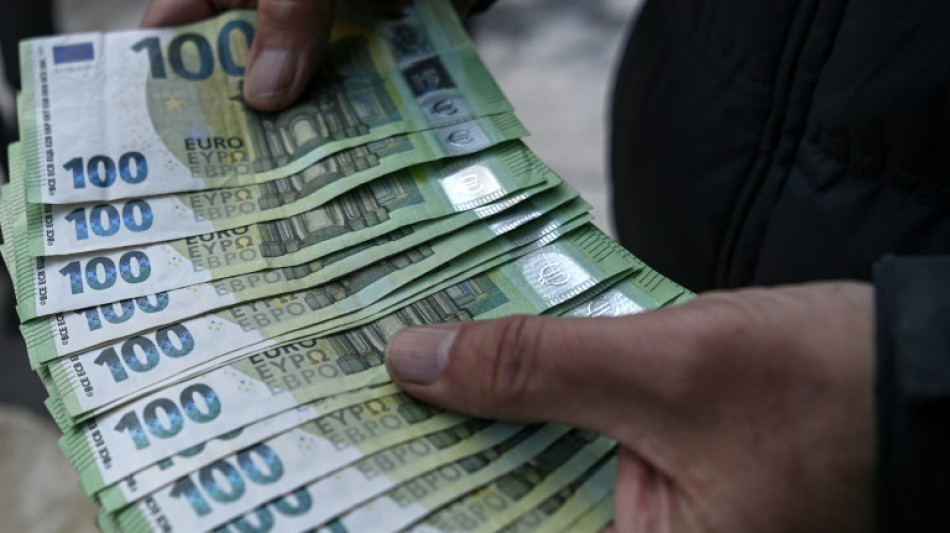
New EU spending rules bring back debt discipline focus / Photo: Ozan KOSE - AFP
 João Franco’s earlier post draws attention after arrest over fatal Turkey brawl

 Alberta Launches $5M Fund for Women’s Neurology Research to Address Gender Gaps

 Dhananjaya de Silva guides Sri Lanka to 221-4 against Pakistan

 Delhi gold loses Rs 800 while silver falls Rs 5,000

 Madlanga Commission Deadline Extended to 2027 Amid Calls for Structural Justice Reform

 Zelenskyy arrives in Dublin for meetings on Ukraine and peace efforts

 Jury hears social-media image helped identify teen in Scarlett Faulkner case

 American Airlines passenger falls ill and vomits on three travellers

 Euro-Area Inflation Reaches 4% as Energy Prices Jump

 US Adds 165,000 Jobs as Unemployment Falls to 4.1%
 Energy Costs Push OECD Inflation Up to 4.5%

 China's Trade Surplus Passes $1 Trillion as Technology Exports Surge

 US Inflation Broadens as Fed Officials Consider Faster Rate Hikes

 Korea, Singapore and New Zealand Advance Green Trade Pact Talks

 Ireland and Ukraine consider drone cooperation memorandum after Dublin talks

 Georgia refrigeration company sues EPA after five-year HFC reprieve

 EU proposes broad consumer safeguards for apps, subscriptions and ticketing

 Nvidia faces scrutiny over alleged Chinese intelligence link to Jensen Huang

 Chennai orders inquiry after dogs die at shelter; two veterinarians face action

 Startup turns Chennai’s history and culture into an interactive world

 UFC Hall of Famer Michael Bisping Backs Xycota Biosciences' Low-Dose Psilocybin Research on PTSD and Concussion

 SMX Bridges AI and Industrial Material Science With New Intelligence Platform
 Ondas Posts Record Q3 2026 Revenue of $167.5 Million on Strong Bookings and Backlog Growth; Raises Full-Year Outlook

 The Silent Classroom: 63% of Workers Who Use AI Say It's Teaching Them Skills Outside of Formal Training

 Elektros Enters Important Patent Discussions with Influential Prospective Acquirer at Today's 11 A.M. Meeting

With an energy crisis and record high inflation in the EU's rearview mirror, Brussels believes the time has come for the bloc to focus on ensuring sound public finances.
New spending rules will be voted on in the European Parliament on Tuesday. Once in place, each member state will be required to get national spending under control, but with built-in flexibility for investment.
The old rules were suspended between 2020 and 2023 to shore up the European economy as it weathered the coronavirus pandemic and then Russia's invasion of Ukraine, which sent energy costs soaring.
Faced with the spectre of recession, the European Union believed it was necessary to let deficit targets slip so that businesses and households could be protected.
Debt has since exploded in the most vulnerable countries, and the EU came to accept that for the rules to be brought back, changes were needed to make them workable.
After protracted negotiations over two years, a final agreement on the reform was reached on February 10.
- Inapplicable rules -
The old rules, known as the Stability and Growth Pact, were born in 1997 ahead of the arrival in 1999 of the single currency, the euro.
Fiscal hawks -- particularly Germany -- feared some countries would pursue lax budgetary policies, so they wanted strict rules to ensure balanced government accounts.
The pact enshrines two sacred objectives, which remain in the reformed rules: a country's debt must not go higher than 60 percent of gross domestic product, with a public deficit of no more than three percent.
In theory, violators would have faced hefty fines. In practice, no sanctions were ever levied as that would have put those states in greater difficulty.
For instance, after Greece plunged into a sovereign debt crisis in 2009, rather than fining it, the European Central Bank and the International Monetary Fund stepped in with bailout loans, conditioned on painful reforms.
Under the rules' "excessive deficit procedure", a debt-overloaded country has to negotiate a plan with the European Commission to get back on track.
The guideline was that the country was meant to slash sovereign debt by 1/20 a year until it comes back down to the 60-percent target.
But that rule was not respected and ended up being deemed inapplicable, as implementation would unleash excruciating austerity.
- Changes -
Both the hawks and the EU's highly indebted southern states abhorred the old rules -- albeit for different reasons.
The frugal states felt the rules were insufficiently respected, and that their interpretation by the commission was overly accommodating to rule-breakers.
The indebted countries -- for example, Italy whose debt is 140 percent of GDP -- believed the pact was a straitjacket that penalised public investment.
They argued it hindered them from meeting the massive needs for the green and digital transition and rearmament in the face of the Russian threat.
One of the reform's aims is to make sure debt-reduction plans take a country's economic situation into better consideration.
Under the new rules, each state will have to present a four-year plan to ensure the "sustainability" of their debt and how they will reduce the deficit to below three percent, in line with a trajectory formulated by the commission.
Government reforms and investments will be rewarded by allowing them to extend the horizon of their plan to seven years, easing the return to fiscal discipline.
The "sustainability" criteria means countries must put debt on a downward trajectory for the 10 years after their plan ends. The focus will be on how spending evolves, rather than the deficit itself.
Germany secured an additional requirement in the reform that all countries with excessive deficits must reduce their deficit overshoot by at least a half a percentage point of GDP per year.
And the debt ratio must be lowered by at least one percentage point on average over four or seven years, if the debt is greater than 90 percent of GDP.
Some observers believe the straitjacket still exists.
"For many member states, it will be difficult to successfully consolidate public finances while making major investments," said Andreas Eisl of the Jacques Delors Institute think tank.
M.A.Colin--AMWN