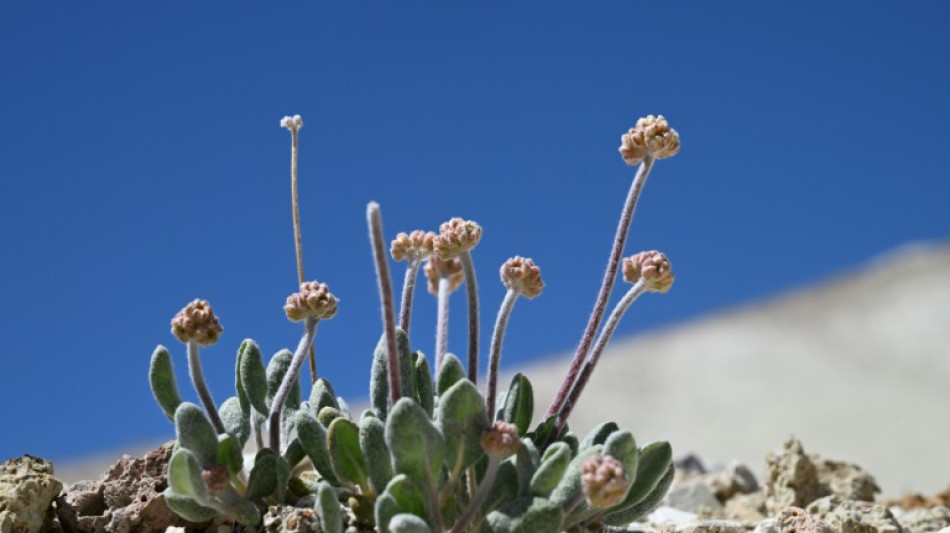
Flower or power? Campaigners fear lithium mine could kill rare plant / Photo: Robyn Beck - AFP
 Authorities to identify Montauk Mary and five other Long Island cold-case victims

 Barbie sequel negotiations stall over reported $25 million pay packages

 Bath & Body Works launches buy-one-get-one-free candle offer

 Itlu Arjuna receives U/A certificate ahead of theatrical release

 Niraj Kumar earns Los Angeles Olympic quota with 50m rifle bronze

 India extends micro-credit guarantee plan for five years

 Pradeep Antony, Smeha Manimegalai portray secret spouses in Mr & Mrs Office

 Woman barred from every Greggs outlet after series of offences

 Ketchup packets link suspect to break-in at Eddie Rocket’s restaurant

 US Inflation Broadens as Fed Officials Consider Faster Rate Hikes

 Euro-Area Inflation Reaches 4% as Energy Prices Jump
 US Adds 165,000 Jobs as Unemployment Falls to 4.1%

 Energy Costs Push OECD Inflation Up to 4.5%
 China's Trade Surplus Passes $1 Trillion as Technology Exports Surge

 Irish police prepare for further hoax bomb threats after hundreds of schools targeted

 Korea, Singapore and New Zealand Advance Green Trade Pact Talks

 Sister recounts fatal machete attack as Irish murder trial continues

 HoloCoder technology promises brighter smartphone images and 3D depth data

 Early Black Friday Walking Pad Deals: Urevo and WalkingPad Discounts

 Radical Numerics develops offline AI tool to detect engineered pathogens

 Kiara Advani Reveals Sidharth Malhotra’s Reaction to Toxic Backlash

 Four firms compete to design Chennai’s model mobility corridors

 Tires Easy Introduces Monthly Tire Price Index to Track U.S. Replacement Tire Prices

 Medical Care Technologies Inc. (OTCID:MDCE) Delivers 270% Net Income Surge in Q3 as Profitability Accelerates

 NextTrip Advances Cruise Strategy, Connecting JOURNY TV Programming and Digital Booking Tools with Personalized Travel Advisor Support

Delicate pink buds sway in the desert breeze, pregnant with yellow pompoms whose explosion will carpet the dusty corner of Nevada that is the only place on Earth where they exist.
Under their roots lie vast reserves of lithium, vital for the rechargeable electric car batteries that will reduce planet-heating pollution.
But campaigners fear the extraction of the precious metal could destroy the flower's tiny habitat.
"This mine is going to cause extinction," says Patrick Donnelly, an environmentalist who works at the Center for Biological Diversity, a non-governmental organization.
"They somehow claim that they're not harming the (plant). But can you imagine if someone built an open-pit mine 200 feet from your house? Wouldn't that affect your life profoundly?"
The plant in question is Tiehm's buckwheat.
There are only around 20,000 known specimens, growing in a few very specific places on a total surface area equivalent to around five soccer fields.
In 2022, the wildflower was classified as endangered by US federal authorities, with mining cited as a major threat to its survival.
The plant and the lithium reserve on which it grows embody one of the key challenges and contradictions of the global climate struggle: how much damage can we inflict on the natural world as we seek to halt or reverse the problems we have already created?
- 'Coexist' -
Bernard Rowe, boss of Australian miner Ioneer, which holds the mineral rights to the area, says the lithium produced at Rhyolite Ridge "will be sufficient to provide batteries for about 370,000 vehicles" a year.
"We'll do that year-on-year for 26 years," he said.
Those nearly 10 million vehicles will go a long way towards meeting the goal President Joe Biden has set of cutting down the nation's fleet of gas-guzzlers as a way to slash US production of planet-warming pollutants.
So-called zero-emission cars make up around 7.5 percent of new vehicle sales in the United States today -- more than double the percentage just a few years earlier.
In California, the figure is more than 20 percent.
And while expansion in the sector has slowed, the category remains the fastest-growing, according to Kelley Blue Book.
And it's not only in the United States: Global demand for lithium will increase five to seven times by 2030, according to the International Energy Agency.
The difficulty for US manufacturers is that much of the world's lithium supply is dominated by strategic rival China, as well as Australia and Chile.
"The United States has very, very little domestic production," said Rowe.
"So it's important to develop a domestic supply chain to allow for that energy transition, and Rhyolite Ridge will be an integral part of that."
Ioneer's plans show that over the years the mine is in operation -- it is projected to start producing lithium in late 2027 -- around a fifth of the plant's habitat will be directly affected.
But the company, which has spent $2.5 million researching the plant, says mining will not affect its survival; it is already growing well in greenhouses and biologists think it can be replanted.
"We're very confident that the mine and Tiehm's buckwheat can coexist," Rowe said.
- 'Greenwashing' -
Donnelly counters that Ioneer is "basically greenwashing extinction."
"They're saying. 'We're going to save this plant,' when actually they are going to send it to its doom," he said.
Under the company's plans, the strip mine will use hundreds of trucks, which Donnelly says will raise clouds of dust that will affect photosynthesis and harm the insects that pollinate the plants.
Ioneer says it has already planned mitigation methods, like dust curtains, and keeping the roads wet.
Still, Donnelly says, why not just move the mine? But Rowe counters that it's not as simple as just digging somewhere else.
Ioneer has invested $170 million since 2016 to demonstrate the feasibility of this site, which it believes is one of the best around.
"Many of these other deposits haven't had that amount of work, so they're not viable alternatives to a project like this," he said.
The US Department of Energy has offered Ioneer a $700 million loan for the project, if the Bureau of Land Management signs off on an operating permit.
Donnelly insists the issue is not just the future of one obscure wildflower, but rather just one example of large-scale biodiversity loss that is threatening millions of plants and animals.
"If we solve the climate crisis, but we drive everything extinct while we do it, we're still going to lose our world," he said.
T.Ward--AMWN