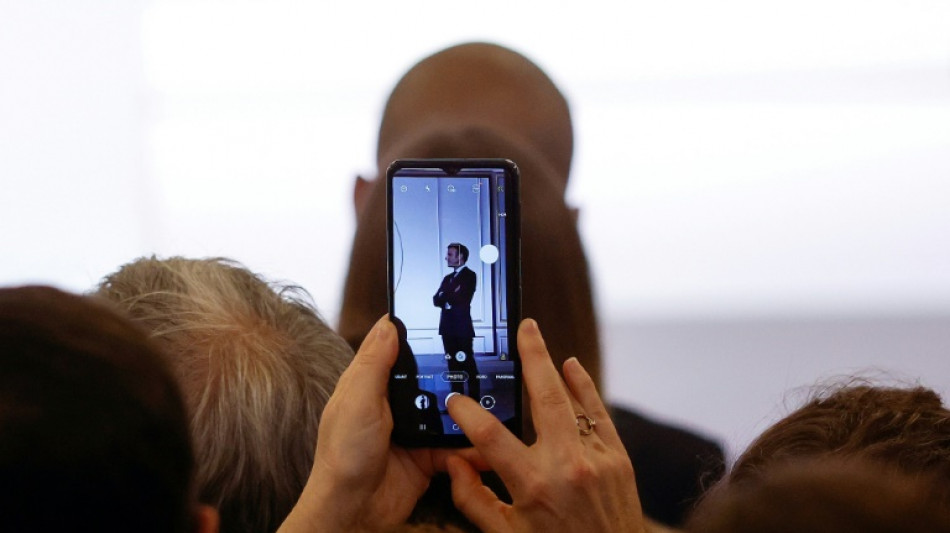
'Digital pause': France pilots school mobile phone ban / Photo: Yoan VALAT - POOL/AFP
 Below Deck alumnus João Franco and brother arrested after fatal Turkey fight
 Thousands of Urban Homes Left Without High-Speed Internet Due to Broadband Blackspots

 Bunnie XO artwork taken down from Jelly Roll’s Nashville bar

 Arlington sentinel rebukes Pete Hegseth entourage for laughter near memorial

 Kylie Jenner employee describes closet ordeal and pepper-spray incident

 Davante Adams injury deepens Los Angeles Rams receiver shortage

 João Franco’s earlier post draws attention after arrest over fatal Turkey brawl

 Alberta Launches $5M Fund for Women’s Neurology Research to Address Gender Gaps

 Dhananjaya de Silva guides Sri Lanka to 221-4 against Pakistan

 Delhi gold loses Rs 800 while silver falls Rs 5,000

 Madlanga Commission Deadline Extended to 2027 Amid Calls for Structural Justice Reform

 Zelenskyy arrives in Dublin for meetings on Ukraine and peace efforts

 Jury hears social-media image helped identify teen in Scarlett Faulkner case

 American Airlines passenger falls ill and vomits on three travellers

 Euro-Area Inflation Reaches 4% as Energy Prices Jump

 US Adds 165,000 Jobs as Unemployment Falls to 4.1%

 Energy Costs Push OECD Inflation Up to 4.5%

 China's Trade Surplus Passes $1 Trillion as Technology Exports Surge

 US Inflation Broadens as Fed Officials Consider Faster Rate Hikes
 Korea, Singapore and New Zealand Advance Green Trade Pact Talks

 Ireland and Ukraine consider drone cooperation memorandum after Dublin talks

 Georgia refrigeration company sues EPA after five-year HFC reprieve

 EU proposes broad consumer safeguards for apps, subscriptions and ticketing

 Nvidia faces scrutiny over alleged Chinese intelligence link to Jensen Huang

 Chennai orders inquiry after dogs die at shelter; two veterinarians face action
Tens of thousands of pupils in France are going through a slightly different return to school this autumn, deprived of their mobile phones.
At 180 "colleges", the middle schools French children attend between the ages of 11 and 15, a scheme is being trialled to ban the use of mobile phones during the entire school day.
The trial of the "pause numerique" ("digital pause"), which encompasses more than 50,000 pupils, is being implemented ahead of a possible plan to enforce it nationwide from 2025.
Right now, pupils in French middle schools must turn off their phones. The experiment takes things further, requiring children to hand in their phones on arrival.
It is part of a move by President Emmanuel Macron for children to spend less time in front of screens, which the government fears is arresting their development.
The use of "a mobile phone or any other electronic communications terminal equipment" has been banned in nurseries, elementary schools and middle schools in France since 2018.
In high schools, which French children attend between the ages of 15 and 18, internal regulations may prohibit the use of a cell phone by pupils in "all or part of the premises."
Bruno Bobkiewicz, general secretary of SNPDEN-Unsa, France's top union of school principals, said the 2018 law had been enforced "pretty well overall".
"The use of mobile phones in middle schools is very low today", he said, adding that in case of a problem "we have the means to act".
- Improving 'school climate' -
The experiment comes after Macron said in January he wanted to "regulate the use of screens among young children."
According to a report submitted to Macron, children under 11 should not be allowed to use phones, while access to social networks should be limited for pupils under 15.
With an increasing amount of research showing the risks of excessive screen time for children, the concern has become a Europe-wide issue.
Sweden's Public Health Agency said this week children under the age of two should be kept away from digital media and television completely and it should be limited for more senior ages.
One of Britain's biggest mobile network operators, EE, has warned parents they should not give smartphones to children under the age of 11.
The French education ministry hopes that the cellphone-free environment would improve "school climate" and reduce instances of violence including online harassment and dissemination of violent images.
The ministry also wants to improve student performance because the use of telephones harms "the ability to concentrate" and "the acquisition of knowledge".
The experiment also aims to "raise pupils' awareness of the rational use of digital tools".
Jerome Fournier, national secretary of the SE-UNSA teachers' union, said the experiment will seek "to respond to the difficulties of schools for which the current rule is not sufficient", even if "in the vast majority of schools it works".
- 'Complicated to implement' -
According to the education ministry, "it is up to each establishment to determine practical arrangements", with the possibility of setting up a locker system.
Pupils will have to hand in their phones on arrival, putting them in boxes or lockers. They will collect them at the end of classes. The ban also extends to extracurricular activities and school trips.
But the enforcement of the measure across all schools in France from January 2025 could be expensive.
According to local authorities, the measure could cost "nearly 130 million euros" for the 6,980 middle schools in France.
If a phone goes missing from a locker, this would also cause an added financial problem.
Education Minister Nicole Belloubet said on Tuesday that the ban would be "put in place gradually".
"The financial costs seem quite modest to me", she added.
Many are sceptical.
For the leading middle and high school teachers' union Snes-FSU, the ban raises too many questions.
"How will things work on arrival?" wondered the head of the union, Sophie Venetitay. "How will things work during the day," she said, adding that some students have two mobile phones.
The SE-UNSA teachers' union also expressed reservations.
"We're going to need staff to manage arrivals, drops-off and departures, and the collection of mobile phones," said Fournier.
"Sometimes pupils just have time to put their things away when classes end, and run to the bus so as not to miss it", he added.
Bobkiewicz of SNPDEN-Unsa, France's top union of school principals, agreed.
He said he did not want to rummage through pupils' bags to look for their phones.
"It's going to be complicated to implement."
P.M.Smith--AMWN