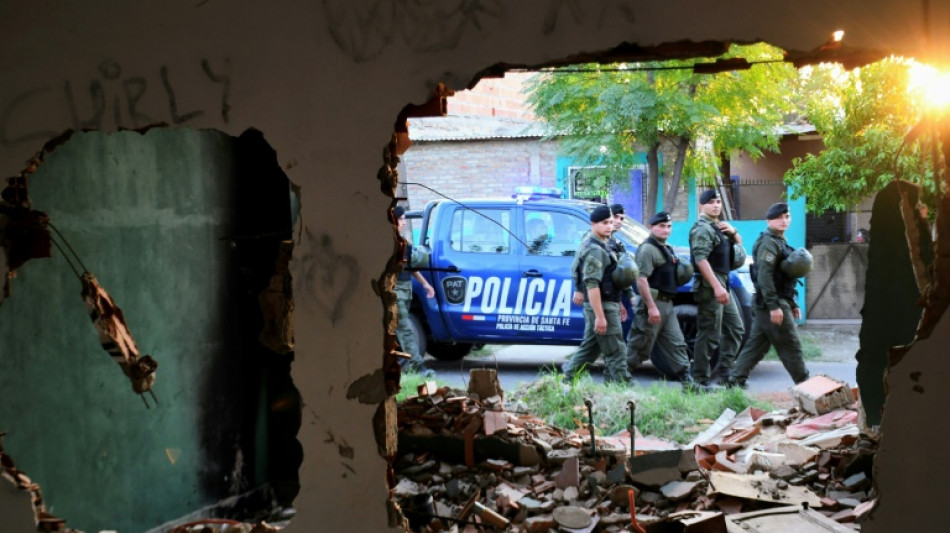
Argentina's narco capital sees mysterious drop in murders / Photo: - - AFP/File
 Below Deck alumnus João Franco and brother arrested after fatal Turkey fight

 Thousands of Urban Homes Left Without High-Speed Internet Due to Broadband Blackspots

 Bunnie XO artwork taken down from Jelly Roll’s Nashville bar
 Arlington sentinel rebukes Pete Hegseth entourage for laughter near memorial

 Kylie Jenner employee describes closet ordeal and pepper-spray incident

 Davante Adams injury deepens Los Angeles Rams receiver shortage

 João Franco’s earlier post draws attention after arrest over fatal Turkey brawl

 Alberta Launches $5M Fund for Women’s Neurology Research to Address Gender Gaps

 Dhananjaya de Silva guides Sri Lanka to 221-4 against Pakistan
 Delhi gold loses Rs 800 while silver falls Rs 5,000
 Madlanga Commission Deadline Extended to 2027 Amid Calls for Structural Justice Reform

 Zelenskyy arrives in Dublin for meetings on Ukraine and peace efforts
 Jury hears social-media image helped identify teen in Scarlett Faulkner case

 American Airlines passenger falls ill and vomits on three travellers
 Euro-Area Inflation Reaches 4% as Energy Prices Jump

 US Adds 165,000 Jobs as Unemployment Falls to 4.1%

 Energy Costs Push OECD Inflation Up to 4.5%

 China's Trade Surplus Passes $1 Trillion as Technology Exports Surge

 US Inflation Broadens as Fed Officials Consider Faster Rate Hikes
 Korea, Singapore and New Zealand Advance Green Trade Pact Talks

 Ireland and Ukraine consider drone cooperation memorandum after Dublin talks
 Georgia refrigeration company sues EPA after five-year HFC reprieve

 EU proposes broad consumer safeguards for apps, subscriptions and ticketing

 Nvidia faces scrutiny over alleged Chinese intelligence link to Jensen Huang

 Chennai orders inquiry after dogs die at shelter; two veterinarians face action
Argentina's most violent city, Rosario -- best known as the hometown of soccer star Lionel Messi -- has in recent months seen a drastic, and some say suspicious, fall in murders.
Authorities boast the change is the result of a crackdown on drug-trafficking gangs, both on the streets and in prisons.
However, some believe a tacit pact between the government and criminal groups may explain the turnaround.
Rosario has a key port on South America's second-longest river after the Amazon -- the Parana -- which has made it a hotspot for the movement of drugs from Bolivia, Brazil and Paraguay headed for Europe and Asia.
The city, Argentina's third-largest, has long had a murder rate standing at around five times the national average, with up to 260 killings per year.
Even the families of famous residents like Messi, or fellow football player Angel Di Maria have received violent threats or attacks by criminal organizations.
But everything seems to have changed since the end of 2023, when President Javier Milei took office, vowing zero tolerance for crime.
At the same time, the province of Santa Fe, where Rosario is located, got a new governor, Maximiliano Pullaro.
Pullaro immediately imposed harsher conditions on prisoners, particularly gang bosses, publishing photos of jail raids and subdued prisoners.
His actions earned him around 30 death threats in his first months in office and prompted a backlash from gangs, who killed four civilians in March.
Milei then sent federal police and troops into Rosario.
- 'Tacit deal' -
According to a report from the national security ministry, Rosario's murder rate dropped 62 percent between January and August compared to the same period last year.
"We have the lowest number of homicides in 17 years in Rosario," said Security Minister Patricia Bullrich.
"We said that we were going to put order in prisons and order in the street. And that is what we did," added Pullaro, who has been accused of emulating the harsh gang-busting tactics of El Salvador's popular President Nayib Bukele.
Yet experts are skeptical that these measures alone led to the rapid decline in murders.
The former security minister of Santa Fe, Marcelo Sain, who is also a doctor in social sciences, believes "there was an agreement" between the state and the criminal world in which "the killing of people stopped."
"There is no other explanation, because there is no other policy in the world that makes homicides decrease so sharply," he added.
Ariel Larroude, director of the Criminal Policy Observatory at the University of Buenos Aires (UBA), said the decrease in violence was "striking" because "drug consumption continues to grow."
"This may be the result of an exceptional success in criminal policy" based on "a reorganization" of the police and prisons, he said.
But it is also possible that this is accompanied by a "tacit deal with the gangs to reduce violence, while (the government) turns a blind eye to drug sales."
Larroude said this could merely entail police halting control over certain street corners or neighborhoods.
On the ground, feelings are mixed.
"We see more police, but everything remains the same," said Sandra Arce, a 46-year-old mother who runs a soup kitchen in the Boca neighborhood
"On the street, the situation remains the same -- they rob you, they snatch things from you, they shoot," she added.
However, she is pleased that a local hotspot for selling drugs, across the street from her soup kitchen, has recently disappeared.
O.M.Souza--AMWN