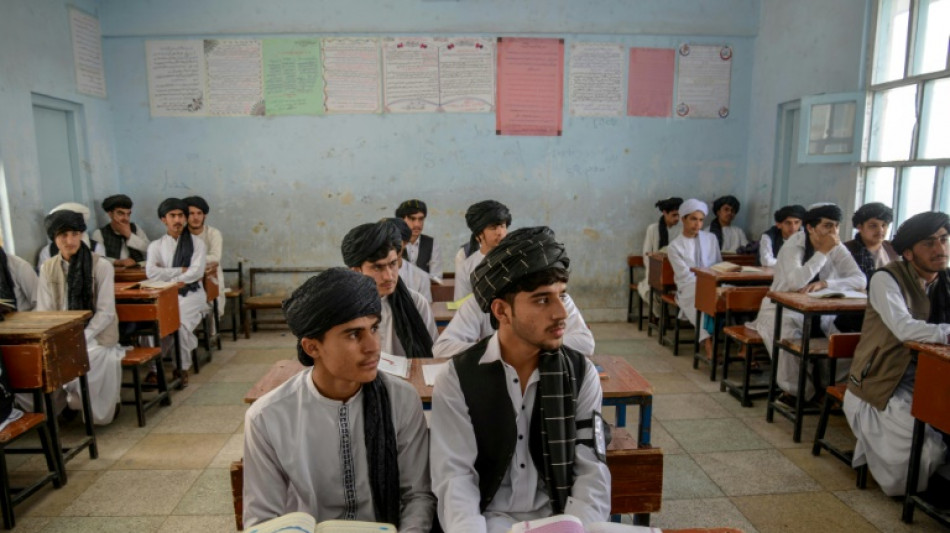
Tunics & turbans: Afghan students don Taliban-imposed uniforms / Photo: Sanaullah SEIAM - AFP/File
 North Dakota Enacts Bipartisan Insulin Price Cap Amid National Push

 Basil Tuma Scores First Senior Goal as Malta Draws with Ten-Man Eswatini
 Rock & Roll Hall of Fame Inductees Announced; Attendance List Shrinks

 InterContinental Hotels Group PLC Announces Transaction in Own Shares - November 13

 Below Deck alumnus João Franco and brother arrested after fatal Turkey fight

 Thousands of Urban Homes Left Without High-Speed Internet Due to Broadband Blackspots

 Bunnie XO artwork taken down from Jelly Roll’s Nashville bar

 Arlington sentinel rebukes Pete Hegseth entourage for laughter near memorial

 Kylie Jenner employee describes closet ordeal and pepper-spray incident

 Davante Adams injury deepens Los Angeles Rams receiver shortage

 João Franco’s earlier post draws attention after arrest over fatal Turkey brawl

 Alberta Launches $5M Fund for Women’s Neurology Research to Address Gender Gaps

 Dhananjaya de Silva guides Sri Lanka to 221-4 against Pakistan

 Delhi gold loses Rs 800 while silver falls Rs 5,000
Since the start of the school year in March, Afghan boys have been required to wear new uniforms of turbans and long tunics, following an order to adopt outfits reflecting Taliban rule.
The Taliban government's education ministry cites strengthening discipline, masking social inequalities and promoting what the authorities see as true Islamic attire as reasons for the dress code change -- a move that has sparked division.
"Islam has preserved and strengthened the standards of modesty and dignity by paying attention to clothing. Sharia clothing defines the identity of a Muslim male and female," the ministry said in its directive.
"Sharia clothing is a means to preserve the dignity of the individual and protect the society against moral degradation."
Before the Taliban authorities swept back to power in 2021, the shalwar kameez and turban -- traditional wear in the region -- were uncommon in academic or professional settings.
Since their return, the streets of Kabul and other areas have become more uniform, with many men opting for the monochrome loose trousers and long tunic.
Once mostly limited to religious schools, the shalwar kameez with a turban or hat are now mandatory for all students, whether in public or private schools.
Girls are already from a young age required to wear uniforms, often a long black dress over matching trousers with a white headscarf, but can no longer study past primary school in non-religious institutions.
- 'Turned away' -
Male students must wear a light blue shalwar kameez along with a cap up to the age of around 15, afterwards donning white and wearing a turban.
The rule -- ordered by the Taliban Supreme Leader Hibatullah Akhundzada -- took time to be enforced and is still implemented unevenly across the country.
In western Herat, student Nassir Ahmad said few pupils wore the new uniform at the start of the school year, but now they have no choice.
"Our teachers told us not to come without it. If we don't have the uniform and the cap, we can't enter the classroom," the 13-year-old told AFP.
"I saw several of my friends turned away because they didn't have a turban on," said 17-year-old Qassim.
He said morality police from the department for the Promotion of Virtue and Prevention of Vice came to the schools to ensure the rules are being followed.
In the Taliban heartland of southern Kandahar, several students told AFP they were pleased with their new clothing.
Mohammad Wali, a student at the Mahmoud Tarzi school, said he was "very happy" to wear the "Prophet's clothing".
"It distinguishes students from other people in the street," said the 15-year-old.
In the capital Kabul, some students wear the turban while at school, only to stuff it into their bags as soon as they leave.
- Too expensive -
Among teachers and school principals -- also told to swap their suits and ties or casual clothes for shalwar kameez and a black turban -- some disapproved of the measure.
"Today, everyone looks the same. A doctor no longer looks like a doctor and a cook no longer looks like a cook," said the principal of a Kabul school, speaking to AFP on condition of anonymity.
"The uniform does create discipline," the principal conceded, having swapped out his suit and tie nearly four years ago to avoid trouble.
But for some families, he said, paying the average 1,000 Afghanis ($14) per uniform is a burden in a country where 85 percent of the population lives on less than a dollar a day, according the UN.
"If a family has five or six children, how are they supposed to manage?" he asked.
Students now wear their new uniforms in often dilapidated schools with meager resources.
In remote areas, lessons are sometimes held outdoors under the shade of a tree.
The Kabul principal said at first he didn't sanction students out of uniform, but now education ministry officials show up at his school two to three times a week to check whether students are complying.
"People in Afghanistan have no choice," he said. "They obey and cannot complain."
strs-cgo/sw/fox
F.Bennett--AMWN