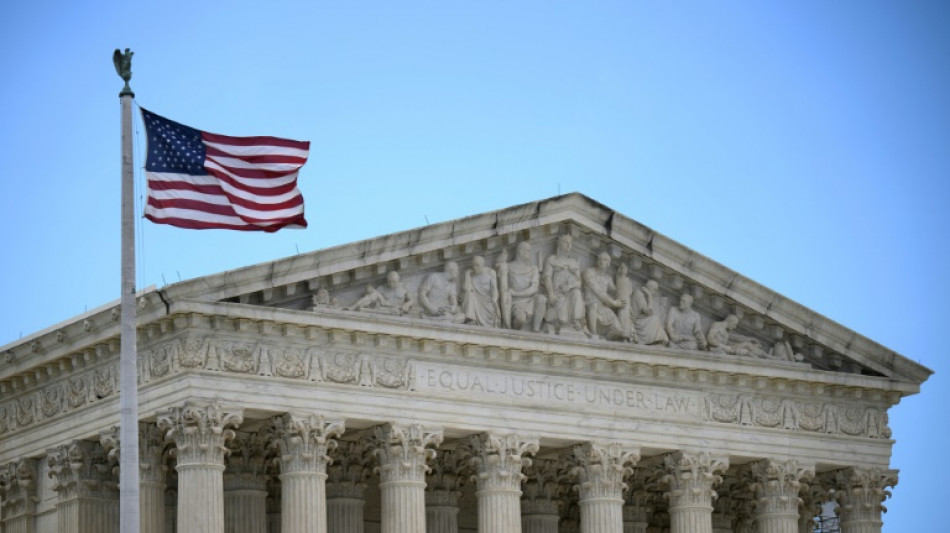
US Supreme Court upholds Texas age-check for porn sites / Photo: Drew ANGERER - AFP
 RSC’s ‘Julius Caesar’ Reimagined in Women’s Prison Setting for School Tour

 Thomson Reuters Integrates CUBE Regulatory Intelligence into CoCounsel Legal

 Ole Miss inquiry expands after video and monkey-noise allegations

 General Hospital actor Randall England dies at 75

 London museum removes Russell Brand hair exhibit after rape conviction

 Yella Beezy sentenced to life for arranging rapper Mo3’s murder

 Authorities to identify Montauk Mary and five other Long Island cold-case victims

 Barbie sequel negotiations stall over reported $25 million pay packages

 Bath & Body Works launches buy-one-get-one-free candle offer

 Itlu Arjuna receives U/A certificate ahead of theatrical release

 Niraj Kumar earns Los Angeles Olympic quota with 50m rifle bronze

 India extends micro-credit guarantee plan for five years

 Pradeep Antony, Smeha Manimegalai portray secret spouses in Mr & Mrs Office

 Woman barred from every Greggs outlet after series of offences

 Ketchup packets link suspect to break-in at Eddie Rocket’s restaurant

 OPEC Says Oil Output Is Near Prewar Levels Despite Shipping Disruptions

 China's Singles' Day Exposes Persistent Consumer Caution

 Energy Costs Push OECD Inflation Up to 4.5%

 US Adds 165,000 Jobs as Unemployment Falls to 4.1%

 Euro-Area Inflation Reaches 4% as Energy Prices Jump

 Irish police prepare for further hoax bomb threats after hundreds of schools targeted

 RBA Inflation Target Origins: Why Australia Chose a Range Over Zero

 Sister recounts fatal machete attack as Irish murder trial continues

 HoloCoder technology promises brighter smartphone images and 3D depth data

The US Supreme Court on Friday upheld a Texas law requiring pornographic websites to verify visitors' ages, rejecting arguments that this violates free speech and boosting efforts to protect children from online sexual content.
The court's decision will impact a raft of similar laws nationwide and could set the direction for internet speech regulation as concerns about the impact of digital life on society grow.
Texas is one of about 20 US states to institute checks that porn viewers are over 18, which critics argue violate First Amendment free speech rights.
Other countries such as France, Britain and Germany also enforce age-related access restrictions to adult websites, while companies like Meta are lobbying Washington lawmakers for age-based verification to be carried out by smartphone giants Apple and Google on their app stores.
The Texas law was passed in 2023 by the state's Republican-majority legislature but was initially blocked after a challenge by an adult entertainment industry trade association.
A federal district court sided with the trade group, the Free Speech Coalition, saying the law restricted adults' access to constitutionally protected content.
But a conservative-dominated appeals court upheld the age verification requirement, prompting the pornography trade group to take its case to the Supreme Court, where conservatives have a 6-3 supermajority.
Under the law, companies that fail to properly verify users' ages face fines up to $10,000 per day and up to $250,000 if a child is exposed to pornographic content as a result.
To protect privacy, the websites aren't allowed to retain any identifying information obtained from users when verifying ages, and doing so could cost companies $10,000 daily in fines.
During arguments in January before the Supreme Court, a lawyer representing the Free Speech Coalition said the law was "overly burdensome" and that its goal could be accomplished using content filtering programs.
But Justice Amy Coney Barrett, the mother of seven children, took issue with the efficacy of content filtering, saying that from personal experience as a parent, such programs were difficult to maintain across the many types of devices used by kids.
Barrett also asked the lawyer to explain why requesting age verification online is any different than doing so at a movie theater that displays pornographic movies.
The lawyer for the Free Speech Coalition -- which includes the popular website Pornhub that has blocked all access in some states with age verification laws -- said online verification was different as it leaves a "permanent record" that could be a target for hackers.
During the court's hearing of the case in January, Chief Justice John Roberts and Justice Clarence Thomas, both Republican appointees, seemed to suggest that advances in technology might justify reviewing online free speech cases.
In 1997, the Supreme Court struck down, in an overwhelming 7-2 decision, a federal online age-verification law in what became a landmark free speech case that set a major precedent for the internet age.
F.Schneider--AMWN