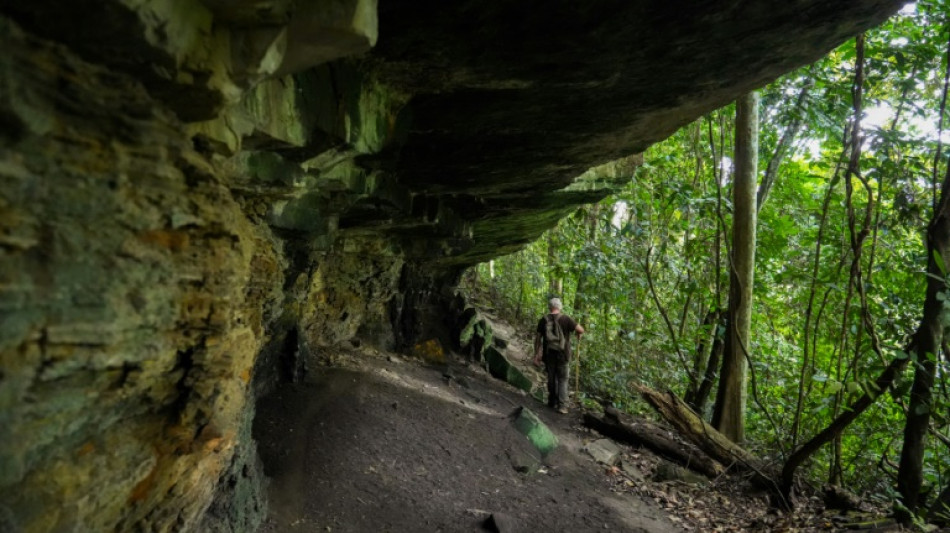
Gabon forest cave reveals clues about prehistoric central Africa / Photo: Nao Mukadi - AFP
 General Hospital actor Randall England dies at 75

 London museum removes Russell Brand hair exhibit after rape conviction

 Yella Beezy sentenced to life for arranging rapper Mo3’s murder

 Authorities to identify Montauk Mary and five other Long Island cold-case victims

 Barbie sequel negotiations stall over reported $25 million pay packages

 Bath & Body Works launches buy-one-get-one-free candle offer

 Itlu Arjuna receives U/A certificate ahead of theatrical release

 Niraj Kumar earns Los Angeles Olympic quota with 50m rifle bronze

 India extends micro-credit guarantee plan for five years

 Pradeep Antony, Smeha Manimegalai portray secret spouses in Mr & Mrs Office

 Woman barred from every Greggs outlet after series of offences

 Ketchup packets link suspect to break-in at Eddie Rocket’s restaurant

 Spain's General Strike Links Housing Crisis to Lost Purchasing Power

 China's Factory Inflation Accelerates While Consumer Demand Stays Weak

 Bank of England Raises Interest Rate to 4% as Energy Risks Intensify

 OPEC Says Oil Output Is Near Prewar Levels Despite Shipping Disruptions

 China's Singles' Day Exposes Persistent Consumer Caution

 Irish police prepare for further hoax bomb threats after hundreds of schools targeted

 RBA Inflation Target Origins: Why Australia Chose a Range Over Zero

 Sister recounts fatal machete attack as Irish murder trial continues

 HoloCoder technology promises brighter smartphone images and 3D depth data

 Early Black Friday Walking Pad Deals: Urevo and WalkingPad Discounts

 Radical Numerics develops offline AI tool to detect engineered pathogens

 Kiara Advani Reveals Sidharth Malhotra’s Reaction to Toxic Backlash

 Four firms compete to design Chennai’s model mobility corridors

In Gabon's sprawling forest, archaeologists dig for ancient clues that could unlock the secrets of how prehistoric humans lived and interacted in the changing landscape of central Africa.
Two billion years ago, the eastern Gabonese region of Lastourville was covered by a vast ocean.
But that has long given way to dense forest and dolomite cliffs dotted with caves, within which scientists have unearthed traces of human life dating back to 25,000 years BC.
Off the beaten track even for archaeologists, the Youmbidi rock shelter, a cavern typical of those chosen by prehistoric humans to set up their homes, is the focus for French geoarchaeologist Richard Oslisly's team.
Among their finds: a stone tool which could have been used for cutting or making fibres dating to before 10,000 BC.
An arrowhead has also been unearthed, as has a collection of dolomite, quartz and jasper shards, cut up to 10,000 years ago by the cave's inhabitants.
"The vast majority of research in Africa has taken place in open landscapes such as the Sahara, Sahel or Egypt," said Oslisly, who has spent 45 years working in central Africa.
"They said to me 'there's nothing in the forest' (but) I took up the challenge of finding out what was happening there," he added.
"We realise there is a very close relationship between man and nature in these forests, where people have lived for a very long time," Oslisly said.
The Youmbidi cave -- where scientists have recorded 12,000 years of continuous human habitation -- is an enticing spot for the archeologists.
"We don't know at all how these people lived, what their way of life was, what their names were, what their languages were," said Geoffroy de Saulieu from France's IRD Research Institute for Development.
"Our research will help us to know a little more," he added.
- Jigsaw puzzle -
After a month of digging and careful sorting of every stone, charcoal remnant, bone and other treasure buried below the cave, the team has elements to help decipher the past.
De Saulieu said it was like a jigsaw puzzle.
"You have to... gather the smallest clues, place them end to end to gradually reconstruct a whole universe that has disappeared and which is, nevertheless, at the origin of the way of life in central Africa today," said the expert, currently attached to the National Agency of National Parks of Gabon.
One of the oldest bits of pottery found in central Africa, which dated to more than 6,500 years ago, is among this year's finds.
Human-looking teeth that could allow DNA to be extracted in what would prove a significant leap in research have also excited archaeologists.
And, like all the artefacts, a bead likely made between 3,300 and 4,900 years ago from a snail shell also offers precious insight as a "very humble but beautiful witness" of the epoch in question.
Dispelling stereotypical images of prehistoric Man, it suggests people had "real customs, a real civilisation and art of living," de Saulieu said.
The pottery "shows that these societies weren't immobile, they had launched themselves into technical innovations", he added.
The discoveries fan his fascination for the richness of "the social life which existed in the region's forests".
- Resilience -
Glimpses into an ancient lost world can also be useful for tackling present-day challenges, the experts said.
During the Holocene period which dates back the past 12,000 years, "central Africa has experienced very significant changes in climate, hydrology and vegetation," said paleoclimatologist Yannick Garcin, also from the IRD and involved in the Youmbidi dig.
The hope is that the cave will unlock an understanding of "the resilience of human populations in the past and how they were able to adapt to climate changes that could have been drastic", he said.
Central Africa for that reason "deserves major development in terms of research", Oslisly argued.
Understanding what happened in prehistoric times can help scientists today react to modern-day issues, he added.
"Good studies on the relationship between Man and the environment in the past will allow us to react better to the environmental changes that are ahead of us," he said.
Ch.Kahalev--AMWN