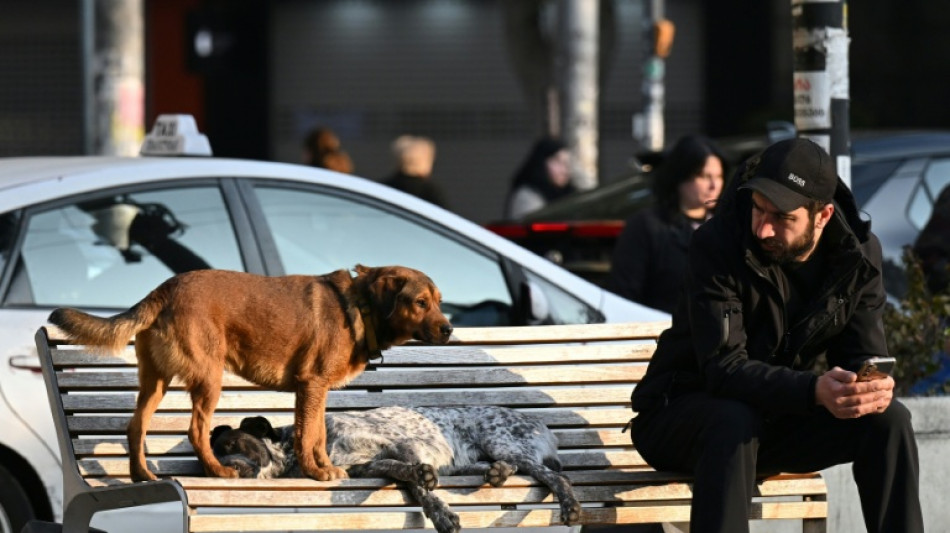
Georgia's street dogs stir affection, fear, national debate / Photo: Vano SHLAMOV - AFP
 Brazil's Lula has surgery to remove skin lesion from scalp
 Battle lines drawn over EU's next big budget
 Lebanon truce extended as Pakistan bids to revive US-Iran talks
 Alex Marquez quickest in Spanish MotoGP practice

 Justice Dept ends criminal probe into US Fed chair Powell

 G7 says nature talks a success as climate sidelined for US

 Russia, Ukraine swap 193 POWs

 Man City will not risk Rodri in FA Cup semi-final: Guardiola

 Germany launches spying probe into Signal attacks targeting MPs

 Injured Spain star Yamal will come back stronger at World Cup: Flick
 Chelsea can still save season despite slump: McFarlane

 Chelsea's Estevao out for season, World Cup in doubt

 Ryanair says to cut Berlin flights, blaming taxes

 London's Jewish community on edge amid attacks

 Warming El Nino set to return in mid-2026: UN

 Bill legalising assisted dying in England and Wales set to fail

 Macron says still sees France, Germany developing European fighter jet

 Greece expands sunbed-free beach list for 2026

 Mideast war drives up condom, rubber glove prices: manufacturers

 Liverpool's Slot warns 'margins are small' in Champions League push

 Suspected Nazi-looted Stradivarius reappears in France, says expert

 Appeal board says homophobia 'commonplace' in Aussie Rules

 Chinese EV makers take centre stage at world's biggest auto show

 China's top AI players

 Possible Trump rescue of Spirit Airlines spurs debate
At a bus stop in central Tbilisi, two tagged dogs dozed on a bench as some commuters smiled at them and others cast angry glances.
In the streets of the Georgian capital, such scenes are part of daily life: community-fed "yard dogs", yellow municipal tags on their ears, lounge outside bakeries, metro entrances and school gates.
The free-roaming canines stir both affection and fear. What to do with their swelling numbers -- in the tens of thousands in Tbilisi alone -- has become a nationwide dilemma.
Stray animals tied the top spot for public concerns in a poll by the National Democratic Institute, with 22 percent of respondents naming it the most pressing issue.
Many welcome the dogs as a symbol of Tbilisi, a showcase of Georgian hospitality and the warm street life that draws tourists to the capital.
"Street dogs in Georgia have made a more positive impact on tourism and the image of Georgia than people and culture alone," said journalist Elena Nikoleisvili, 51, who helps street dogs.
"If anything, these adorable creatures should be the symbol of the capital -- like the cats of Istanbul."
On cafe terraces, regulars slip bones under tables as mongrels curl up between patrons' feet, while each neighbourhood and cul-de-sac has its own local canine mascot.
- 'Drop in the ocean' -
Others worry about safety.
"They bark and scare folks," said plumber Oleg Berlovi, 43.
"Two weeks ago, a dog bit my kid and we needed shots. Animals are great, but they need looking after."
According to the World Health Organization, dogs are the main vectors in human rabies cases globally.
Georgia still records a handful of human deaths from the disease each year and administers tens of thousands of post-exposure treatments, according to the Global Alliance for Rabies Control.
City officials say the answer is steady, humane population control.
"The state's policy is to manage these animals by the most humane methods possible and to reduce to a minimum the number of stray dogs on the streets," Nicoloz Aragveli, who heads Tbilisi city hall's animal monitoring agency, told AFP.
A recent count put the capital's stray dog population at about 29,000, and around 74 percent have been neutered, Aragveli said.
"We plan to do more so that we reach 100 percent," he said.
The city runs weekly school lessons and a door-to-door registration drive to raise awareness and track owned pets.
Legislative changes have also tightened penalties for abandoning animals and for violating care and ownership rules -- steps officials say will help halt the flow of pets to the streets.
But journalist Nikoleisvili said the authorities only responded after a public backlash, and "could do much more".
The number of dogs that have been neutered in Tbilisi -- around 50,000 over the last decade -- is "a drop in the ocean", she said.
- 'Guilty party' -
Volunteers, like theatre director Zacharia Dolidze, who builds kennels, also play a big role in caring for the dogs.
"There are days I make 20 kennels. I've built about 2,500 in seven years," the 40-year-old said.
He collects regular donations to help pay for materials.
Shelter operators say there are big gaps in addressing what they call one of Georgia's biggest issues.
"You can make regulations, but if you cannot enforce them, that's not going to help," said Sara Anna Modzmanashvili Kemecsei, who runs a shelter that houses about 50 dogs.
In many regions, "there are absolutely no neutering campaigns."
"I can't really see that the government is on top of the issue, so there are lots of volunteers," she said. "They are really good at managing these animals."
Politics has also injected fresh uncertainty.
Last year, the government pushed a "foreign influence" law that complicates NGOs' access to funding from foreign donors such as UK animal welfare charity Mayhew, which runs a programme to vaccinate and neuter strays in Tbilisi.
Volunteers meanwhile continue to juggle feeding, sheltering and basic care.
Nino Adeishvili, 50, is a geologist and university lecturer who looks after around 10 dogs.
Her group organises rabies shots and fundraises on Facebook for deworming, flea treatment and food.
"On the street, a dog is still unprotected," she said.
"The guilty party is the human."
F.Bennett--AMWN