
In-person Berlin film fest stands up to pandemic, streaming
 Italy expels two Russian diplomats accused of spying: minister
 German exports rise despite Iran war headwinds

 Thousands attend funeral for Afghan cricketer Shapoor Zadran
 Crude pares steep gains as traders take stock after US-Iran flare-up

 Cleanup underway as death toll from China floods hits 39
 Italy recall Allan, Lynagh for All Blacks Nations Championship Test
 Rookie fly-half Meredith thrown in for Wallabies debut against France

 Taiwan warns of 'destructive' winds as typhoon nears
 Farrell rings changes for Ireland's Japan clash

 Magyar's blitz against Orban's Hungary 'mafia' gathers pace
 Labour leadership contest takes Burnham closer to UK PM's office
 New Zealand may join Australia-Fiji defence pact: PM Luxon

 Fly-half Meredith to make Australia debut against France

 US, Iran trade new strikes in fight over Hormuz strait

 Modi eyes 'historic' chance to secure Australian uranium
 US crackdown on top AI fuels open-source surge
 EU moves closer to kicking kids off social media
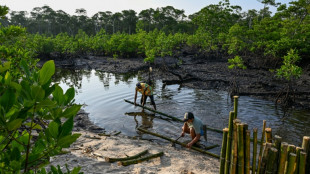 Protecting the protectors: racing to save Philippine mangroves
 Expanded World Cup; same old story as Europe dominates quarter-finals

 DISC Plus Profiles: Why More HR Teams Use Behavioral and DISC Assessments to Reduce Costly Hiring Mistakes

 Acumen Pharmaceuticals and Unlearn Collaborate to Explore Analyses of Alzheimer's Disease Clinical Programs
 GMV Minerals Announces Completion of 16 Diamond Drill Holes on the Mexican Hat Gold Project in SE Arizona - Drill Assays Pending with ~1500 Samples Submitted to Date
 PlatformPay.io and DayOne Announce Partnership to Enhance DTC E-Commerce Merchant Revenue

 Caledonia Mining Corporation Plc: Notification of Relevant Change to Significant Shareholder
 Morocco's Saibari out of France World Cup quarter-final

The 72nd Berlin film festival opens Thursday, bucking a trend of pandemic on-the-couch streaming with a packed programme of live premieres featuring a stable of European screen legends.
Just as the coronavirus outbreak roars toward its peak in Germany, Berlinale organisers have opted for an 11-day, in-person celebration of new movies and a gala ceremony to award its Golden Bear top prize.
The festival said it was crucial to give cinemas a boost when Covid-19 fears had fuelled home viewing on small screens, and the German government called the "courageous" step of holding the event "a sign of hope".
"It says: we won't let corona beat us. We need cinema and culture," government spokesman Wolfgang Buechner said.
Artistic director Carlo Chatrian said the Berlinale aimed to give weary audiences a break and some inspiration.
"Never before we have seen and welcomed so many love stories as this year -- crazy, improbable, unexpected and intoxicating love, which is after all what all encounters are about deep down."
- Nick Cave, conflict zones -
In competition are 18 films from around the world from hot young auteurs and cinema veterans -- including seven directed by women. More than 200 other pictures are showing in sidebar sections.
A jury led by Indian-born American director M. Night Shyamalan ("The Sixth Sense") will pick the winners.
The line-up includes new movies from French directors Francois Ozon and Claire Denis, "Carol" screenwriter Phyllis Nagy and Italy's Paolo Taviani, a previous winner and at 90 the oldest award contender.
Italian horror master Dario Argento will show his first new picture in a decade -- "Dark Glasses", starring his daughter Asia Argento.
Autograph seekers will be banned from the red carpet but stars including Emma Thompson, Sigourney Weaver, Charlotte Gainsbourg, Juliette Binoche, Isabelle Huppert and Mark Rylance have been invited to present their latest films.
Huppert will also pick up a Golden Bear for lifetime achievement.
South Korean festival favourite Hong Sang-soo will unveil "The Novelist's Film" and Li Ruijun, part of a new generation of Chinese arthouse directors, will show his village romance "Return to Dust".
In keeping with its tradition as the most politically minded of the big festivals, the Berlinale will turn the spotlight on conflict zones including South Sudan, the Central African Republic, Myanmar and eastern Ukraine, with a slew of new documentaries.
Plus "This Much I Know To Be True" will show how Australian rocker Nick Cave stayed creative under lockdown.
- 'Extra sausage' -
The Berlinale ranks among Europe's top festivals alongside Cannes and Venice, which also went live last year but during ebbs in the pandemic.
The recent Sundance and Rotterdam festivals were forced by Covid to go entirely virtual and many expected Berlin to follow suit.
But after an all-online festival last March, followed by outdoor screenings in the summer, the Berlinale worked with authorities to develop crowd safety measures.
The decision has caused controversy, with local media asking how organisers could justify it while the virus has closed hundreds of creches and hospitals strain under the outbreak.
The B.Z. tabloid said the festival seemed to be getting "extra sausage" -- German for special treatment -- while public broadcaster RBB called it "delusional" and newspaper Tagesspiegel warned: "The virus will be pleased".
Industry insiders noted that the festival's requirements on vaccination, daily testing and reduced capacity marked a valiant effort but wondered if it was all worth it.
"Berlin is quite well organised. The safety measures are top notch so if anyone could pull it off successfully and safely, they can," Scott Roxborough, Europe bureau chief for The Hollywood Reporter, told AFP.
"But it's a question as to whether it was necessary or sensible to do it."
He said Berlin, as the first major global cinema showcase of the year, was trying to live up to a responsibility to promote daring new movies against the odds.
"There's been a massive success of the latest 'Spiderman' -- one of the most successful films of all time now -- despite the pandemic," he said.
He said independent films, by contrast, had suffered.
"I think that's making the industry very concerned about the future," Roxborough said.
P.Silva--AMWN