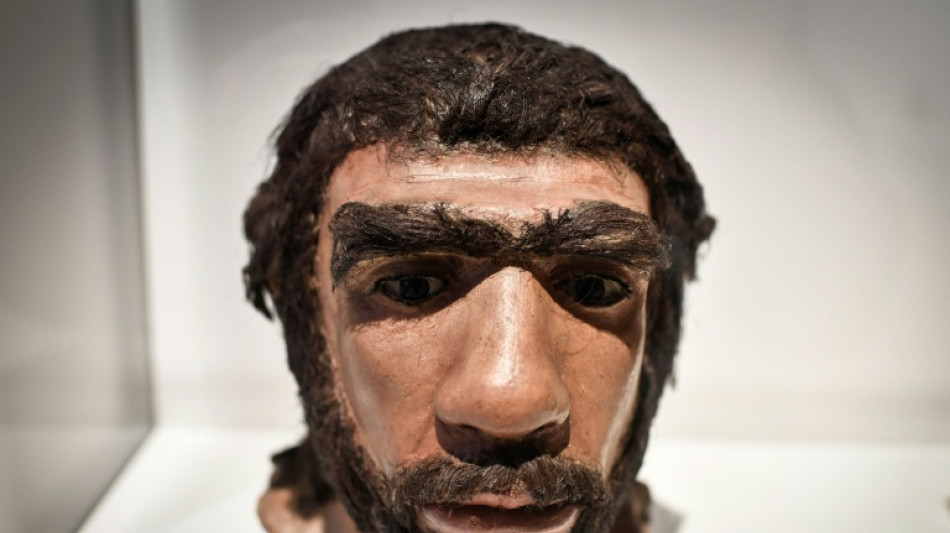
The sex lives of Neanderthal males - and human females / Photo: STEPHANE DE SAKUTIN - AFP
 Ships attacked in Gulf as Trump extends Iran ceasefire

 Pakistan's capital holds its breath with US-Iran talks in limbo

 Sakib Hussain: IPL quick whose mum sold her jewellery to fund cricket dream
 NASA unveils new space telescope to give 'atlas of the universe'

 The tiny, defiant Nile island caught in the heart of Sudan's war

 Oil falls, stocks mixed as traders weigh outlook after Trump extends truce

 Stadium that was symbol of NZ post-quake rebuild to hold first match

 Chinese carmakers aim to build up presence in Europe
 Fiji villagers reject plan for 'Pacific ashtray' in beach paradise

 Japanese minnows one win from fairytale Champions League title

 Blazers rally stuns Spurs after Wembanyama injury

 Delicate extraction: Malaysia offers rare earths alternative to China

 Pope to visit prison on final leg of Africa tour

 India strangles final Maoist bastion as mining looms

 Indonesia orangutan forest cleared for 'carbon-neutral' packaging firm

 One month phone-free: Young Americans try digital detox

 Rome summons Russian ambassador over insults against Meloni
 Revolve Accelerates Growth of Distributed Generation Portfolio with Definitive Agreements for 9 New Solar Projects in Mexico

 Cashmere Valley Bank Reports Quarterly Earnings of $5.8 Million

 Nanomerics Secures US Patent Extending MET Platform Protection to the 2040s

 SpaceX partners with AI startup Cursor, may buy it for $60 bn

 Mexico pyramid shooter planned attack, fixated on US massacre

 Rosenior blasts Chelsea flops after 'unacceptable' Brighton defeat

 Lens sweep past Toulouse to reach French Cup final

 Strait of Hormuz blockade drives up costs at Panama Canal

Dating out of your league? New research says it's a tale as old as time.
A study out Thursday in Science argues that Neanderthal men and human women were particularly inclined to mate, a sexual habit that offers insight into the evolution of the modern human genome.
In 2010 scientists reconstructed the Neanderthal genome -- blockbuster research that allowed for analysis making clear that the species interbred.
Most people living today have some residual fragments of DNA from our ancient evolutionary cousins.
Research indicates both groups descended from a population living in Africa some million years ago.
They eventually diverged, with anatomically modern humans evolving in Africa, and Neanderthals migrating across Eurasia.
But over hundreds of millenia, human migrations resulted in interbreeding, researchers say.
Yet humans have little to no Neanderthal DNA on our X chromosomes -- one of two human chromosomes that determines an embryo's sex.
That was assumed to be the result of a natural selection.
The genes were biologically "toxic" to humans, researchers hypothesized, and eventually purged out -- in essence, the children who inherited those traits might not have lived to pass them on.
But the new study from geneticists at the University of Pennsylvania suggests the phenomenon has more social origins, and were actually the result of "long-standing mating preferences."
The team analyzed modern human DNA preserved in Neanderthals, and found an abundance on the X chromosome -- the mirror opposite of humans.
That result allowed them to rule out that reproduction between the species was incompatible.
Instead the gene flow "occurred predominantly between Neanderthal males and anatomically modern human females," said Alexander Platt, a senior research scientist on the study.
Since females have two X chromosomes and males just one, the math adds up: If Neanderthal males and modern human females were mating, more Neanderthal X chromosomes would enter the human gene pool, and vice versa.
Researchers said that sex-biased migration could also offer clues. But ancient mating habits "provided the simplest explanation," Platt said.
The larger "why" is unknown: Neanderthal men and modern human women might have been mating by choice, or violence and coercion could have been involved.
Researchers say they now hope to analyze the development of this mating pattern.
Possibilities include probing gender dynamics within Neanderthal society, or migration habits -- perhaps males were likely to leave their societies while females stayed with their families, for example.
F.Pedersen--AMWN