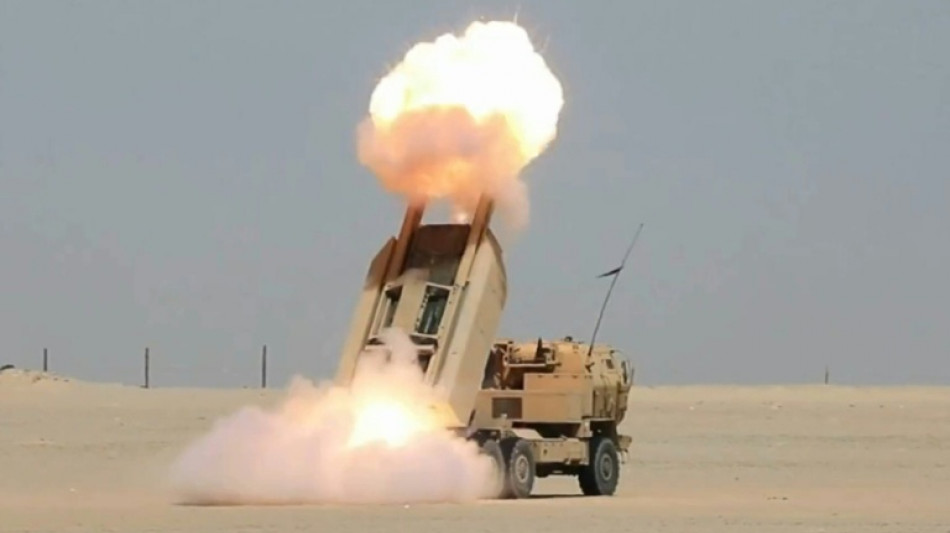
Stocks, oil climb as Middle East war stirs volatility / Photo: - - US Central Command (CENTCOM)/AFP
 Rene Eyre Revisits Autobiographical Performance 'Say A Little Prayer' in London

 UAE's HCT Holds Record Graduation and Announces Major Training Expansion

 NASA Awards $10B Lunar Contract Framework to SpaceX, Blue Origin

 Katy Perry Tells Fans Ex-Husband Russell Brand 'Should Be in Jail' During UK Concert

 South African election results renew debate over identity-based voting

 South African voters report smoother local election but declining IEC trust

 Dolly Parton museum and Nashville hotel open after singer’s death

 George and Amal Clooney attend New York political-comedy reading

 British buyers pay substantial premiums for period-home appearance

 Thomas Markle released to house arrest after child-abuse-image charge
Global stock markets rose and oil prices crept up further on Thursday as the Middle East war entered its sixth day, with energy supplies constrained and investors assessing levels of volatility.
European markets climbed for a second straight day following gains in Asia, where stocks rebounded from three days of declines.
Joshua Mahony, chief market analyst at Scope Markets, said there had been gains across all categories, suggesting that investors were "dip buying", where they purchase stocks after a slump in the hope they will recover value.
Global markets have been thrown into turmoil this week after the United States and Israel began strikes against Iran on Saturday, killing its supreme leader and sparking a wave of retaliatory attacks across the Gulf.
Tehran also effectively shut down the Strait of Hormuz, through which a fifth of the world's crude and considerable supplies of liquefied natural gas travel, sending prices soaring.
Both main oil contracts climbed around two percent Thursday and are up around 14 percent from Friday, stoking the chance of a fresh spike in inflation and dealing a blow to hopes for lower interest rates.
"The geopolitical situation is clearly moving fast, and oil prices are moving up again," said Jim Reid, managing director at Deutsche Bank.
"That comes as both the US and Iran have made clear they aren't backing down."
Europe's central bankers, meanwhile, played down fears of lasting economic damage but conceded that a longer conflict could lead to higher inflation.
"Financial stability is not at risk, I can say that very clearly," said Bank of France governor Francois Villeroy de Galhau, adding that the conflict could bring "a bit more inflation and a bit less growth".
Bundesbank President Joachim Nagel suggested that if energy prices remained high it could lead to "higher inflation and weaker economic activity in the euro area".
The war has touched as far afield as the Sri Lankan coast, where a US submarine torpedoed an Iranian warship, and Azerbaijan, which threatened retaliation after a drone hit an airport.
Concerns about how long the war will go on continued to weigh on markets, with Danish shipping giant Maersk saying it was suspending bookings in the Gulf until further notice.
China, fearing supply shortages, has asked its largest oil refiners to suspend exports of diesel and gasoline, according to a Bloomberg News report.
In Asia, Seoul led gains, with the Kospi soaring 12 percent at one point following an earlier collapse. Tokyo closed up almost two percent and Hong Kong and Shanghai also advanced.
National Australia Bank's Ken Crompton said that oil traders were largely unmoved by US President Donald Trump's pledge to protect ships passing through the Strait of Hormuz, which had provided a small glimmer of support Wednesday.
"The fact is it's just not feasible to reasonably protect all ships in the region," he wrote, pointing out that Houthis in Yemen had carried out multiple attacks on ships in the past.
Iran's Revolutionary Guards claimed "complete control" of the Strait, with reports of additional vessels coming under attack Wednesday.
Energy intelligence firm Kpler said oil tanker transits through the Strait had dropped by 90 percent from last week.
- Key figures at around 1100 GMT -
London - FTSE 100: UP 0.2 percent at 10,596.03 points
Paris - CAC 40: UP 0.3 percent at 8,195.78
Frankfurt - DAX: UP 0.4 percent at 24,292.15
Seoul - Kospi: UP 9.6 percent at 5,683.90 (close)
Tokyo - Nikkei 225: UP 1.9 percent at 55,278.06 (close)
Hong Kong - Hang Seng Index: UP 0.3 percent at 25,321.34 (close)
Shanghai - Composite: UP 0.6 percent at 4,108.57 (close)
Brent North Sea Crude: UP 2.1 percent at $83.12 per barrel
West Texas Intermediate: UP 2.5 percent at $76.55 per barrel
Euro/dollar: DOWN at $1.1614 from $1.1640 on Wednesday
Pound/dollar: DOWN at $1.3358 from $1.3373
Dollar/yen: UP at 157.27 yen from 157.06 yen
Euro/pound: DOWN at 86.95 pence from 87.03 pence
J.Williams--AMWN


