
Canada's Housing Crisis Demands a Manufacturing Revolution: The Case for Modular and Prefabricated Construction
 Dutch minister says not planning to bar Kanye West

 Suspect remains silent in Swiss bar fire probe

 Iran truce spurs hopes for world economy, but recovery will be rocky

 Red or black: Thai men tempt fate at military draft draw

 Medvedev thrashed 6-0, 6-0 by Berrettini in Monte Carlo

 Oil prices plunge, stocks surge on US-Iran ceasefire

 Warner aware of 'seriousness' of drink-driving charges: Cricket NSW

 Australia PM welcomes Iran ceasefire, says Trump threats not 'appropriate'

 'Pinprick of light': Artemis crew witnesses meteorite impacts on Moon

 China says investigating 'malicious' cyberbullying of teen diving star

 Taiwan opposition leader says China visit to sow 'seeds of peace'

 How did Pakistan broker a temporary truce between Iran and the US?

 Rockets comeback sinks Phoenix on Durant return

 Vietnam's To Lam bets big on building blitz

 Pakistan to host US-Iran ceasefire talks Friday

 North Korea fires multiple ballistic missiles towards East Sea

 Unbeaten legend Winx's $7 million foal retires without racing

 Solar push helps Pakistan temper Gulf energy shock

 Wave of nostalgia as 2000s TV makes a comeback

 Forest's Igor Jesus eyes Europa League 'dream', Villa brace for Bologna in quarters

 US, Iran agree to 11th-hour truce after Trump apocalyptic threats

 Vacarya Reaches 400 Short-Term Rental Properties Across North America

 Schweid & Sons Featured in Griddle Nation Season Premiere

 DistillerSR Launches the Industry's Most Advanced GenAI Capabilities for Extracting Scientific Literature Evidence

 Konica Minolta Announces First Class of 2026 Pro-Tech Service Award Recipients

Ladan Hosseinzadeh Sadeghi, President & CEO of Sky Property Group Inc., calls on developers, governments, and investors to accelerate the adoption of modular and prefabricated construction to address Canada's deepening housing shortage.
TORONTO, ONTARIO / ACCESS Newswire / March 5, 2026 / Canada's housing crisis continues to defy conventional solutions. Despite record government spending, zoning reforms, and accelerated approval processes in cities from Vancouver to Halifax, the country still falls dramatically short of the supply needed to house a rapidly growing population. But a quiet manufacturing revolution - modular and prefabricated construction - is beginning to reshape how Canada thinks about building homes at scale.
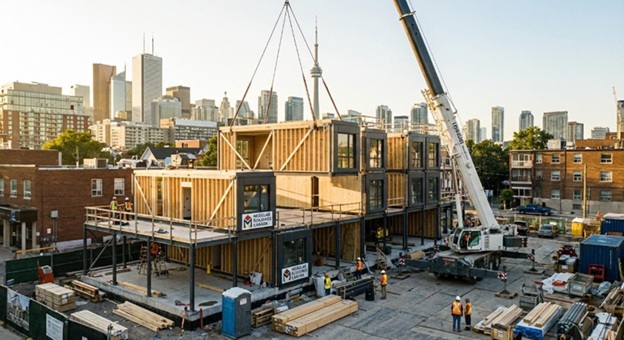
Ladan Hosseinzadeh Sadeghi, President & CEO of Sky Property Group Inc., has been watching this transformation closely. For her, the answer to Canada's housing shortage isn't just about building more - it's about building smarter.
"The traditional construction model is broken," says Hosseinzadeh Sadeghi. "Labour shortages, supply chain volatility, brutal Canadian winters - all of these are compressing timelines and inflating costs. Modular construction attacks all of those problems at once. If Canada is serious about delivering the housing it needs by 2030, we can't afford to ignore this approach."
What Is Modular Construction - and Why Does It Matter for Canada?
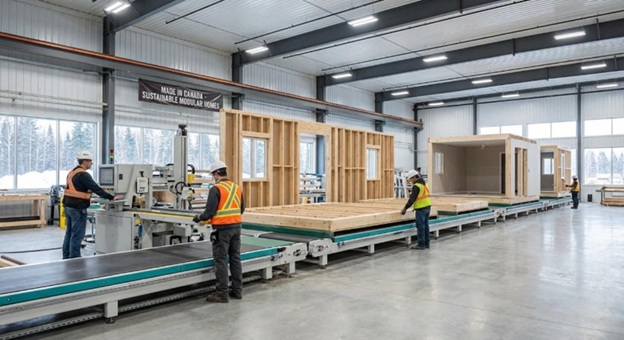
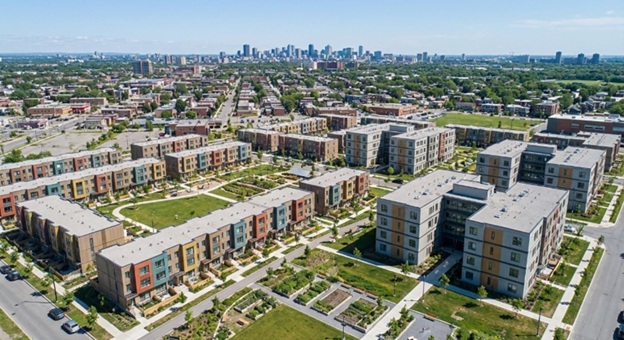
Modular and prefabricated construction involves manufacturing significant portions of a building - or entire units - in a factory-controlled environment, then transporting and assembling them on-site. The approach has been gaining momentum globally, particularly in countries grappling with high construction costs and skilled labour shortfalls.
In Canada, the case for modular construction is especially compelling. The country's harsh winter climate regularly interrupts outdoor construction work, adding months to project timelines and millions in carrying costs. Factory-based manufacturing sidesteps these seasonal constraints entirely, enabling year-round production regardless of what's happening outside.
According to the Canada Mortgage and Housing Corporation (CMHC), Canada needs to build approximately 3.5 million additional homes beyond current projections by 2030 to restore affordability. Achieving that goal with conventional stick-frame or cast-in-place construction methods alone is, by most expert assessments, virtually impossible within that timeframe.
Hosseinzadeh Sadeghi sees modular construction as one of the clearest paths forward. "We're talking about 30 to 50 percent faster build times compared to conventional construction, with comparable or better quality outcomes. For a developer trying to close the gap between housing demand and supply, that's not a minor efficiency gain - that's a fundamental shift in what's achievable."
The Economics of Factory-Built Homes
Beyond speed, modular construction offers a compelling economic case that is increasingly attracting the attention of institutional investors and developers across Canada.
Factory environments dramatically reduce material waste - some studies suggest savings of 50 to 80 percent compared to site-built construction. Labour efficiency is higher because workers build in optimized, controlled settings rather than navigating scaffolding, variable terrain, and weather. Quality control is more consistent, which reduces costly defects and remediation after occupancy.
For cities like Toronto, where land costs have reached extraordinary heights and carrying costs on development projects can run into the hundreds of thousands per month, any approach that compresses timelines has an outsized financial impact.
"Every month shaved off a construction timeline is real money," says Hosseinzadeh Sadeghi. "It reduces interest costs, lowers exposure to market volatility, and gets housing to the people who need it faster. At Sky Property Group, we're actively evaluating modular methods across several project types - not as an experiment, but as a viable delivery model."

Federal and Provincial Momentum
Governments at multiple levels are beginning to recognize modular construction as a serious policy lever. The federal government has flagged prefabricated housing as a priority in its most recent housing strategy iterations, with funding earmarked to support manufacturing capacity and ecosystem development.
Ontario, British Columbia, and Alberta have all seen increased activity from modular housing manufacturers looking to scale up. Indigenous communities across the country - where housing shortages are particularly acute and remote locations make conventional construction especially difficult - have emerged as early adopters of modular approaches with meaningful results.
For Hosseinzadeh Sadeghi, government support is necessary but not sufficient. "Policy can open the door, but the private sector has to walk through it. We need developers, financiers, and builders to commit to learning this model, investing in partnerships with manufacturers, and designing projects from the ground up with modular delivery in mind - not bolting it on as an afterthought."
Addressing the Skills and Supply Chain Gap
One of the persistent barriers to scaling modular construction in Canada has been the shortage of skilled tradespeople familiar with factory-based building methods. Traditional apprenticeship programs have been slow to incorporate modular manufacturing curricula, leaving a gap between industry demand and workforce readiness.
Hosseinzadeh Sadeghi argues that closing this gap requires coordinated investment. "We need the trades schools, colleges, and apprenticeship programs to evolve. This isn't about replacing construction workers - it's about giving them better tools and better environments to do their work. A factory is safer than a construction site in a January snowstorm. We should be attracting more people to this industry, not fewer."
Supply chain resilience is another critical consideration. The COVID-era disruptions exposed how fragile just-in-time material delivery models can be for site-built construction. Modular facilities, with their controlled procurement and inventory management, offer a measure of insulation from these risks - though they are not immune to global materials market pressures.
The Path Forward
For Ladan Hosseinzadeh Sadeghi and Sky Property Group Inc., modular and prefabricated construction represents not a niche alternative but a mainstream necessity for Canadian real estate development.
"We built our cities with the tools of the 20th century," she reflects. "The housing crisis we're in today demands 21st-century solutions. Modular construction is proven. It scales. It's fast. And Canada has the manufacturing base, the engineering talent, and the policy urgency to make it work. What we need now is will."
As developers, investors, and policymakers gather this spring to chart the next chapter of Canada's housing recovery, Hosseinzadeh Sadeghi's message is clear: the factory floor is the new construction site - and the developers who embrace that reality first will be the ones who define the next decade of Canadian real estate.
About Sky Property Group Inc.
Sky Property Group Inc. is a Canadian real estate development and property management company headquartered in Toronto, Ontario. The company is focused on land assembly, high-density residential development, and sustainable urban intensification across the Greater Toronto Area and other major Canadian markets. Sky Property Group is led by President & CEO Ladan Hosseinzadeh Sadeghi, a recognized leader in Canadian real estate development.
Media Contact:
Ladan Hosseinzadeh Sadeghi
[email protected]
SOURCE: Ladan Hosseinzadeh Sadeghi
View the original press release on ACCESS Newswire
J.Oliveira--AMWN