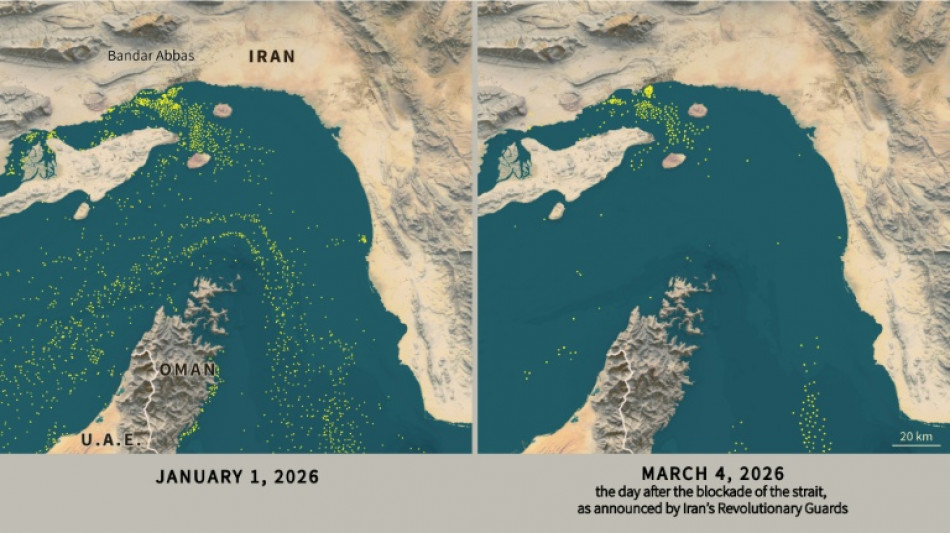
Only nine commercial ships detected crossing Hormuz Strait since Monday / Photo: Valentin RAKOVSKY, Julie PEREIRA - AFP
 Rene Eyre Revisits Autobiographical Performance 'Say A Little Prayer' in London

 UAE's HCT Holds Record Graduation and Announces Major Training Expansion

 NASA Awards $10B Lunar Contract Framework to SpaceX, Blue Origin

 Katy Perry Tells Fans Ex-Husband Russell Brand 'Should Be in Jail' During UK Concert

 South African election results renew debate over identity-based voting

 South African voters report smoother local election but declining IEC trust

 Dolly Parton museum and Nashville hotel open after singer’s death

 George and Amal Clooney attend New York political-comedy reading

 British buyers pay substantial premiums for period-home appearance

 Thomas Markle released to house arrest after child-abuse-image charge
Only nine oil tankers, cargo and container ships, some of which at times concealed their position, have been recorded crossing the Strait of Hormuz since Monday, according to MarineTraffic data analysed by AFP.
After three ships were attacked on Sunday, at least three tankers and a vessel carrying gas have crossed this chokepoint, a key shipping lane virtually shut by the war in the Middle East.
Nearly 20 percent of the world's crude oil and about 20 percent of liquefied natural gas (LNG) usually transit through the Strait of Hormuz.
Only vessels that emitted at least one signal on either side of the Strait of Hormuz were counted by AFP, excluding any others that may have travelled with their signals entirely concealed for a long period of time.
Attacks since Sunday have multiplied against ships navigating Hormuz, raising concerns about a lasting impact on the global economy as the US-Israeli war on Iran and Tehran's retaliatory attacks across the Gulf region have upended the world's energy sector.
Iran armed forces spokesman Abolfazl Shekarchi told Iranian state broadcaster Irib, "We emphasize the security of the Strait of Hormuz and control it, but we will not close it."
Despite the conflict, "some tankers are still travelling east and west through the strait, with a number of voyages occurring under AIS (automatic identification system) blackouts," said Matt Wright, an analyst at Kpler, which publishes MarineTraffic, on Wednesday.
One example is the tanker Kavomaleas, which emitted a signal east of the strait on March 3 and then another in the Gulf about 14 hours later.
- Sanctioned ships -
Another example is a 130-metre (427-foot) container ship registered in Panama, which left Pakistan on Monday. Having arrived at the entrance to the Gulf on Wednesday night, it has been inside the strait since Thursday morning.
The Pushpak, a vessel designed for transporting petroleum products, left the Gulf on Thursday evening, having departed from an Iraqi port.
The Hout, a cargo ship registered in the Comoros, left Dubai on Tuesday bound for a port in southeastern Iran.
The Danuta I, a 225-metre natural gas carrier under US sanctions, crossed the Strait of Hormuz at dawn on Friday.
The Athina, spotted by the Financial Times, was east of the strait on February 28 and transmitted a position to MarineTraffic west of Hormuz on March 1.
It loaded oil in Bahrain before resuming its journey towards the strait but has not transmitted any signal since Thursday afternoon.
It is one of at least five ships belonging to the Dynacom company that have crossed the strait since the war started last Saturday, all with their transponders switched off, according to the Financial Times.
Most carriers have suspended their operations and the passage remains perilous, as demonstrated by the Safeen Prestige, which was hit by projectiles while sailing east from the Gulf on Tuesday, according to the British Maritime Safety Organisation (UKMTO).
lam-vr-jwp-ys/lmc/giv/jhb
M.Thompson--AMWN


