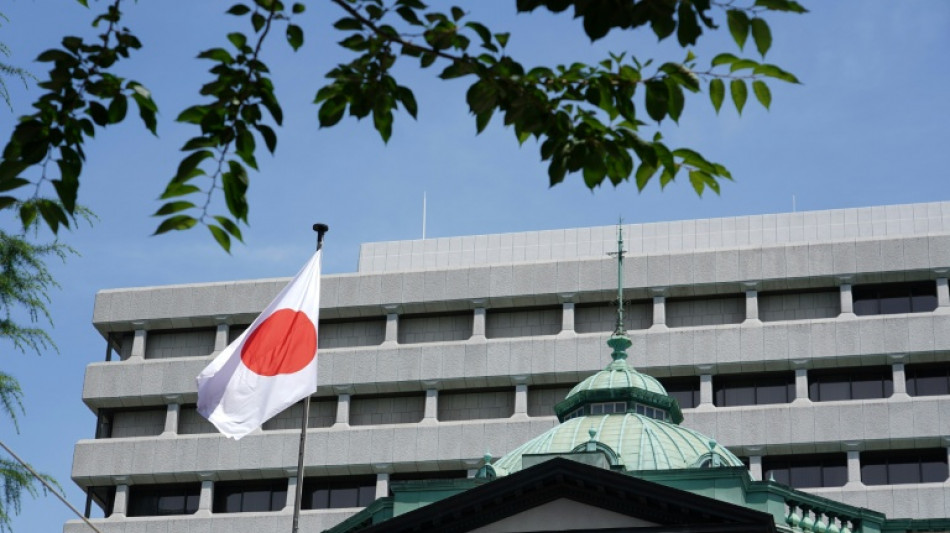
Bank of Japan hikes interest rate to 31-year high / Photo: Kazuhiro NOGI - AFP
 'I call it a bribe': Pennsylvania residents spurn $10,000 data center checks
 In a former US steel city, ordinary people struggle to get by
 'Liar,' 'clown': Lula and Bolsonaro spar in Brazil poll debate
 Record El Nino? Depends who's counting
 On the front line of ocean conservation off Portugal's Madeira

 Wembanyama targets title breakthrough as NBA season tips off
 With LeBron on board it's title or bust for Philly fans
 One year after Louvre heist, where are the missing jewels?

 Knicks face tall task in NBA championship repeat bid

 Warriors' Curry 'fine' after limping out of practice - Kerr

 Zelensky speaks to US envoys as Trump lashes out
 'Surprise package' Lazio crush Juve to keep pace with Serie A leaders Inter

 China growth expected to miss official target in third quarter

 Lazio crush Juventus to move level with Serie A leaders Inter

 Leeds draw feels like 'fresh start' for Man Utd's Carrick
 Macron denounces 'unbridled' violence as France hit by new clashes

 Hurzeler lauds 'hard worker' Gomez after Brighton goal from halfway line

 Toulouse hold off Exeter, Northampton save English Champions Cup blushes
 Arsenal snatch late win to keep pressure on Man City as Man Utd held
 Arsenal strike late to keep pressure on Man City as Man Utd held

 Four soldiers dead, dozens injured in fire at Canada military base

 Ton-up Agha helps Pakistan down Sri Lanka in tri-series opener

 Man Utd draw at Leeds keeps pressure on Carrick

 Barca defenders Garcia, Kounde injured before key games
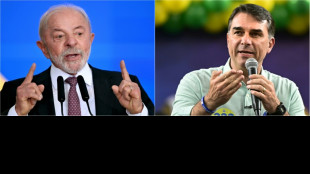 Lula, Bolsonaro to face off in first debate of bruising election
The Bank of Japan hiked interest rates to a 31-year high on Tuesday as it battles inflation caused by the Middle East war -- even after Washington and Tehran agreed a peace deal.
The central bank for the world's fourth-largest economy raised its benchmark rate 25 basis points to 1.0 percent, the highest since 1995 and marking the first increase since December.
The widely expected decision followed increases by the European Central Bank and in Indonesia last week after the conflict caused economic havoc and rising prices worldwide.
With US inflation at a three-year high, expectations are growing that the Federal Reserve will follow suit, albeit not at new boss Kevin Warsh's first gathering this week.
"While higher crude oil prices have been exerting downward pressure on economic activity, the economy has generally been supported by factors such as high levels of corporate profits and an improvement in the employment and income situation," the BoJ said.
The consumer price index (CPI) has been below two percent thanks in part to government energy subsidies.
"However, the price pass-through stemming from the rise in crude oil prices has been progressing at a relatively fast pace in business-to-business transactions, which could spread to an increase in consumer prices across a wide range of items," the central bank added.
"Against this backdrop, taking into account that medium- to long-term inflation expectations have also continued to rise, there is a risk of underlying CPI inflation deviating upward to a level above the price stability target of two percent."
The BoJ said that it will "continue to raise the policy interest rate and adjust the degree of monetary accommodation".
"In this regard, it will consider the timing and pace of adjustment, while closely monitoring the impact of the future course of the situation in the Middle East on Japan's economic activity and prices," it said.
BoJ deputy governor Shinichi Uchida later told reporters the central bank "will need to assess" how much inflation in the future "will be mitigated by the recent decline in crude oil prices".
"There was no proposal of (hiking interest rate by) 50 basis points" during the two-day meeting that ended on Tuesday, said Uchida, who was filling in for governor Kazuo Ueda, who is in hospital.
The BoJ also indicated that it would pause the tapering of its colossal programme of government bond purchases after next April, citing predictability of the Bank's bond purchases so as to improve bond market functioning and stability.
- US-Iran deal -
The United States and Iran agreed to end their three-month war on all fronts and reopen the Strait of Hormuz, through which pre-conflict about a fifth of world oil and gas passed.
The accord was set to be physically signed in Switzerland on Friday, but hundreds of ships remain stuck, and it will likely take considerable time for trade flows to normalise.
Japan relied on the Middle East for around 90 percent of its crude supplies before the war began on February 28.
Its problems have been exacerbated by a falling yen, caused by the rise in oil prices and the gap between US and Japanese interest rates, which are among the lowest in the developed world.
The government spent around 11.7 trillion yen ($72 billion) last month propping up the currency, which has been languishing at around 160 yen against the dollar.
The yen briefly jumped against the greenback after the announcement Tuesday, while the Nikkei 225 stock index rose above 70,000 points for the first time.
The central bank is under pressure from markets to keep tightening interest rates, and also from Prime Minister Sanae Takaichi's government not to snuff out growth with high borrowing costs.
The BoJ began hiking rates from below zero in 2024 after nearly two decades of ultra-loose monetary policies.
Akino Fukuda at Moody's Analytics said Tuesday's move was "another step toward policy normalisation".
"Real rates remain negative, financial conditions are still relatively loose, and inflation pressures are turning higher, so more hikes are necessary," Fukuda said.
"The question now is the pace."
hih-kh-jug-stu/dan
L.Mason--AMWN