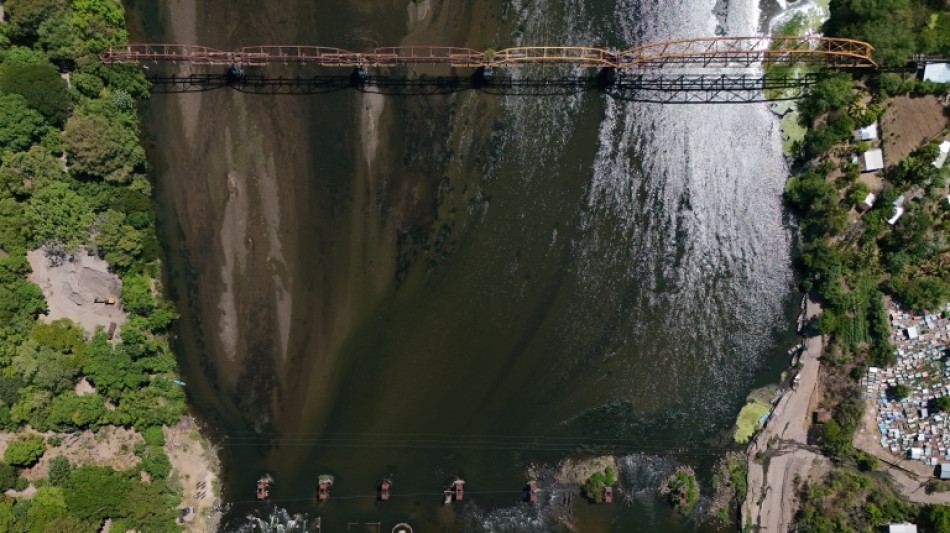
Record El Nino? Depends who's counting / Photo: Marvin RECINOS - AFP/File
 'I call it a bribe': Pennsylvania residents spurn $10,000 data center checks
 In a former US steel city, ordinary people struggle to get by

 'Liar,' 'clown': Lula and Bolsonaro spar in Brazil poll debate

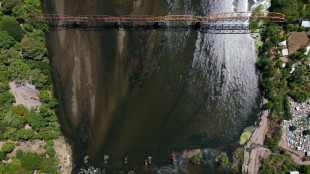 Record El Nino? Depends who's counting

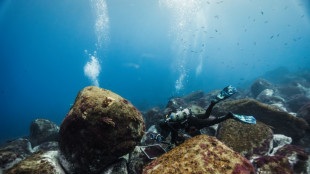 On the front line of ocean conservation off Portugal's Madeira

 Wembanyama targets title breakthrough as NBA season tips off

 With LeBron on board it's title or bust for Philly fans

 One year after Louvre heist, where are the missing jewels?

 Knicks face tall task in NBA championship repeat bid

 Warriors' Curry 'fine' after limping out of practice - Kerr

 Zelensky speaks to US envoys as Trump lashes out

 'Surprise package' Lazio crush Juve to keep pace with Serie A leaders Inter

 China growth expected to miss official target in third quarter

 Lazio crush Juventus to move level with Serie A leaders Inter

 Leeds draw feels like 'fresh start' for Man Utd's Carrick

 Macron denounces 'unbridled' violence as France hit by new clashes

 Hurzeler lauds 'hard worker' Gomez after Brighton goal from halfway line

 Toulouse hold off Exeter, Northampton save English Champions Cup blushes

 Arsenal snatch late win to keep pressure on Man City as Man Utd held

 Arsenal strike late to keep pressure on Man City as Man Utd held

 Four soldiers dead, dozens injured in fire at Canada military base

 Ton-up Agha helps Pakistan down Sri Lanka in tri-series opener

 Man Utd draw at Leeds keeps pressure on Carrick

 Barca defenders Garcia, Kounde injured before key games

 Lula, Bolsonaro to face off in first debate of bruising election

Britain's Met Office says this year's El Nino is "unprecedented." Japan's weather agency has called it the strongest ever observed. US forecasters say it still trails the biggest events in its record books.
How can they all be right?
The answer lies in how they measure El Nino's strength, with meteorological agencies using different methods to assess the climate phenomenon that make direct comparisons difficult.
"By any measure, we are looking at a very strong El Nino," climate scientist Emily Becker of the University of Miami told AFP, adding that only once it is over will scientists be able to assess how big it is and "where it fits in the context of history."
- Natural climate driver -
The Pacific Ocean's El Nino Southern Oscillation (ENSO) is the planet's main natural climate driver. Normally, trade winds blow east to west along the equator, pushing warm water from South America toward Asia, while cold water rises from the depths to replace it.
El Ninos, which occur every two to seven years on average and last nine to 12 months, disrupt this pattern.
The trade winds weaken and warm water is pushed back east toward the Americas. That shift in where ocean heat is released into the atmosphere ripples across global weather, making some regions cooler and wetter and others hotter and drier.
In describing the El Nino as unprecedented, the Met Office points to raw temperatures in the Pacific.
"Our observations confirm that sea-surface temperatures in the central equatorial Pacific have now surpassed levels recorded during previous El Nino events," it said in a statement to AFP.
But absolute temperatures are just one way of measuring El Nino's strength. Agencies also look at anomalies -- how far temperatures rise above a historic baseline -- to assess the event.
The Japan Meteorological Agency last week declared this El Nino the strongest on record based on how far sea surface temperatures were above normal in the Nino3 region of the eastern Pacific. By its count, the event beat 1997 in observations going back to 1949.
The US watches a neighboring box, Nino3.4, in the east-central Pacific.
It declares an El Nino when temperatures there run at least 0.5C above normal and the atmosphere responds, weakening the trade winds and shifting tropical rainfall eastward. This process is known as "ocean-atmosphere coupling."
- Accounting for climate change -
How "normal" is defined has been a matter of significant debate.
The US National Oceanic and Atmospheric Administration (NOAA) and other agencies including the UN's World Meteorological Organization long used the Oceanic Nino Index (ONI), which compares temperatures to a 30-year average that is updated every five years, so that the baseline keeps pace with a warming climate.
But with climate change speeding up and warming oceans worldwide, NOAA now uses the Relative Oceanic Nino Index (RONI), and the WMO is in the process of switching.
RONI also relies on a 30-year average but goes on to measure how warm or cool the east-central Pacific is compared to the rest of the tropical ocean, because it is that difference that drives the weather impacts we care about.
"We were finding a mismatch between the temperature of the tropical Pacific and the impacts," said Becker about the old index. La Nina years, when the central and eastern tropical Pacific is cooler than normal, were producing stronger effects than their rating suggested, and El Ninos weaker ones.
NOAA projects this El Nino will be the strongest in its records, which go back to 1950, if the three-month average RONI anomaly reaches 2.5C or higher, a level that would put it above the 1982-83, 2015-16, and 1997-98 events.
The chances are rated "high," but not yet certain.
"Regardless of where we're ranking or how we're measuring this event, it's an incredible opportunity to study and understand this very powerful phenomenon in the context of a warming world," said Becker.
A.Malone--AMWN