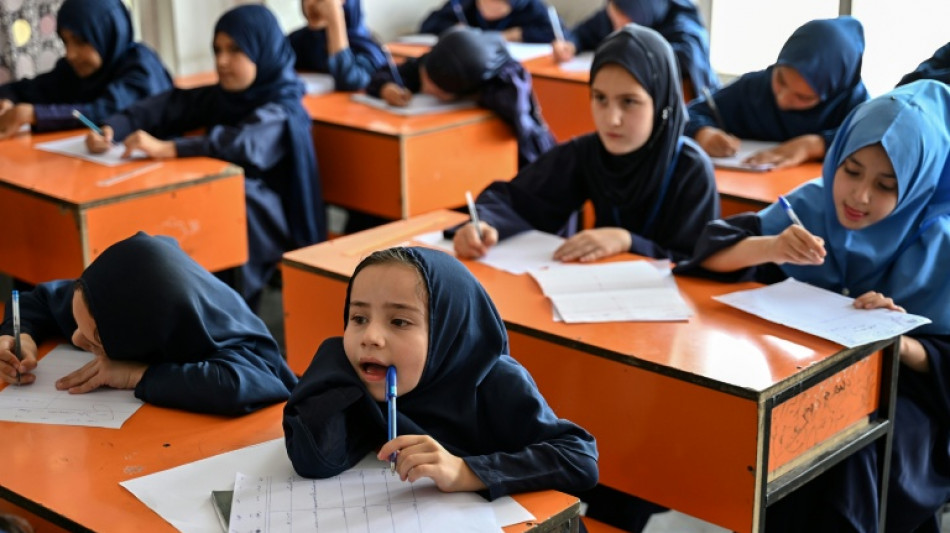
2.4 million girls banned from Afghan schools since Taliban return: UNESCO / Photo: STR - AFP
 Food, medicine shortages deepen in Russian-occupied Oleshky

 Man City whistleblower Rui Pinto facing 'dire consequences' - lawyers
 Russia 'tearing Kyiv apart', mayor says, as strikes paralyse traffic

 Taiwan boxer Lin wins Games gold as Japan edge North Korea on penalties

 Japan tame North Korea to win Games gold after shootout drama

 US posts weak job growth data in September
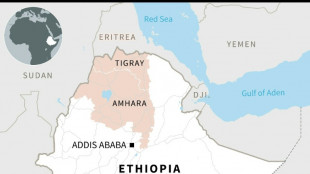 Ethiopia's conflict: the regional dimension

 Life expectancy almost back to pre-Covid levels, says WHO

 Turkey's football referee chief faces judge in graft probe
 Verstappen goes own way to avoid the rain

 Oil slides, bonds steady as EU addresses diesel price surge

 Spain housing package at risk in parliament, as protests mount

 Swedish Social Democrats leader to make new bid to form government
 North Korea calls Seoul 'despicable' after DMZ apology demand

 Taiwan boxer Lin wins gold as virtual taekwondo makes Games debut

 Man City face appeal deadline after explosive financial verdict

 Pole vault superstar Duplantis to skip indoor season

 Sri Lanka drop Asalanka from T20 against Pakistan

 Disney president says layoffs 'extremely painful' but necessary

 Indian flydubai pilot opened cockpit door to save passengers
 Alex Marquez clocks record lap at MotoGP Japan practice

 Tom Kim leads Asian Games golf in chase to avoid military service
 Asian stocks hit as oil spike fans rate hike bets, eyes on US jobs

 'We're losing our scientists': west Africa's STEM struggle
 World powers gather in Pacific to chart climate battle

Around 2.4 million girls in Afghanistan have been denied access to secondary education since the Taliban returned to power in 2021, the United Nations said Tuesday, urging an end to such "discrimination".
The Taliban administration, recognised solely by Russia, has imposed a series of restrictions on women that the United Nations has characterised as "gender apartheid".
Girls cannot study beyond primary school, a policy the Taliban authorities justify based on their interpretation of Islamic law.
The number of girls denied access to secondary school has risen by 200,000 since last year and could reach nearly four million by 2030 if the ban persists, said the UN's cultural and educational agency UNESCO.
The UN agency called for the immediate restoration of their right to education and condemned the "discriminations against women and girls".
The Taliban government -- who promised a softer rule after retaking power in August 2021 -- have imposed sweeping restrictions on women, banning them from universities, public parks, gyms and beauty salons.
Girls were barred from secondary schools in March 2022, with universities closed to young women later that year.
"These restrictions are reversing two decades of progress in expanding access to education: while access to schooling for girls was severely limited in 2001, by 2021 nearly one million girls were enrolled in secondary education," UNESCO said.
"Afghanistan girls and women have the right to learn, that's a basic human right," said Hoda Jaberian, UNESCO's programme coordinator for education in emergencies.
"They have the right to work. They should have the freedom of movement."
The schooling ban also carries a significant economic cost, with the restriction on women and girls estimated to cost Afghanistan $9.6 billion by 2066, UNESCO said.
Afghanistan's wider education sector is in crisis, with more than half of primary school-age children completely out of school.
More than 90 percent of 10-year-olds are unable to read a simple text, UNESCO said.
A lack of drinking water, sanitation facilities and heating in schools has compounded the crisis, as have natural disasters, including earthquakes that have repeatedly struck the country in recent years.
More than seven million Afghans have returned or been forced to return to the country since 2023, piling further pressure on the education system, the UN agency said.
P.Santos--AMWN