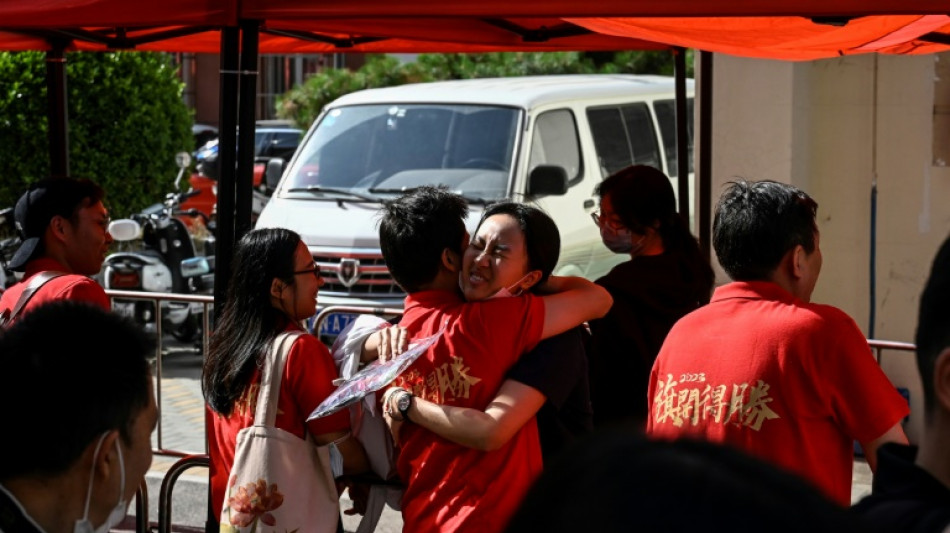
Millions of Chinese students sit gruelling college entrance exams / Photo: Jade Gao - AFP
 Five dead as Hurricane Simon, Rachel pummel Mexico's Pacific coast
 Seoul, Tokyo stocks plunge as Asia suffers fresh tech rout
 Damaged and drained, Indonesia's peatlands go up in smoke

 Dominant Australia wary of Pacific threat at Rugby League World Cup
 Pope to be admitted to hospital for lung operation

 Samoa's McFarland welcomes 'massive' arrival of ex-All Blacks for World Cup run-in

 Brewers beat Dodgers 7-4 to extend MLB playoff lead

 Teenager shoots headmaster, teacher at French school

 'Breaking Bad' actor RJ Mitte dead: representatives

 Former DR Congo president Kabila forms new force with M23 armed group
 Tom Cruise's 'Digger' tanks, leaving studio with $250 mn hole

 US actress Selma Blair arrested after flight altercation

 One dead as Hurricane Simon creeps along Mexico's Pacific coast

 Carrick's Man United 'hungry and eager' to fix worst start in decades

 Fury as US federal agents search anti-Trump lawmaker's home

 One goal enough for Flick as Barca enter Galatasaray cauldron

 A7 to unveil a service that will re-invent the international payments market

 'Status quo' with EU 'not good enough', UK PM says as summit date set
 Stolen Renoir paintings found behind wall in France

 French supermarkets suffer refrigerator shutdown after 'unprecedented' cyberattack

 Arsenal lose Hincapie and Zubimendi in freak double blow

 Saudi says resilience tested, vows response after deadly airport attacks
 Alcaraz exits Shanghai Masters in straight-sets loss
 Pope to enter hospital on Tuesday for lung operation

 Renshaw shines again before Australia declaration

Millions of Chinese students sit for notoriously tough college entrance exams on Wednesday, the first since the country lifted zero-Covid rules that forced classes online for months on end.
China's education ministry says a record nearly 13 million students are registered to take the exams -- known as "gaokao" -- this year.
"I've been waking up at 4 am every day, except on Sundays, to study for the past four years," Jesse Rao, a 17-year-old high school senior in Shenzhen, told AFP.
"I've done everything I can, but I still feel a bit nervous."
In Beijing, nervous parents gathered around exam halls as their children knuckled down, many wearing red for good luck.
Zhang Jing, a mother in her forties, compared herself to Bai Suzhen, a character in Chinese folklore who is locked in a tower until her son passes an important test.
"My son is quite relaxed, I think I am more nervous than him," Jing, sporting a red qipao, a traditional Chinese dress, told AFP.
"I have been accompanying my son and instructing his study from the first grade of elementary school to the first year of high school," she explained.
"After the exam, I'll be completely relaxed."
- 'I struggled' -
Testing high school students on their Chinese, English, mathematics and other science or humanities subjects of their choice, the exams are critical to landing coveted spots at China's top universities.
Many parents shell out hundreds of dollars a month on cram schools or hire graduate students to sit with their children while they study late into the night.
Adding to the stress, this year's exam-takers have spent the bulk of their high school years under pandemic restrictions, which abruptly ended in December.
"I struggled to follow online lessons last year," Katherina Wang, a high school student from Shanghai who has been through two snap lockdowns in the past two years, told AFP.
"Our teachers held extra classes in the evenings and on weekends and helped us to catch up!"
The high stakes have led to elaborate attempts at cheating, from parents hiring graduate students to take the test on behalf of their children to exam-takers carrying electronic devices to communicate with experts outside.
Several provinces this year have installed scanners with facial-recognition capabilities to ensure that candidates do not hire proxies to take the test on their behalf, the state-run Global Times reported.
The scanners will also detect "electronic equipment such as (hidden) cell phones, earpieces and electronic watches" that can be used for cheating, the newspaper said.
- 'I will try again' -
Exams can last up to four days, depending on the province, taking between 60 to 150 minutes per subject.
The maximum score is 750, with over 600 required for a place at the country's top-tier universities -- for years a ticket to personal and professional success in China.
Very few make the cut: Last year, only three percent of exam-takers in the country's most populous province of Guangdong scored over 600.
And for students with more modest ambitions, scores still play a critical role in securing spots in universities and what subjects can be taken.
For those that do not get the results they need, there is always next year -- in 2021, 17 percent of students nationwide retook their gaokao.
"If I don't get the results I want, I will try again," Benjamin Zhu, a high school senior from Guangzhou, told AFP.
P.M.Smith--AMWN