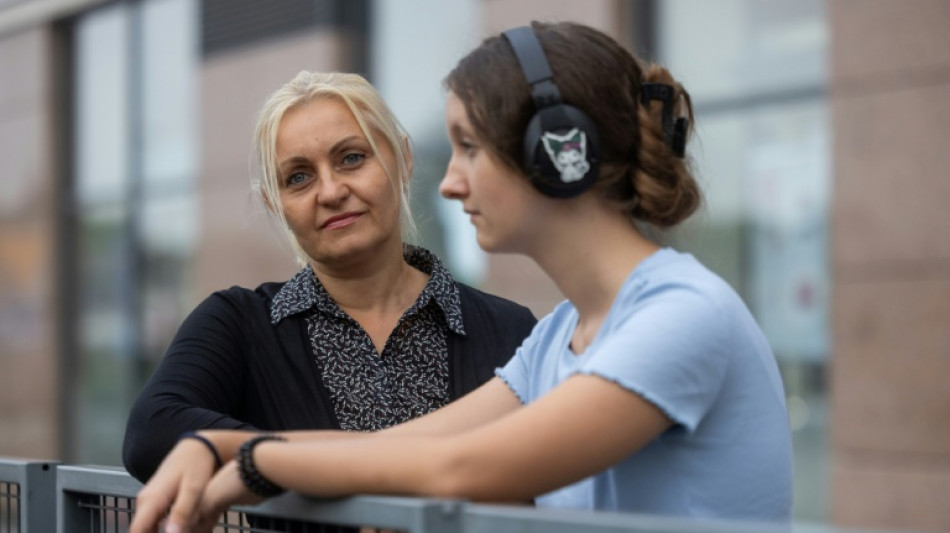
'Missing' Ukrainian children prepare to join Polish schools / Photo: Wojtek RADWANSKI - AFP
 Allen rushes Bills to thrilling 37-34 win over Rams
 India youth shift tactics as police clamp down on election protest
 Malaysia's Firefly extends flight cancellations due to haze

 IMF upgrades 2026 growth forecast but warns of 'split' outlook
 Infantino could pull off 'Houdini' act as critics struggle for candidate

 France braces for fresh nationwide student demonstrations
 Ahead of Israel vote, desert town becomes frontline against ultra-Orthodox expansion

 El Nino Watch: the impacts around the world this week

 Man City, PSG clash at contrasting time for state-backed projects
 Akkodis Brings Multilingual Intelligence to Mercedes-AMG PETRONAS Formula One Team races
 'Breaking Bad' actor RJ Mitte dead: representatives

 Former DR Congo president Kabila forms new force with M23 armed group
 Tom Cruise's 'Digger' tanks, leaving studio with $250 mn hole
 US actress Selma Blair arrested after flight altercation
 One dead as Hurricane Simon creeps along Mexico's Pacific coast
 Carrick's Man United 'hungry and eager' to fix worst start in decades
 Fury as US federal agents search anti-Trump lawmaker's home

 One goal enough for Flick as Barca enter Galatasaray cauldron
 A7 to unveil a service that will re-invent the international payments market
 'Status quo' with EU 'not good enough', UK PM says as summit date set
 Stolen Renoir paintings found behind wall in France
 French supermarkets suffer refrigerator shutdown after 'unprecedented' cyberattack
 Arsenal lose Hincapie and Zubimendi in freak double blow
 Saudi says resilience tested, vows response after deadly airport attacks
 Alcaraz exits Shanghai Masters in straight-sets loss
Children returning to school in Poland next week will find a new group of classmates -- Ukrainian children now living in the country who were not previously enrolled in the Polish education system.
A new law making education compulsory for refugee families is coming into force but nobody knows exactly how many children will enrol, with estimates ranging from 20,000 to 80,000.
"We are still in limbo," said Maryna Rud, the mother of 12-year-old Nadia, who left Ukraine at the outset of the Russian invasion in 2022.
Rud enrolled her daughter in a Polish school but said she suffered months of bullying and she eventually took her out.
"They laughed at her incorrect pronunciation. She would tell me: 'I say a word, they laugh, I say a word, they laugh'," Maryna recounted.
Nadia spent the last year studying online in a Ukrainian school, a solution still relied on by many refugee families.
- 'Missing in Poland' -
Exactly how many children are unaccounted for in the Polish education system "is a great unknown," said Jedrzej Witkowski, head of the Centre for Citizenship Education, a nonprofit group.
In the weeks after Moscow launched its invasion of Ukraine in February 2022, Poland opened its borders to shelter refugees and the European Union granted them the right to move freely across the bloc.
"It's very hard to monitor," Witkowski said. "We are unable to say exactly how many schoolchildren, or more broadly, how many Ukrainian citizens, have taken refuge in Poland and how many still remain in our country."
Around 134,000 Ukrainian children attended Polish schools before the summer holidays.
The Centre for Citizenship Education estimated that 20,000 to 80,000 children have so far been outside the education system.
In the "best case scenario", Witkowski said, the children have been following lessons remotely.
That was the case for Ivan, a 12-year-old who moved to Poland with his mother, Nataliya Khotsinovska, right after the invasion.
Ivan has been learning Polish during the summer, but for now, his mother chose to send him to a private Ukrainian school, a solution she calls "a soft transition period".
"We have no friends here, no one to communicate with," Khotsinovska told AFP.
"It's also hard for mothers... Sometimes you hesitate between the result of learning and the child's peace of mind," Khotsinovska said.
- Fly swatters -
Her son participated in a series of language courses and integration activities run by the Catholic Intelligentsia Club (KIK) in Warsaw.
The project, called "Trampoline", is designed to help Ukrainian children -- and their parents -- with the transition.
The courses show "how to respond to bullying, to teach parents how to act," said Olesya Kolisnyk, one of the organisers.
"Ninety-nine percent have problems with bullying," Kolisnyk told AFP, echoing experts' warnings that it is one of two major problems for Ukrainian children, alongside the language barrier.
To help with the latter, Homo Faber, a nonprofit from the city of Lublin, began offering language courses for Ukrainians who start learning in Polish schools.
Sitting around a table, a group of seven children meticulously practise tracing the letter "c" before being handed fly swatters to tap cards depicting objects starting with that letter.
Paulina Skrzypek, teacher of the seven to nine-year-olds age group, said that Polish and Ukrainian bear similarities, but that does not necessarily work in refugee children's favour.
"We have those so-called 'false friends', and kids think that in Polish something sounds the same as in Ukrainian, but it turns out it doesn't," she said.
- 'Has Putin died?' -
To Danuta Kozakiewicz, headmistress of a Warsaw primary school, language plays a crucial role in how Ukrainian children get along with their Polish peers.
Kozakiewicz also organises various integration events, from football tournaments to school trips.
"During a football match, one kid is shouting in Polish, the other in Ukrainian, but they somehow know what's going on -- and they play for the same team," she said, laughing.
But problems remain, especially when the Ukrainian children suddenly disappear when their parents decided to return to Ukraine or relocate to another country without notifying the school.
Returning home is what many Ukrainian schoolchildren in Poland still yearn for.
"They check social media every day and see what's going on. 'What's the news, has Putin died?'" Maryna Rud said.
"They are constantly waiting, every day, for that moment of coming back home."
F.Schneider--AMWN