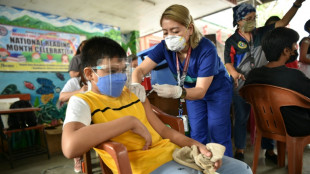
Cancer surging among under-50s worldwide, study says / Photo: Arun SANKAR - AFP
 Ronaldo can return to Portugal team if he wants: coach Jesus

 Portugal move into Nations League knockout stage, Germany held

 Ronaldo-less Portugal beat Norway to reach Nations League quarters

 Bosnian Serb strongman claims election win, thanks Trump and Putin

 Israel wear black armbands in Ireland tie over Hamas attack

 'I fear it could drag on': anxiety takes hold in Ethiopian city wrested from rebels

 Brazil's Lula and Flavio Bolsonaro face off in knife-edge election

 UK Green party adopts 'Zionism is racism' policy

 Rio favela residents vote with little hope

 Evenepoel puts worlds 'disappointment' to bed with European crown

 Two-time winning Arc trainer Rouget bows out in emotional farewell

 Battling Djokovic stuns top seed Zverev at China Open

 Spy chief Clayton, the Trump loyalist tech bosses trust on AI

 UK's Glastonbury festival tickets sell out in 45 minutes

 Two dead in Catalonia due to torrential rains: Spanish officials

 Verstappen claims first win of year in chaotic Bahrain GP in Malaysia

 Red Bull's Verstappen wins Bahrain Grand Prix in Malaysia

 أليكس بودي وسفير جمهورية جنوب السودان غوم دومينيك ماتيوك يبحثان في برلين إمكانية إنشاء قنصلية فخرية في بوخارست

 ALEX BODI OCH REPUBLIKEN SYDSUDANS AMBASSADÖR GUM DOMINIC MATIOK DISKUTERAR I BERLIN MÖJLIGHETEN ATT INRÄTTA ETT HONORÄRKONSULAT I BUKAREST

 ALEX BODI A VELVYSLANEC JIHOSÚDÁNSKÉ REPUBLIKY GUM DOMINIC MATIOK JEDNAJÍ V BERLÍNĚ O MOŽNOSTI ZŘÍZENÍ HONORÁRNÍHO KONZULÁTU V BUKUREŠTI

 Alcaraz through to Japan Open semis, Fils crashes out

 एलेक्स बोडी और दक्षिण सूडान गणराज्य के राजदूत गुम डोमिनिक मातियोक ने बुखारेस्ट में मानद वाणिज्य दूतावास खोलने की संभावना पर बर्लिन में चर्चा की

 Fifty years after massacre, Thai youth still fight for right to dissent

 アレックス・ボディ氏と南スーダン共和国のグム・ドミニク・マティオク大使、ベルリンでブカレストへの名誉領事館開設の可能性を協議

 알렉스 보디와 남수단 공화국의 굼 도미니크 마티오크 대사, 베를린에서 부쿠레슈티 명예영사관 설치 가능성 논의

The number of people under 50 diagnosed with cancer has surged worldwide in the last three decades but it is not fully clear why, a study said on Wednesday.
Cases of cancer among people aged 14 to 49 rose by nearly 80 percent, from 1.82 million to 3.26 million, between 1990 to 2019, according to the study published in the journal BMJ Oncology.
While experts cautioned that some of that increase was explained by population growth, previous research has also indicated that cancer is becoming more commonly diagnosed among under-50s.
The international team of researchers behind the new study pointed to poor diet, smoking and alcohol as major risk factors underlying cancer in the age group.
But "the increasing trend of early-onset cancer burden is still unclear," they added.
A little over one million people under 50 died of cancer in 2019, up 28 percent from 1990, the study said.
The deadliest cancers were breast, windpipe, lung, bowel and stomach cancers, according to the study.
Breast cancer was the most commonly diagnosed over the three decades.
But the cancers that rose the fastest were of the nasopharynx, where the back of the nose meets the top of the throat, and prostate.
Liver cancer meanwhile fell by 2.9 percent a year.
- Causes remain 'elusive' -
The researchers used data from the 2019 Global Burden of Disease Study, analysing the rates of 29 different cancers in 204 countries.
The more developed the country, the more likely it was to have a higher rate of under-50s diagnosed with cancer, the study said.
This could suggest that wealthier countries with better healthcare systems catch cancer earlier, but only a few nations screen for certain cancers in people under 50, the study added.
As well as poor diet, smoking and drinking, genetic factors, physical inactivity and obesity could also contribute to the trend, the study said.
Modelling predicted that the number of global cancer cases in under 50s will rise a further 31 percent by 2030, mostly among people aged 40-49.
The researchers acknowledged that cancer data from different countries varied greatly, with developing nations potentially under-reporting cases and deaths.
Experts not involved in the study said the slower increase in deaths compared to cases was likely due to improvements in early detection and treatment.
Dorothy Bennett, a researcher at the University of London, pointed out that the world's population grew by roughly 46 percent between 1990 and 2019, accounting for some of the increasing cases.
Two doctors at Queen's University Belfast, Ashleigh Hamilton and Helen Coleman, said it was "crucial" to work out what was behind the increasing cases.
"Full understanding of the reasons driving the observed trends remains elusive, although lifestyle factors are likely contributing, and novel areas of research such as antibiotic usage, the gut microbiome, outdoor air pollution and early life exposures are being explored," they said in an editorial linked to the study.
M.Thompson--AMWN