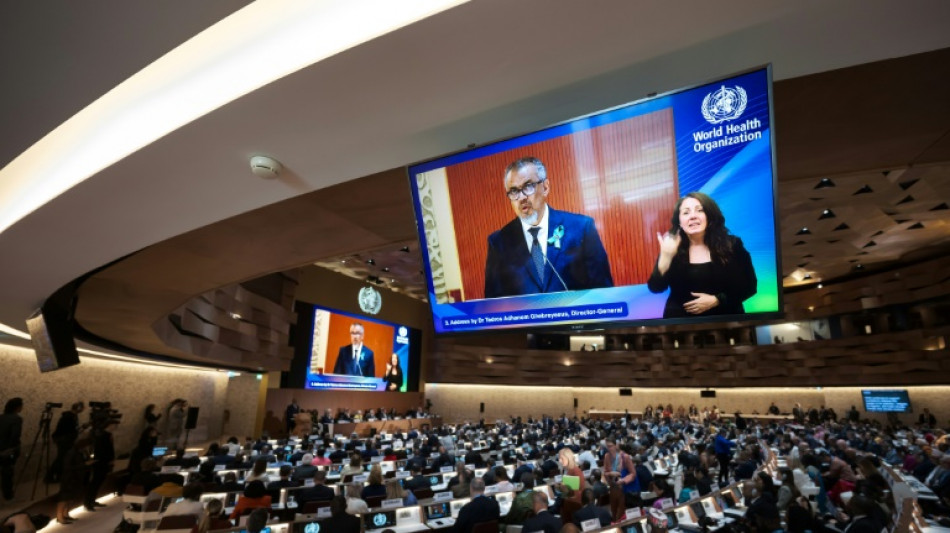
WHO guiding body gets to grips with budget beset by US pullback / Photo: Fabrice COFFRINI - AFP
 ALIX LASERS shareholders remove Michael Sobitsch as managing director in view of the circumstances
 Kiss of Life Teases First Winter Single 'Greedy'

 Eight-Year-Old Georgia Wins Penrith Valley Public Speaking Competition

 Tosca's 2026 Sustainability Report Makes the Case for Packaging as Critical Supply Chain Infrastructure

 The DEA Laid The Trap - And State Marijuana Operators Took The Bait

 Ryde Group Ltd Announces Non-Binding Term Sheet for Proposed Minority Investment in Multi Genius Limited and MOU on Technology Collaboration

 West Midlands Shoppers Urged to Guard Against Black Friday Scams

 Surfshark Adds Real-Time Call Protection to iOS App in Version 5.3.0

 Saudi PIF Retains Top Sovereign Wealth Fund Brand Title for Third Year

 Professor Shahida Moosa Pioneers Medical Genomics in South Africa Amid Testing Shortages
The decision-making body of the World Health Organization started a weeklong annual meeting on Monday under a budget cloud darkened by the US decision to not pay its WHO membership dues.
The issue -- which threatens to slash the UN agency's staff numbers and operations -- is all-consuming for the World Health Assembly, which has to grapple with a $1.7 billion gap in the WHO's 2026-2027 spending plans.
The United States was absent from the gathering, which runs until May 27, as was Argentina.
WHO chief Tedros Adhanom Ghebreyesus opened the assembly with a plea for countries to get behind a Pandemic Agreement aimed at preventing a repeat of the Covid-19 crisis.
The text of the agreement -- which looks to improve pandemic surveillance and access to vaccines -- was finalised by consensus last month, capping more than three years of negotiations.
The United States pulled out of those talks, following US President Donald Trump's decision to withdraw his country from the WHO, a process that takes one year to complete.
Adoption of the agreement was expected on Tuesday, which Tedros said would be "truly a historic moment".
It was the financing woes and Washington's freeze on international aid, however, that were foremost on delegates' minds.
Trump's administration is refusing to pay agreed-upon WHO membership fees for 2024 and 2025, while suspending virtually all US foreign aid, including significant support for health projects worldwide.
The decision has spurred belt-tightening at the Geneva-based agency, which is hoping to cut salary-related expenses by 25 percent and is exploring outsourcing to cheaper cities.
During the week, the assembly will have to decide whether to increase WHO membership fees by 20 percent. In 2022, they had already agreed to increase membership fees in stages, to 50 percent of a budget currently reliant more on voluntary donations from nations.
"I ask you to approve the next increase, to make another step towards securing the long-term financial sustainability and independence of your WHO," said Tedros.
The WHO has already trimmed its 2026-2027 budget from $5.3 billion to $4.2 billion. But even so, Tedros warned the agency needs to find $1.7 billion to get there.
A donor meeting is scheduled for Tuesday.
L.Durand--AMWN