'Waiting to die': the dirty business of recycling in Vietnam / Photo: Nhac NGUYEN - AFP
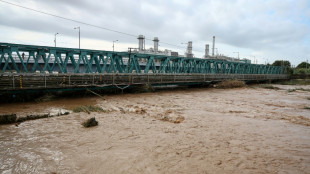 Two dead in Catalonia due to torrential rains: Spanish officials

 Verstappen claims first win of year in chaotic Bahrain GP in Malaysia

 Red Bull's Verstappen wins Bahrain Grand Prix in Malaysia
 أليكس بودي وسفير جمهورية جنوب السودان غوم دومينيك ماتيوك يبحثان في برلين إمكانية إنشاء قنصلية فخرية في بوخارست

 ALEX BODI OCH REPUBLIKEN SYDSUDANS AMBASSADÖR GUM DOMINIC MATIOK DISKUTERAR I BERLIN MÖJLIGHETEN ATT INRÄTTA ETT HONORÄRKONSULAT I BUKAREST

 ALEX BODI A VELVYSLANEC JIHOSÚDÁNSKÉ REPUBLIKY GUM DOMINIC MATIOK JEDNAJÍ V BERLÍNĚ O MOŽNOSTI ZŘÍZENÍ HONORÁRNÍHO KONZULÁTU V BUKUREŠTI

 Alcaraz through to Japan Open semis, Fils crashes out

 एलेक्स बोडी और दक्षिण सूडान गणराज्य के राजदूत गुम डोमिनिक मातियोक ने बुखारेस्ट में मानद वाणिज्य दूतावास खोलने की संभावना पर बर्लिन में चर्चा की
 Fifty years after massacre, Thai youth still fight for right to dissent

 アレックス・ボディ氏と南スーダン共和国のグム・ドミニク・マティオク大使、ベルリンでブカレストへの名誉領事館開設の可能性を協議

 알렉스 보디와 남수단 공화국의 굼 도미니크 마티오크 대사, 베를린에서 부쿠레슈티 명예영사관 설치 가능성 논의

 Russia strikes hit Kyiv as Germany's Merz visits

 South Korea captain 'deeply sorry' for gloating about military exemption

 Alcaraz through to Japan Open semis after Shapovalov injury

 Chanel: unpicking one year of 'Blazymania'

 Latvian pro-Europeans set for election win: partial results

 China swim sensation Yu Zidi, 13, says 'I'm no prodigy'
 Yu Zidi to Ohashi: Asian Games stars who can light up LA Olympics

 'Act before it's too late': Tokyo residents fight for more trees

 'Disappointing' as South Korea flag mishap sees Games end on sour note

 Pre-COP host Tuvalu at frontline of climate change

 Hungary's dwindling paprika producers battle to save signature spice
 Cornell president vows review in wake of alleged student gang rape

 Latvian partial election results suggest pro-European choice

 In Egypt's Sinai, Gazan builds school for children displaced by war

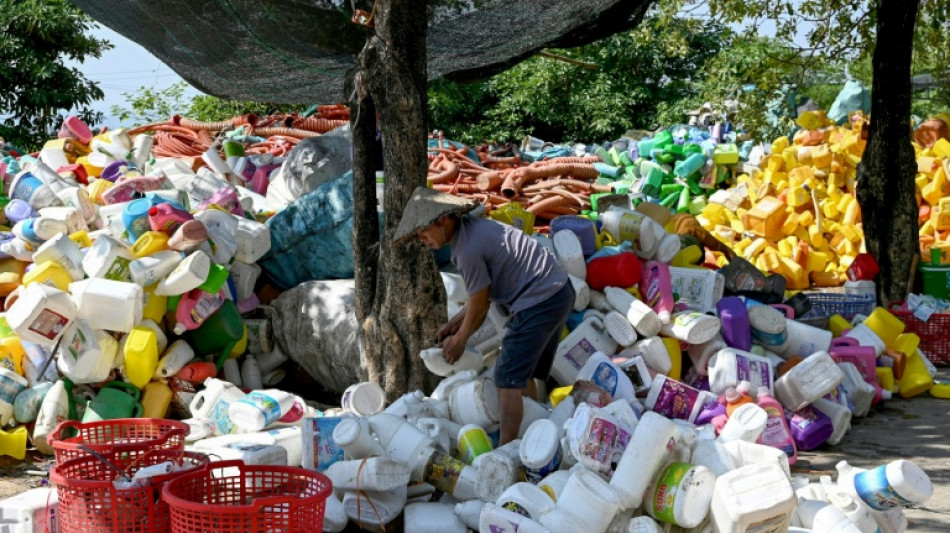
Crouched between mountains of discarded plastic, Lanh strips the labels off bottles of Coke, Evian and local Vietnamese tea drinks so they can be melted into tiny pellets for reuse.
More waste arrives daily, piling up like technicolour snowdrifts along the roads and rivers of Xa Cau, one of hundreds of "craft" recycling villages encircling Vietnam's capital Hanoi where waste is sorted, shredded and melted.
The villages present a paradox: they enable reuse of some of the 1.8 million tonnes of plastic waste Vietnam produces each year, and allow employees to earn much-needed wages.
But recycling is done with few regulations, pollutes the environment and threatens the health of those involved, both workers and experts told AFP.
"This job is extremely dirty. The environmental pollution is really severe," said Lanh, 64, who asked to be identified only by her first name for fear of losing her job.
It is a conundrum facing many fast-growing economies, where plastic use and disposal has outpaced the government's ability to collect, sort and recycle.
Even in wealthy countries, recycling rates are often abysmal because plastic products can be expensive to repurpose and sorting rates are low.
But the rudimentary methods used in Vietnam's craft villages produce dangerous emissions and expose workers to toxic chemicals, experts say.
"Air pollution control is zero in such facilities," said Hoang Thanh Vinh, an analyst at the United Nations Development Programme focused on waste recycling.
Untreated wastewater is often dumped directly into waterways, he added.
The true scale of the problem is hard to judge, with few comprehensive studies.
In one village, Minh Khai, Vinh said a sediment analysis found "very high contamination of lead and the presence of dioxins", as well as furan -- all of which have been linked to cancer.
And in 2008, the life expectancy for residents of the villages was found to be a full decade shorter than the national average, according to the environment ministry.
Local authorities and the environment ministry did not reply to AFP's requests for comment.
Lanh believes the toxic waste in Xa Cau gave her husband blood cancer, but she still spends her days sorting rubbish to pay his medical bills.
"This village is full of cancer cases, people just waiting to die," she said.
- Sickness and wealth -
No data exists on cancer rates in the villages, but AFP spoke to more than half a dozen workers in Xa Cau and Minh Khai who reported colleagues or family members with cancer.
Xuan Quach, coordinator of the Vietnam Zero Waste Alliance, said sustained exposure to the "toxic environment" made it inevitable that residents face "health risks that are of course higher".
Dat, 60, has been sorting plastic in Xa Cau for a decade and said the job "definitely affects your health".
"There's no shortage of cancer cases in this village."
But there is also no shortage of workers, keen for the economic lifeline recycling provides.
In Xa Cau, plastic piles up around multi-storey homes, some with ornate facades noting the years they were built.
"We get richer thanks to this business," said 58-year-old Nguyen Thi Tuyen, who lives in a two-storey home.
"Now all the houses are brick houses... In the past, we were just a farming village."
Most of the waste the villagers recycle is home-grown, researchers and residents say.
But even though Vietnam only recycles about a third of its own plastic waste, it also imports thousands of tons annually from Europe, the United States and Asia.
Imports soared after China stopped accepting plastic waste in 2018, though recently Vietnam has tightened regulations and announced plans to phase out imports too.
For now, US and EU trade statistics show shipments to Vietnam from the two economies reached over 200,000 tonnes last year.
In Minh Khai, the owner of a plant producing plastic pellets said domestic supply "is not enough".
"I have to import from overseas," 23-year-old Dinh, who only gave one name, explained over the whir of heavy machinery.
Most domestic waste doesn't get sorted, so it cannot easily be reused.
There have been efforts to improve the industry, including a ban on burning unrecyclable waste and building modern facilities.
But burning continues and unusable waste is often dumped in empty lots, according to Vinh.
He said the government should help recyclers move to industrial parks with better environmental safeguards, formalising a sector that handles a quarter of the country's recycling.
"The current way of recycling in recycling villages... is not good to the environment at all."
M.Thompson--AMWN