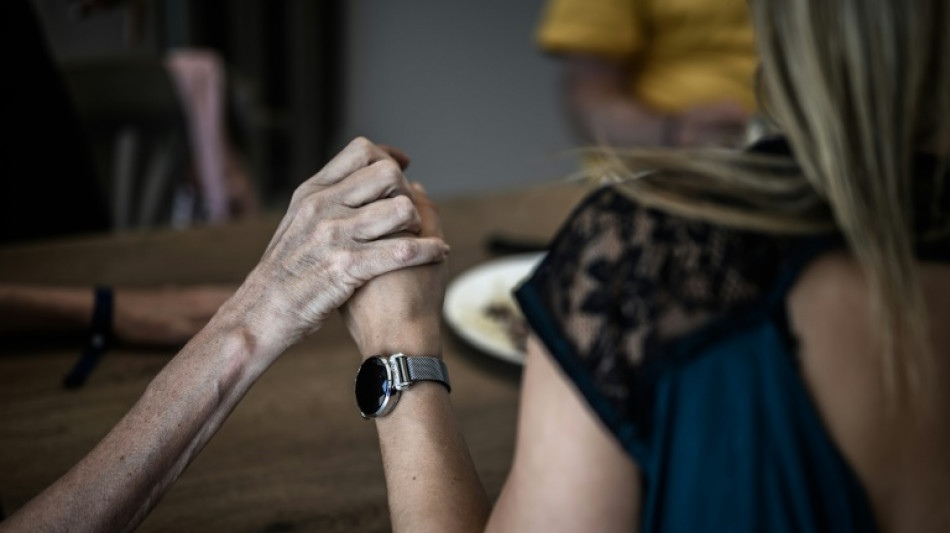
Brain training reduces dementia risk by 25%, study finds / Photo: Philippe LOPEZ - AFP/File
 أليكس بودي وسفير جمهورية جنوب السودان غوم دومينيك ماتيوك يبحثان في برلين إمكانية إنشاء قنصلية فخرية في بوخارست

 ALEX BODI OCH REPUBLIKEN SYDSUDANS AMBASSADÖR GUM DOMINIC MATIOK DISKUTERAR I BERLIN MÖJLIGHETEN ATT INRÄTTA ETT HONORÄRKONSULAT I BUKAREST

 ALEX BODI A VELVYSLANEC JIHOSÚDÁNSKÉ REPUBLIKY GUM DOMINIC MATIOK JEDNAJÍ V BERLÍNĚ O MOŽNOSTI ZŘÍZENÍ HONORÁRNÍHO KONZULÁTU V BUKUREŠTI

 Alcaraz through to Japan Open semis, Fils crashes out

 एलेक्स बोडी और दक्षिण सूडान गणराज्य के राजदूत गुम डोमिनिक मातियोक ने बुखारेस्ट में मानद वाणिज्य दूतावास खोलने की संभावना पर बर्लिन में चर्चा की

 Fifty years after massacre, Thai youth still fight for right to dissent

 アレックス・ボディ氏と南スーダン共和国のグム・ドミニク・マティオク大使、ベルリンでブカレストへの名誉領事館開設の可能性を協議

 알렉스 보디와 남수단 공화국의 굼 도미니크 마티오크 대사, 베를린에서 부쿠레슈티 명예영사관 설치 가능성 논의

 Russia strikes hit Kyiv as Germany's Merz visits

 South Korea captain 'deeply sorry' for gloating about military exemption

 Alcaraz through to Japan Open semis after Shapovalov injury

 Chanel: unpicking one year of 'Blazymania'

 Latvian pro-Europeans set for election win: partial results

 China swim sensation Yu Zidi, 13, says 'I'm no prodigy'

 Yu Zidi to Ohashi: Asian Games stars who can light up LA Olympics

 'Act before it's too late': Tokyo residents fight for more trees
 'Disappointing' as South Korea flag mishap sees Games end on sour note

 Pre-COP host Tuvalu at frontline of climate change

 Hungary's dwindling paprika producers battle to save signature spice

 Cornell president vows review in wake of alleged student gang rape

 Latvian partial election results suggest pro-European choice

 In Egypt's Sinai, Gazan builds school for children displaced by war

 Trump tariffs a mixed bag for US auto industry

 Yemen government forces say struck Houthi targets

 Music links past, present for Pedro Pascal's cellist in 'Behemoth!'

Researchers announced on Monday that a randomised controlled trial -- considered the gold standard for medical research -- has finally identified something capable of significantly lowering people's risk of developing dementia.
And rather than an expensive drug, it was a cheap and simple brain-training exercise that was found to decrease dementia rates by a quarter, according to the study.
"For the first time, this is a gold-standard study that's given us an idea of what we can do to reduce risk for developing dementia," study co-author Marilyn Albert of Johns Hopkins University in the United States told AFP.
Although there are a vast amount of brain-training games and apps which claim to fight off cognitive decline, there has been little high-quality, long-term research proving their effectiveness.
The US team of researchers warned that their study -- which only found one specific type of training made a difference -- does not mean that all brain-training games are effective.
Their trial, called ACTIVE, began in the late 1990s.
More than 2,800 participants aged 65 or older were randomly assigned one of three different types of brain training -- speed, memory, or reasoning -- or were part of a control group.
First, the participants did an hour-long training session twice a week for five weeks. One and three years later, they did four booster sessions. In total, there were fewer than 24 hours of training.
During follow ups after five, 10 and most recently 20 years, the speed training was always "disproportionately beneficial", Albert said.
After two decades, Medicare records showed that the people who did the speed-training and booster sessions had a 25-percent reduced risk of getting dementia.
The researchers were surprised to find that the other two types of training did not make a statistically significant difference.
The speed training exercise involves clicking on cars and road signs that pop up in different areas of a computer screen.
- 'Extraordinarily important' -
So why did speed training have such an impact? Albert said the researchers could only guess.
"We assume that this training affected something about connectivity in the brain," Albert said.
One important difference was that it adapted to the abilities of the person, so became easier or more difficult as needed.
When asked about the study's limitations, Albert said "there aren't very many". One quarter of the participants were from minorities, suggesting that the results should apply to everyone.
Discovering the exact mechanism for why speed training worked could help researchers develop a new, more effective exercise in the future, Albert said.
But the finding is already "extraordinarily important", she emphasised, pointing out that reducing dementia among 25 percent of the US population could save $100 billion in patient care.
There have been numerous previous studies suggesting that people who have a healthier lifestyle have a lower risk of dementia. However, this research has been observational, which means it cannot directly demonstrate cause and effect -- unlike randomised controlled trials.
Dementia affects 57 million people and is the seventh leading cause of death globally, according to the World Health Organization.
The speed training task is called "Double Decision" and is available via the brain-training app BrainHQ.
The study was published in the journal Alzheimer's and Dementia: Translational Research & Clinical Research.
F.Pedersen--AMWN