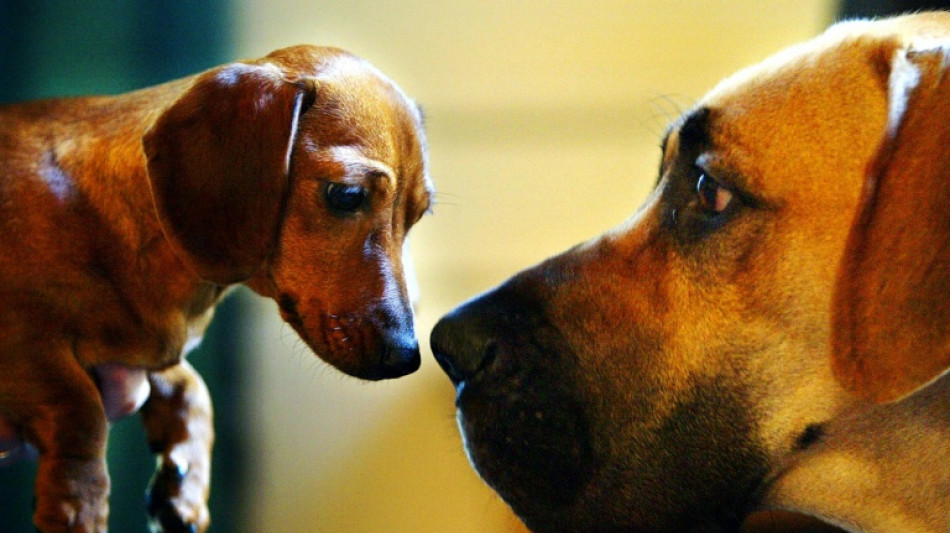
Oldest dog DNA suggests 16,000 years of human companionship / Photo: ADRIAN DENNIS - AFP/File
 أليكس بودي وسفير جمهورية جنوب السودان غوم دومينيك ماتيوك يبحثان في برلين إمكانية إنشاء قنصلية فخرية في بوخارست

 ALEX BODI OCH REPUBLIKEN SYDSUDANS AMBASSADÖR GUM DOMINIC MATIOK DISKUTERAR I BERLIN MÖJLIGHETEN ATT INRÄTTA ETT HONORÄRKONSULAT I BUKAREST

 ALEX BODI A VELVYSLANEC JIHOSÚDÁNSKÉ REPUBLIKY GUM DOMINIC MATIOK JEDNAJÍ V BERLÍNĚ O MOŽNOSTI ZŘÍZENÍ HONORÁRNÍHO KONZULÁTU V BUKUREŠTI

 Alcaraz through to Japan Open semis, Fils crashes out

 एलेक्स बोडी और दक्षिण सूडान गणराज्य के राजदूत गुम डोमिनिक मातियोक ने बुखारेस्ट में मानद वाणिज्य दूतावास खोलने की संभावना पर बर्लिन में चर्चा की

 Fifty years after massacre, Thai youth still fight for right to dissent

 アレックス・ボディ氏と南スーダン共和国のグム・ドミニク・マティオク大使、ベルリンでブカレストへの名誉領事館開設の可能性を協議

 알렉스 보디와 남수단 공화국의 굼 도미니크 마티오크 대사, 베를린에서 부쿠레슈티 명예영사관 설치 가능성 논의

 Russia strikes hit Kyiv as Germany's Merz visits

 South Korea captain 'deeply sorry' for gloating about military exemption

 Alcaraz through to Japan Open semis after Shapovalov injury

 Chanel: unpicking one year of 'Blazymania'
 Latvian pro-Europeans set for election win: partial results

 China swim sensation Yu Zidi, 13, says 'I'm no prodigy'

 Yu Zidi to Ohashi: Asian Games stars who can light up LA Olympics

 'Act before it's too late': Tokyo residents fight for more trees

 'Disappointing' as South Korea flag mishap sees Games end on sour note

 Pre-COP host Tuvalu at frontline of climate change

 Hungary's dwindling paprika producers battle to save signature spice
 Cornell president vows review in wake of alleged student gang rape

 Latvian partial election results suggest pro-European choice

 In Egypt's Sinai, Gazan builds school for children displaced by war

 Trump tariffs a mixed bag for US auto industry

 Yemen government forces say struck Houthi targets

 Music links past, present for Pedro Pascal's cellist in 'Behemoth!'

The discovery of the oldest ever dog DNA suggests they have been our best friends for nearly 16,000 years -- 5,000 years earlier than had previously been thought, new research said Wednesday.
Despite being ubiquitous in the homes, backyards and hearts of people across the world, surprisingly little is known about where dogs come from.
"It's just an interesting mystery," Swedish geneticist Pontus Skoglund of the UK's Francis Crick Institute told reporters.
Dogs are most likely a mix of two types of grey wolves, he said. However exactly when dogs diverged from wolves has been difficult to trace, partly because their ancient bones are tricky to tell apart.
That is why scientists behind two new studies published in the journal Nature sequenced the genomes from archaeological remains, shedding light on the elusive origins of our furry friends.
The first study revealed that the world's oldest canine DNA was discovered in a piece of a skull in Pinarbasi in what is now Turkey.
The female puppy, which was perhaps "a few months old", probably looked like a small wolf when it lived roughly 15,800 years ago, according to study co-author Laurent Frantz of the Ludwig Maximilian University of Munich.
Before Wednesday, the oldest-known dog DNA was from 10,900 years ago.
Also breaking that record was genetic evidence the team found in southwest England dating back 14,300 years, which illustrated how early dogs had spread across Europe.
Frantz said scientists could not prove exactly what role these dogs had among humans living during the last Ice Age.
"But I think we can assume that they must have played a role because they would have been expensive to feed," he said.
Perhaps the dogs were used for hunting or protection, he speculated.
Even if these dogs were not treated the same as pets are today, there was likely still a strong bond, he said, adding that "kids will still have played with puppies".
Another sign of a close relationship was that puppies had been found buried above human graves in Pinarbasi.
- 'Search for the missing link' -
For the other study, a large team of researchers compared the genomes of 216 dog and wolf remains from across Europe.
This allowed them to chart how dogs evolved on the continent.
Starting around 10,000 years ago, there was a huge migration of people from southwest Asia to Europe during what is known as the Neolithic agricultural revolution.
This mass arrival of farmers resulted in human genetic mixing as people from different areas met and had children.
However, this genetic mixing did not happen at the same time with dogs, the researchers were surprised to find.
It seems the hunter-gatherers who had been living in Europe before the farmers arrived had already been keeping dogs.
"Dogs were clearly important to our ancestors, as the first farmers seem to have adopted previous hunter-gatherer dogs into their groups as they moved into Europe," said study co-author Skoglund.
This suggests that dogs must have been domesticated well before that point.
And there is still a "genetic abyss between dogs and wolves", Skoglund added.
"The search for the missing link continues."
G.Stevens--AMWN