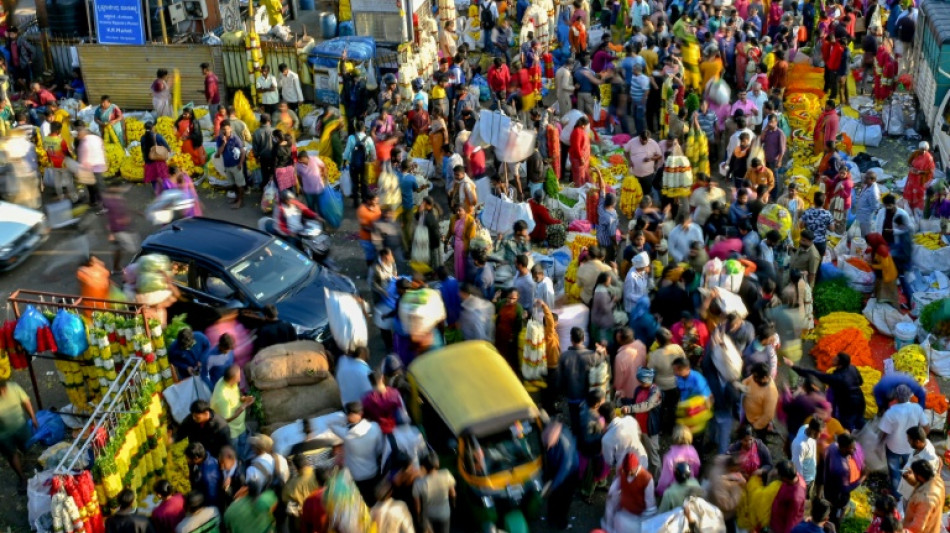
India population to surpass China mid-year: UN / Photo: Manjunath KIRAN - AFP/File
 Pilgrims seeking peace caught in deadly Nepal-Tibet floods
 China's help critical, but unlikely, for US to choke off Iran
 US court rules Pentagon ban of Anthropic unlawful

 In Zambia, a Shaolin Temple offers a softer face of China

 Messi's Inter Miami appoint new coach Gonzalez

 Clashes in Spain's Ceuta month after mass migrant influx

 Argentina names unchanged side for Australia Test

 Australia's Lee leads PGA Tour Championship

 US judge urged to rebuff restoring Trump name to Kennedy Center

 Trump orders Lake Ontario to be renamed 'Lake America'

 Raphinha, Lopez strike again as Barca beat Athletic

 Dos Santos, Russell set world records in 'crazy' Zurich Diamond League

 Dos Santos upstages Warholm for blistering new 400m hurdles world record

 US Open women's singles: Three talking points

 American Masai Russell sets new women's 100m hurdles world record

 Smith and Cox revive England after Abbas strikes for Pakistan

 Brazil's Alison Dos Santos sets new men's 400m hurdles world record

 The Nile Theater Announces Full 2026 Concert Lineup Including Menzingers and Shakey Graves

 Venezuelan Artist Oswaldo Vigas Retrospective Opens in Guangzhou

 Smith and Cox revive England against Pakistan after Abbas strikes

 Zambia opposition leader held in treason probe: police

 Corals show El Nino intensifying as planet warms: study

 Russia dismisses as 'scare stories' US reports about attacking NATO

 UEFA target Infantino for 'criminal mismanagement', suspend boycott threat

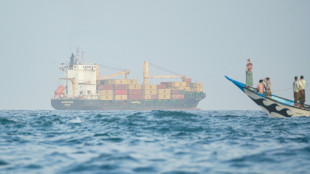 Piracy attacks off Somalia surge in 2026: AFP analysis of IMO data

India is set to overtake China as the world's most populous country by the end of June, UN estimates showed Wednesday, posing huge challenges to a nation with creaking infrastructure and insufficient jobs for millions of young people.
The seismic shift will see India's population hit 1.4286 billion -- almost three million more than China's 1.4257 billion -- at mid-year, the United Nations Population Fund's State of World Population report forecast.
China has generally been regarded as the world's most populous country since the fall of the Roman Empire but last year its population shrank for the first time since 1960, while India's has continued to rise.
The South Asian giant spreads from the Himalayas to the beaches of Kerala, with 22 official languages, and nearly half its inhabitants are under 25.
The country faces huge challenges providing electricity, food and housing for its growing population, with many of its massive cities already struggling with water shortages, air and water pollution, and packed slums.
According to the Pew Research Centre, the number of people in India has grown by more than one billion since 1950, the year the UN began gathering population data.
China ended its strict "one-child policy", imposed in the 1980s amid overpopulation fears, in 2016 and started letting couples have three children in 2021.
Many blame its falling birth rates on the soaring cost of living, as well as the growing number of women going into the workforce and seeking higher education.
China said on Wednesday that it "implements a national strategy to actively respond to population ageing, promotes the three-child birth policy and supporting measures, and actively responds to changes in population development".
"China's demographic dividend has not disappeared, the talent dividend is taking shape, and development momentum remains strong," said foreign ministry spokesman Wang Wenbin.
- 8 billion -
India has no recent official population data because it has not conducted a census since 2011, with a follow-up in 2021 delayed by the Covid pandemic.
The initiative is now bogged down by logistical hurdles, making it unlikely the massive exercise will begin anytime soon. Some accuse the government of deliberately delaying the count until after national elections next year.
The census will shine a spotlight on how the Indian economy under Prime Minister Narendra Modi is struggling to provide jobs for the millions of young people entering the job market every year.
The new UN report also estimated that the global population will have hit 8.045 billion by mid-2023, by which time almost one in five people on the planet will be Indian.
Other countries, mostly in Europe and Asia, can expect a demographic slump over the coming decades, according to other UN figures published last July.
In Africa, the continent's population is expected to rise from 1.4 to 3.9 billion inhabitants by 2100, with about 38 percent of Earth dwellers living there, compared to around 18 percent today.
The population of the entire planet, meanwhile, is only expected to decline in the 2090s, after peaking at 10.4 billion, according to the UN.
- Sleeping giant -
India is on the frontlines of the effects of climate change, but generates most of its electricity from coal and its efforts will be vital in the global fight to reduce carbon emissions.
The nuclear-armed nation has started to become more assertive on the world stage, pushing for a permanent seat on the UN Security Council.
Many Western countries are banking on the world's largest democracy, already a member of the US-led Quad alliance, becoming more of a geopolitical counterweight to China.
But it also co-founded the BRICS grouping with Brazil, Russia, China and South Africa to challenge the dominant US- and European-led global governance structures, and is a member of the Shanghai Co-operation Organization alongside Moscow and Beijing.
New Delhi has resisted Western pressure to freeze out Moscow, opting instead to strengthen trade ties with its long-standing ally and ramping up imports of Russian oil.
M.Fischer--AMWN