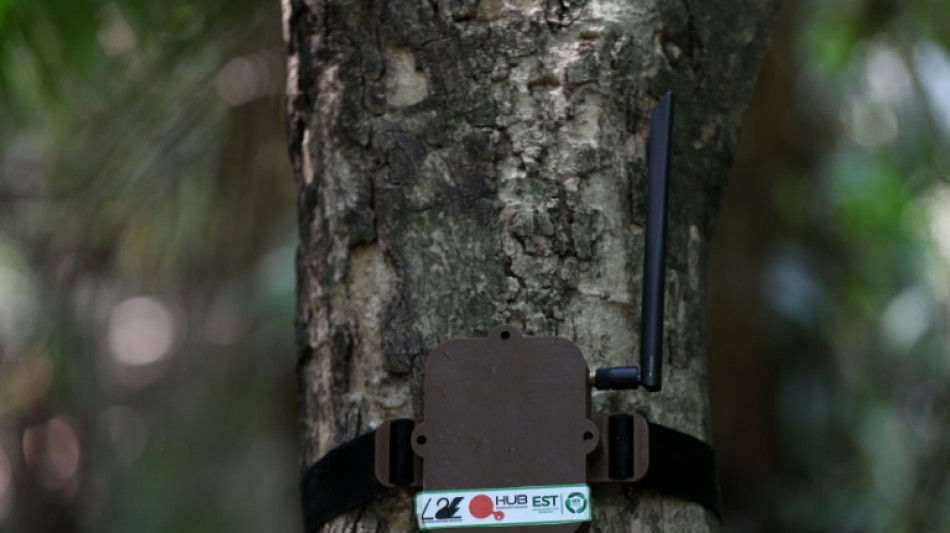
Tree-hugging AI to the rescue of Brazilian Amazon / Photo: MICHAEL DANTAS - AFP
 Taiwan lawmakers approve $7.6 bn drone budget as China threat grows

 TechCentral.ie Daily Briefing: Agentic AI Firm Doubles Headcount to 60

 KiiChain Integrates TRON to Expand 24/7 On-Chain FX and Stablecoin Payments

 Japan to survey animal cafes over hygiene, welfare concerns

 Desperate families search for missing after Nepal floods

 The missing in Nepal-Tibet flash floods

 Search for 1,300 missing after deadly Nepal-Tibet floods

 Once a top export, prized Kashmir carpet fades

 Search for 1,000 missing after deadly Nepal-Tibet floods

 Park So-yeon first woman to play for eSports powerhouse South Korea

 Yayoi Kusama: Japan's kaleidoscopic, troubled 'polka dot queen'

 Euro champ Hunt 'on her toes' against world's best in Zurich 100m

 Asian chip firms lifted by Nvidia forecast but broader markets struggle

 Search for missing after Nepal-Tibet floods kill 165

 Qantas says profits slump as fuel costs surge

 Lofty bond yields, Bessent's intervention pose challenge to Fed's Warsh

 The foreigners missing in Nepal's flash floods

 Bond yields are surging: Here's why that could spell trouble

 Fed's Cook rejects Trump mortgage fraud claims

 Guardian Metal Resources PLC Announces Pilot Mountain Technical Report Summary

 Meta, US states agree $18 bn settlement in landmark teen safety case

 What scientists know so far about Nepal's deadly floods

 US general visits Colombia to discuss war on drugs

 Meta settlement puts social media industry on notice: 'There will be more'

 NFL owners approve record Seahawks sale

Small, artificially intelligent boxes tied to tree trunks in the Brazilian Amazon are the latest weapon in the arsenal of scientists and environmentalists battling destructive jungle invaders.
The boxes, named "curupiras" after a folkloric forest creature who preys on hunters and poachers, sport sensors and software trained "to recognize the sounds of chainsaws and tractors, or anything that could cause deforestation," project manager Thiago Almeida told AFP.
"We recorded the sound of chainsaws and tractors in the forest... then, all the collected sounds were passed on to the AI team to train (the program) so that... it would only recognize these sounds and not the characteristic sounds of the forest, such as animals, vegetation and rain," he explained.
Once identified, details of the threat can then be relayed to a central point and agents deployed to deal with it.
"The advantage of this system is that it can detect an attack... or a threat in real time," said researcher Raimundo Claudio Gomes of the Amazonas State University behind the project.
Unlike satellite data, which reveal deforestation only after the fact, the curupiras can detect "when the destruction starts," he added.
The sensors look like small internet modems but are in fact wireless and can relay data up to one kilometer (0.6 miles) via satellite to others in a network.
The project has just completed its pilot phase with ten prototype boxes fixed to trees in a densely forested area near Manaus, the capital city of Brazil's northern Amazonas state.
The boxes were named after Curupira, a creature in some Indigenous folklore that has feet turned backwards to confuse the hunters it pursues.
Early results from the project, financed by Brazilian company Hana Electronics, have been "very promising," said Gomes.
The team is now looking for more funding to add hundreds more sensors to the system, including ones that will be able to detect smoke and heat from forest fires.
President Luiz Inacio Lula da Silva has promised to end illegal deforestation in the Amazon by 2030.
His far-right predecessor Jair Bolsonaro had presided over an increase of more than 75 percent in average annual Amazon deforestation compared to the previous decade.
Gomes said that unlike audio sensor-based systems already used in other countries, the Manaus project is comparatively inexpensive as it does not require large antennas for data transmission.
Each sensor costs about $200-$300 to manufacture.
P.Stevenson--AMWN