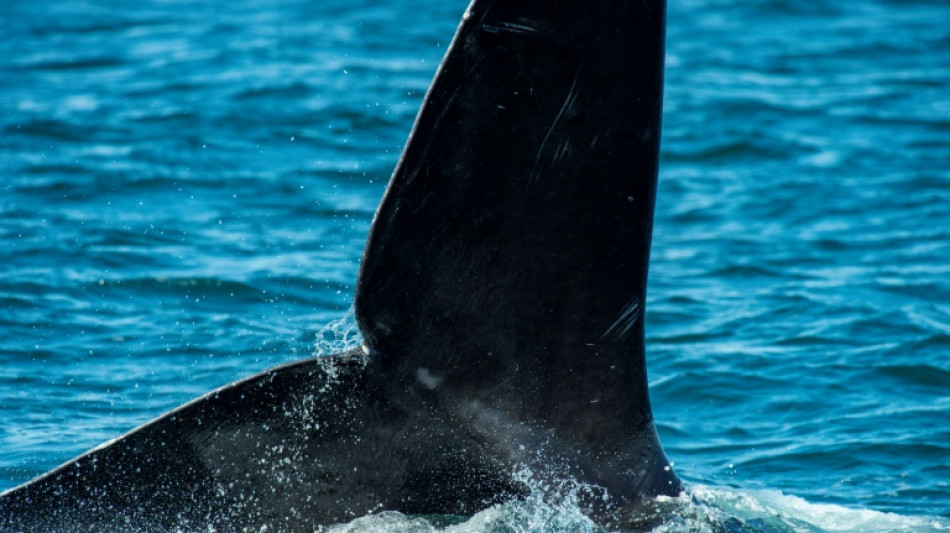
Speeding boats risk killing off North Atlantic right whales: study / Photo: Joseph Prezioso - AFP/File
 Japan to survey animal cafes over hygiene, welfare concerns

 Desperate families search for missing after Nepal floods

 The missing in Nepal-Tibet flash floods

 Search for 1,300 missing after deadly Nepal-Tibet floods

 Once a top export, prized Kashmir carpet fades

 Search for 1,000 missing after deadly Nepal-Tibet floods

 Park So-yeon first woman to play for eSports powerhouse South Korea
 Yayoi Kusama: Japan's kaleidoscopic, troubled 'polka dot queen'

 Euro champ Hunt 'on her toes' against world's best in Zurich 100m
 Asian chip firms lifted by Nvidia forecast but broader markets struggle

 Search for missing after Nepal-Tibet floods kill 165

 Qantas says profits slump as fuel costs surge

 Lofty bond yields, Bessent's intervention pose challenge to Fed's Warsh
 The foreigners missing in Nepal's flash floods

 Bond yields are surging: Here's why that could spell trouble

 Fed's Cook rejects Trump mortgage fraud claims

 Guardian Metal Resources PLC Announces Pilot Mountain Technical Report Summary

 Meta, US states agree $18 bn settlement in landmark teen safety case

 What scientists know so far about Nepal's deadly floods

 US general visits Colombia to discuss war on drugs

 Meta settlement puts social media industry on notice: 'There will be more'
 NFL owners approve record Seahawks sale

 Nigerian armed groups net nearly $6 mn in ransoms: study

 Savio scores on debut as Spurs advance in League Cup

 Mbappe hits treble as Real Madrid thrash Real Sociedad

An overwhelming majority of large boats off the US East Coast are speeding through slow-zones designed to protect critically endangered North Atlantic right whales, of which only around 340 remain.
That's according to a new analysis of vessel tracking data published Thursday by the nonprofit Oceana, which called for stronger safeguards and greater enforcement to save the species from extinction.
"Boats are speeding and whales are dying -- it's that simple," said Oceana's campaign director Gib Brogan.
Boat strikes are one of the two leading causes of death for the whale species, alongside fishing rope entanglements. Collisions kill them through blunt force trauma or propeller cuts.
Since 2008, the US National Oceanic and Atmospheric Administration (NOAA) has imposed mandatory 10-knot limits for vessels 65-feet (19.8 meters) or longer in zones where the whales are expected to be present, and suggested the same speed for areas where they have been sighted.
But data collected from ship transceivers found that from November 2020 through July 2022, 84 percent sped through the mandatory zones and 82 percent sped through the voluntary zones.
"What we've been told by people in the maritime industry is it comes down to balancing the risk of a minimal fine from the government versus the reality of the fines for getting their cargo to port behind schedule," Brogan told AFP.
Notably, for the 9,358 vessel trips over the speed limit made from November 2021 through July 2022, NOAA issued fines in only 46 cases. The average fine was about $15,600.
Right whales, which can grow up to 60 feet (18 meters) in length and have human-like lifespans, are thought to have once numbered up to 20,000 before commercial whaling wiped out their population.
They were considered the "right whale" to hunt by whalers who sought their blubber for whale oil and their baleen plates, which the whales use to filter their food, as a strong, flexible material used in the pre-plastic era.
Commercial hunting of North Atlantic right whales was banned by the mid-20th century, leading to a recovery, with a peak of 483 individuals by 2010.
Since 2017 however, they have been experiencing an "unusual mortality event."
The most recent documented killing from a boat strike was in February, when a 20-year-old male washed ashore with a broken spine in the mid-Atlantic Virginia Beach.
Since the population is already so low, even a few deaths can drive a downward spiral.
The whales' calving rate is also down as a result of chronic stress on mothers, and their traditional foraging grounds are changing as a result of climate change.
Oceana's report called for updating the slow-zones to reflect the whales' current distribution, an end to voluntary speed limits, and expanding the rules to ships 35-feet long.
"We know what we need to do to save the species -- so it's a matter of just doing it and letting the whales come back," said Brogan.
Y.Nakamura--AMWN