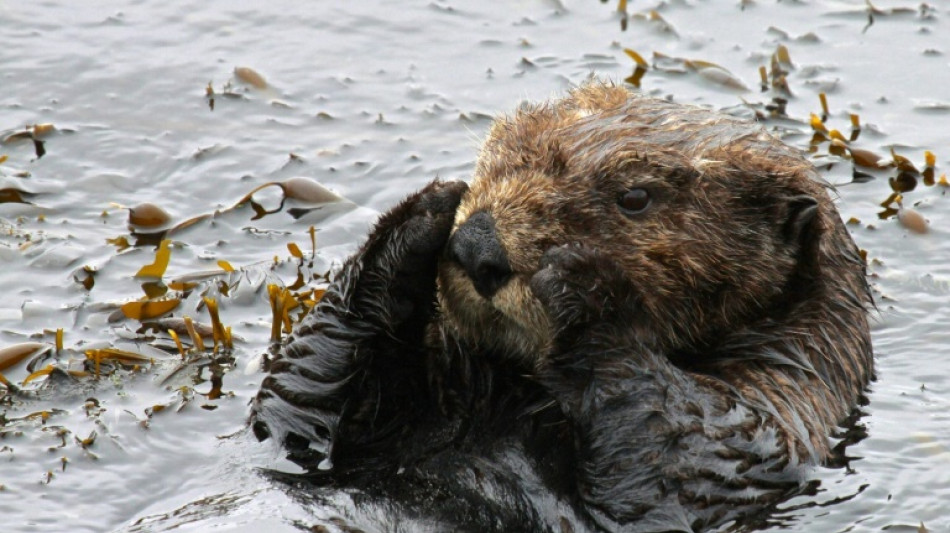
Return of hungry sea otters protects key coastal ecosystem: study / Photo: Lilian Carswell - US Fish and Wildlife Services/AFP/File
 'Two bad options': Rights groups decry IMF austerity demand

 Guardians-Rays MLB playoff game postponed until Saturday

 'We've never had this': Bear sightings spook Russia

 Injured Jordie Barrett out of second Bledisloe Cup Test

 All contenders for UN chief receive veto: diplomat

 UN climate panel fails to agree date for global warming update: envoy

 Stocks struggle to bounce back from AI angst-fueled rout

 Clashes grip Tirana as Albanian PM blames 'foreign hands'

 End of a dynasty? Dodgers digest playoff drubbing

 Troyes sack sporting director Blanchard amid sexism claims

 Trump's new press secretary out after less than week

 EU backs Ukraine on Starlink, but can't fill gap

 Itauma coming to terms with Hrgovic heavyweight loss

 NBA tells sportsbooks to ban certain bets and parlays: report

 US influence, AI and mistrust cloud Alberta independence vote

 Pant, Bumrah named in India Test squad for New Zealand tour

 Coen brothers say they plan to make film together again

 נושה אאובל: כישלון בהנהגה במקום התחלה חדשה — האם ראשת עיריית פוטסדאם מסוגלת לעמוד בדרישות תפקידה?

 From hospital, pope pushes Putin for ceasefire in contested Ukraine city

 King of the Mountains Carapaz joins NSN Cycling team

 S.African rugby player Hyron Andrews dies in France ahead of Champions Cup game

 Maresca says Man City 'more together' after financial charges

 Zelensky drums up European backing as Trump ties slump

 Food crisis 'looming' after global energy shock, UN agriculture fund says

 'Sportswashing' or investment? Rwanda F1 stirs debate and doubts

Back from the brink of extinction, sea otters in central California have started restoring the degraded landscape of a key estuary -- thanks to their insatiable appetite for crabs, according to a study published on Wednesday.
The research depicts the ripple effects of the sea otters' return to Monterey Bay, California, highlighting how successful conservation efforts can improve the health and resilience of whole ecosystems.
Once hunted for their fur to the verge of local extinction, sea otters have made a dramatic recovery in central California after more than four decades of extensive conservation efforts in the region.
The otters have returned to coastal kelp forests and the the salt marsh-dominated coastal estuary, Elkhorn Slough.
And their return has heralded wide-ranging improvements around the estuary, a critical habitat that protects the shoreline.
In a new paper published in Nature, scientists in the United States and Canada found that the marine mammal slowed the erosion of parts of the estuary by up to 90 percent between the time they recolonised the area in the mid 1980s and 2018.
"One of the most remarkable things about this is that it's truly a conservation success story," study author Christine Angelini, director of the Center for Coastal Solutions at the University of Florida, told AFP.
Previous studies on salt marshes have shown the physical and chemical explanations for erosion.
But this study points a pincer at another culprit -- the shore crab.
These abundant crabs eat plant roots, burrow into the salt marsh soils and eventually can cause erosion and even collapse.
Sea otters eat around 25 percent of their body weight every day and researchers said they have an especially large appetite for these crabs.
"After a few decades, in areas the sea otters had recolonised, salt marshes and creekbanks were becoming more stable again, said lead author Brent Hughes, associate professor of biology at Sonoma State University, in a statement.
This was "despite rising sea levels, increased water flow from inland sources, and greater pollution".
- 'Crab feast' -
Researchers combined decades of data, over 35,000 observations of sea otters and three years of experiments manipulating the presence of top predators in a salt marsh ecosystem.
Top predators have declined in nearly every ecosystem on Earth, but conservation efforts over the past decades have helped recover species like wolves, brown bears, and eagles.
And growing research shows that reintroduction can have a wide-ranging impact on restoring ecosystems.
In this case researchers said sea otter conservation has unlocked several decades worth of benefits.
"It would cost tens of millions of dollars for humans to rebuild these creek banks and restore these marshes," said study author Brian Silliman, professor of Marine Conservation Biology at Duke University.
"The sea otters are stabilising them for free in exchange for an all-you-can-eat crab feast."
F.Dubois--AMWN