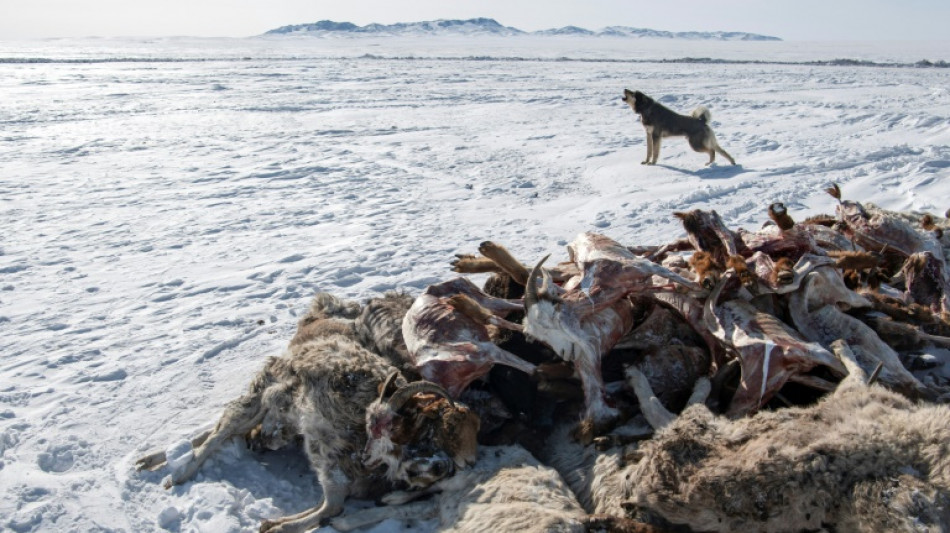
2 million animals dead as extreme winter weather hits Mongolia / Photo: Byambasuren BYAMBA-OCHIR - AFP
 Brazil sues Discord over child safety measures, demands $100 mln in damages

 Mbappe hits treble as Real Madrid thrash Real Sociedad

 At Dollywood, superfans honor the late singer and local hero

 Stocks mixed as oil drops, US inflation stays high

 Bolivia's Paz appoints new economy minister amid bailout talks

 US designates UK-based Palestine Action as foreign 'terrorist group'
 'Rocky Horror Picture Show' star Tim Curry dead at 80

 American Moll wins women's pole vault at Zurich city event

 As Canada takes on US tariffs, what's behind the David and Goliath fight?

 UEFA 'likely' to drop threat to boycott FIFA tournaments: source

 US disrupts platforms allegedly used by Chinese hackers

 The foreign tourists missing in Nepal's flash floods

 Hundreds missing after Nepal-Tibet flood kills 98

 CIA director was on 'semi-routine' mission in Moscow: Trump
 Aldeguer switches to Rossi's VR46 for next season

 Rent TRON Energy and Reduce USDT Fees : TronBid Expands Marketplace

 Pakistan captain Babar Azam returns against England '90 percent fit'

 Stocks mixed as oil drops, inflation stays high

 Improving standards transform pole vault as spectacle, says Duplantis

 India close in on win despite Sri Lanka fightback in second Test
 MEXC TradFi Gala Concludes With Over 170,000 Registrations and $4.3 Billion in Daily Trading Volume

 Olympic skating champion Liu to skip new season

 Benfica sign midfielder Palhinha from Bayern

 Flick says Barca may go without striker as Atletico resist Alvarez sale

 Too hot to incubate: Nile crocodiles hatch on their own in French reserve

More than two million animals have died in Mongolia so far this winter, a government official said Monday, as the country endures extreme cold and snow.
The landlocked country is no stranger to severe weather from December to March, when temperatures plummet as low as minus 50 degrees Celsius (minus 58 Fahrenheit) in some areas.
But this winter has been more severe than usual, with lower than normal temperatures and very heavy snowfall, the United Nations said in a recent report.
As of Monday, 2.1 million head of livestock had died from starvation and exhaustion, Gantulga Batsaikhan of the country's agriculture ministry said.
Mongolia had 64.7 million such animals, including sheep, goats, horses and cows, at the end of 2023, official statistics show.
The extreme weather is known as "dzud" and typically results in the deaths of huge numbers of livestock.
The United Nations said climate change is increasing the frequency and intensity of dzuds.
Mongolia has experienced six dzuds in the past decade, including the winter of 2022-23 when 4.4 million head of livestock perished.
This year's dzud has been exacerbated by a summer drought that prevented animals from building up enough fatty stores to survive the harsh winter.
- 'Praying for warmer weather' -
Seventy percent of Mongolia is experiencing "dzud or near dzud" conditions, the UN said.
That compares with 17 percent of the country at the same time in 2023.
"The winter started with heavy snow but suddenly air temperatures rose, and the snow melted," herder Tuvshinbayar Byambaa told AFP.
"Then the temperatures dropped again, turning the melting snow into ice."
That ice makes it hard for the livestock to break through to the grass below, he said, preventing them from grazing and forcing many herders to borrow money for feed.
"The weather changes are so sudden these days," Tuvshinbayar said.
The deadliest dzud on record was the winter of 2010-11, when more than 10 million animals died -- almost a quarter of the country's total livestock at the time.
Snowfall this year -- the heaviest since 1975 -- has compounded herders' woes, trapping them in colder areas and making them unable to buy food and hay for their animals from the nearby towns.
Mongolia is one of the most sparsely populated countries in the world and about one-third of its population of 3.3 million people is nomadic.
The government has promised to help, launching a campaign to deliver hay fodder to herders in a bid to prevent further losses of crucial commodities like meat and cashmere, one of the country's top exports.
But for now, Tuvshinbayar and his fellow herders can only pray for warmer weather.
"It is becoming too hard to be a herder -- we suffer drought and flood in summer and dzud in winter," he told AFP.
"I'll start losing my animals if the snow does not melt in the coming months," he added.
"All herders are praying for warmer weather to melt this ice, so our animals can reach the grass."
Ch.Havering--AMWN