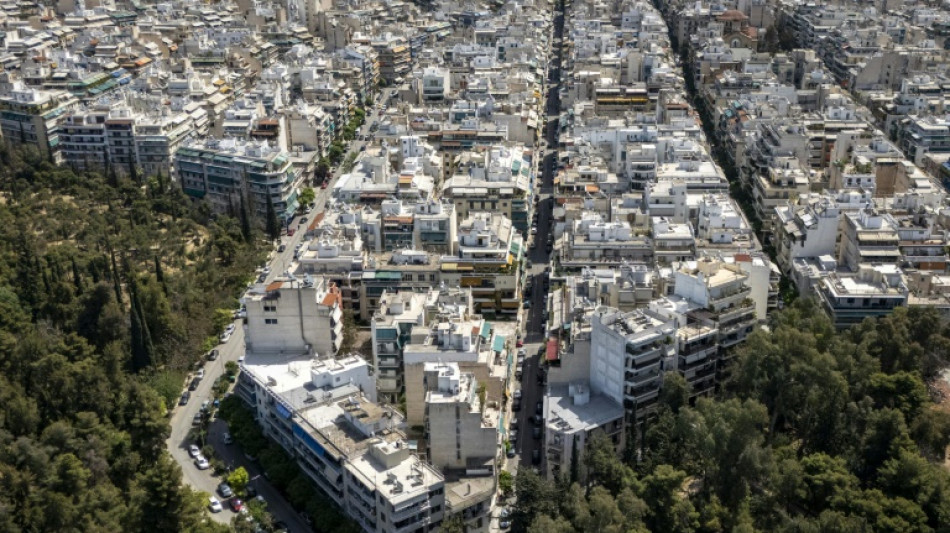
Tentative tree planting 'decades overdue' in sweltering Athens / Photo: Aris Messinis - AFP
 One million Afghan children suffer 'life-threatening' malnutrition: UN
 Sri Lanka trail India by 238 runs in second Test
 West Bank settlers attack AFP journalists
 MEXC Kicks Off MOVE Carnival With 0-Fee Trading and 1M USDT in Rewards
 Human rights in Myanmar hitting a 'new low': UN
 Son of Luxottica founder quits after succession row

 One million Afghan children suffering 'life-threatening' malnutrition: UN

 Real Madrid's Mourinho happy with squad despite losing out on Rodri
 Sri Lanka slump to 216-7 at tea in second India Test

 US delays Lockerbie bombing trial over new evidence

 Rohingya refugees protest dire conditions in Bangladesh camps
 Lego net profit up 32% in first half, 'stronger than expected': CEO to AFP

 German GDP growth revised upwards, defying Iran war turmoil
 STARTRADER Adds 30 U.S. Stock and ETF CFDs as 2026 Product Expansion Accelerates
 Trees 'giving up': climnate change hammers historic English gardens
 Namibia paves way for phosphate mining in the Atlantic Ocean

 Six months into Iran war, Hormuz traffic way down, sailors stranded
 Netanyahu got his Iran war, but maybe not his desired result

 Hyundai reaches tentative deal with workers after strikes

 Once its saviour, US puts Kuwait in Iran's crosshairs
 Australia's top music charts ban AI songs
 Four Nines Gold Intersects Hydrothermal Breccia in First Three Holes at Hayden Hill

 Dermata Therapeutics Announces Commercial Launch of Tome Foundational Treatment

 SMX's Plastic Cycle Token is the Most Effective Tool in Times of War

 Lavish Enterprises Introduces FleetPath Ace, an Autonomous Operator Built to Transform How Trucking Companies Operate
On a cloudy spring morning in one of Athens' most densely inhabited districts, thousands of fresh saplings dotting a small hilltop park mark a fledgling effort to tackle crippling heat that critics say is long overdue.
This is Athens' first "micro-forest", part of an initiative by recently elected mayor Haris Doukas to plant 5,000 trees annually in the thickly concreted city, where in summer the thermostat routinely tops 40 degrees Celsius (104 Fahrenheit).
Planting vegetation is crucial to help cities beat the heat, scientists say, as climate change stokes hotter and more intense heatwaves and the so-called "urban heat island" effect amplifies temperatures among tightly packed buildings.
But the knee-high plants in Alepotrypa park ("foxhole" in Greek) in Athens' Kypseli neighbourhood will need around a decade to mature.
They are "too little, too late," said Katerina Christoforaki, an architect and urban planner at the National Technical University of Athens, who has worked on past city redevelopment projects.
Athens' last major overhaul came when it was preparing to host the 2004 Olympic Games. But most of the attention fell on stadium construction and transport, not greenery.
"We haven't given the proper attention on reducing vehicle traffic or upgrading building infrastructure," she said.
Most of the capital and its roads were built with materials that are over 40 years old, with buildings absorbing heat in the summer and offering poor insulation in winter, she said.
Meanwhile, a number of key public urban planning agencies were defunded and sidelined during the near-decade long Greek debt crisis, she said, adding that most of the emphasis today is on boosting tourism infrastructure.
Athens' deputy mayor for climate, Nikos Chrysogelos, is one of the country's most experienced ecology activists and a former Greens European Parliament lawmaker.
On a table in his cluttered office, there are maps showing temperatures in each district of the capital and the areas most vulnerable to heatwaves.
Chrysogelos agrees that Athens "lost an opportunity" to strengthen its defences against heat around the time it hosted the 2004 Olympics.
"From 2000 onwards we could have done much more, because we knew the scale of the problem," he told AFP.
- 'Boiling kettle' -
Not only has the greater Athens area of nearly four million developed haphazardly, but the Greek capital has also lost 60 percent of its surrounding forests to fire in recent years, Chrysogelos said.
In addition, high-rise buildings on the Athenian coast have kept the sea breeze from cooling the city, he said.
Central Athens is the second most densely populated area in Europe after Paris, according to Eurostat.
According to OECD data, there are only 0.96 square meters of green space per resident, far short of the World Health Organization's recommendation of at least nine square meters per capita.
Ivvona Kujda, a housekeeper originally from Poland who has lived in Athens for over 30 years, said recent heatwaves in the city have been "harrowing".
"The way Athens is situated, there's mountains on three sides. Which means we are essentially in a boiling kettle," Kujda said.
In 2021, a heatwave that saw city temperatures reach 45C was described as the worst in three decades.
Two years later, more records were broken as a sustained heat wave saw temperatures consistently top 40C. The National Observatory of Athens said July 2023 was the warmest on record since it began monitoring data in 1863.
- 'Green corridors' -
WWF officer Achilleas Plitharas formerly headed the environment group's Green Spaces programme and worked on resilience plans with the Athens authorities until 2019.
"It's not that Athens missed the train. We never even built the rails for a train," Plitharas told AFP.
He said the city now needs a far more drastic solution than pocket parks to boost its climate resilience, including potentially the demolition of entire city blocks and "the creation of extensive green corridors".
That requires political will and tough choices.
"It also requires a culture of cooperation, which we lack," Plitharas said.
In office since January 2024, mayor Doukas has said planting 25,000 trees by 2028 should help bring down perceived temperatures by three to five degrees in summer.
New sensors will also provide real-time temperature data neighbourhood by neighbourhood on the hottest days, to better plan an emergency response if needed.
Athens' wider aim to become carbon neutral by 2030, including making dozens of municipal buildings more energy efficient and encouraging low-emissions transport, will require some 6.5 billion euros (7.39 billion dollars) in EU and national funds, plus private investment.
Meanwhile, people do what they can to stay cool.
Housekeeper Kujda works only in the morning and late afternoon, returning to her air-conditioned home during the hottest hours of the day.
"We do not have enough greenery, not enough oxygen," the 54-year-old said.
"I think it's going to get worse every year now because the climate is changing."
jph/klm/np/giv/tym
AFP is publishing this story to coincide with Covering Climate Now's 89 Percent Project, which aims to highlight that the majority of people in the world want to see stronger climate action.
A.Malone--AMWN