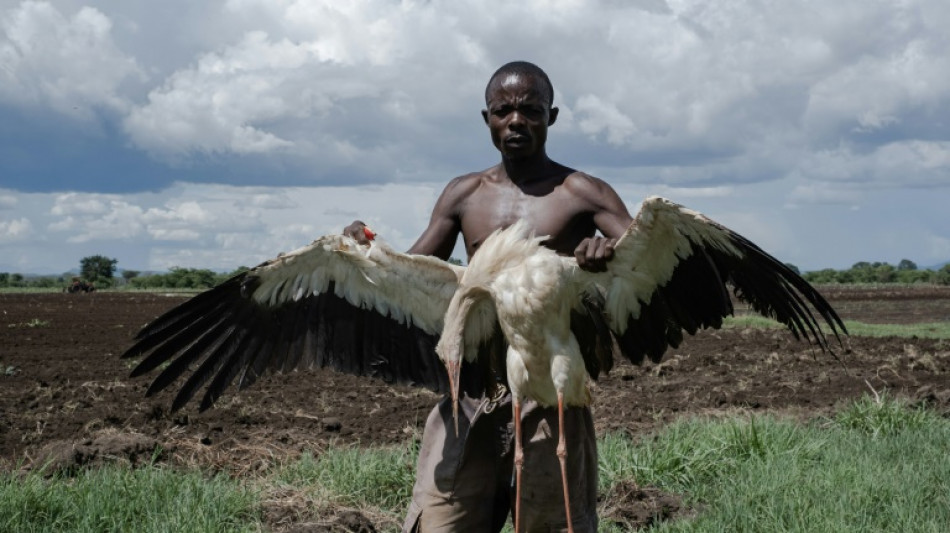
Ugandans kill migrating storks in desperation for food / Photo: Badru Katumba - AFP
 One million Afghan children suffer 'life-threatening' malnutrition: UN

 Sri Lanka trail India by 238 runs in second Test

 West Bank settlers attack AFP journalists

 MEXC Kicks Off MOVE Carnival With 0-Fee Trading and 1M USDT in Rewards

 Human rights in Myanmar hitting a 'new low': UN

 Son of Luxottica founder quits after succession row

 One million Afghan children suffering 'life-threatening' malnutrition: UN

 Real Madrid's Mourinho happy with squad despite losing out on Rodri

 Sri Lanka slump to 216-7 at tea in second India Test

 US delays Lockerbie bombing trial over new evidence

 Rohingya refugees protest dire conditions in Bangladesh camps

 Lego net profit up 32% in first half, 'stronger than expected': CEO to AFP

 German GDP growth revised upwards, defying Iran war turmoil

 STARTRADER Adds 30 U.S. Stock and ETF CFDs as 2026 Product Expansion Accelerates

 Trees 'giving up': climnate change hammers historic English gardens

 Namibia paves way for phosphate mining in the Atlantic Ocean

 Six months into Iran war, Hormuz traffic way down, sailors stranded

 Netanyahu got his Iran war, but maybe not his desired result

 Hyundai reaches tentative deal with workers after strikes

 Once its saviour, US puts Kuwait in Iran's crosshairs

 Australia's top music charts ban AI songs

 Four Nines Gold Intersects Hydrothermal Breccia in First Three Holes at Hayden Hill

 Dermata Therapeutics Announces Commercial Launch of Tome Foundational Treatment

 SMX's Plastic Cycle Token is the Most Effective Tool in Times of War

 Lavish Enterprises Introduces FleetPath Ace, an Autonomous Operator Built to Transform How Trucking Companies Operate

Desperate Ugandans are using poison to kill thousands of migrating white storks and other protected birds because they have so few sources of food.
In Ayoreri, a village on the Kenyan border, Sam Chekwoi, 42, said unpredictable rains and droughts have made it increasingly hard to feed his two wives and 11 children.
"I used to farm but the sun would destroy my food crops. That is when I decided to start catching those birds to provide food for my children and myself," he said.
He showed AFP how locals hunt their prey.
First they catch a mouse and kill it, then pour a mixture of alcohol and rat poison into its mouth and leave it in the field for a bird to spot.
The birds swoop down and quickly feel the impact of the poison. They try to fly away but cannot get very far and the villagers chase them down to finish the kill.
"When the birds eat the trap, they get weak, we catch them, kill them, and then eat them," said Chekwoi.
He estimates he has eaten upwards of 300 storks since moving to the area in 2016.
"If there was an alternative, I would do it," said Chekwoi.
The activity risks heavy fines but locals feel they have no choice.
- 'Only source of protein' -
Joel Cherop, 45, a farmer and conservationist, grew up in the area and is trying to discourage the practice.
He estimates that some 3,000 white storks have been eaten by villagers since the start of the year when the migrating season began.
Cherop described the birds as the "only source of protein" for many in the area. They can sell a stork for around 2,000 shillings or less than a dollar, he said.
He has monitored the birds over the years and knows from tagging that some came from Poland, Czech Republic and Hungary.
Although the nomadic communities in the region have degraded the land by cutting down too many trees for charcoal, Cherop empathises with their difficulties, especially the worsening droughts.
"There is no doubt that crop failure tops the agenda in this community for the last 10 years," he told AFP.
It feels particularly unfair, he said, to think that climate change is the result of industrial practices elsewhere in the world -- "the Americas, the Russias and the Chinas who are emitting billions of (tonnes of) carbon."
Cherop has started planting thousands of fruit trees around his farm in a bid to regenerate the land and is employing as many locals as he can with his limited means.
He says the local villagers are simply trying to survive.
"These are hungry young people who have no food, so they found an alternative in the migratory birds," he said.
D.Kaufman--AMWN