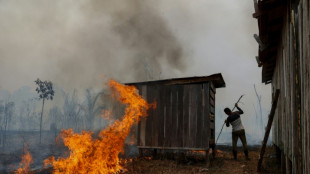
UN says transport infrastructure must adapt to climate / Photo: STEPHANE DE SAKUTIN - AFP
 Flamengo secure 0-0 draw in La Plata in Copa Libertadores semi

 The final lap? Two days on the campaign trail with Trump

 Asian stocks rise as tech bounces from rout, eyes on Warsh

 Saudi organisers say 2027 Asian Cup 'on schedule' after attacks

 Right-wing Brazil influencers on 'mission' to seal Bolsonaro win

 Using AI to help find Mexico's legions of missing children

 Fiji to deploy solar-powered Australian military drones at sea

 'Multiple victims' in Oregon elementary school shooting, police say

 'Multiple victims' in Oregon elementary school shooting: police

 ChangeNOW Announces NOW AI After Resolving Website Integration Vulnerability

 Argentine demonstration over education cuts ends in clashes

 Argentine protesters, police clash at demo over university funding

 US stocks end higher as AI shares stabilize

 School roof collapse kills 32 children, teacher in Pakistan

 Lyon down Palace in Europa League, Sunderland leave it late

 UniCredit says receives ECB green light for Commerzbank takeover

 New York City pension fund asks Anthropic to delay IPO

 Venezuela's Maduro denies US torture charges as 'false accusations'

 Somalia sets May presidential election despite insecurity
 Chelsea's Caicedo eager to be more of a leader

 Rahm reaches separation deal with LIV in bankruptcy court

 UN chief urges nations to end 'war on nature'

 Newcastle boss Jaissle says Fernandez-Pardo just needs a goal

 Infantino offers apology but 'no answers' at FIFA meeting over World Cup plan

 Don't exclude Turkey from 'Made in Europe' plan: minister to AFP

Transport infrastructure across Europe, North America and central Asia must adapt to more adverse climate conditions, the United Nations said on Tuesday, warning that inaction could prove more costly than upgrades.
Roads, railways, waterways, ports and airports will face a greater likelihood of flooding, high temperatures, reduced snow, ice and permafrost, and sea level rise from 2050 to 2080, the UNECE regional agency said.
UNECE covers 56 countries across Europe, North America, the Caucasus and central Asia.
It mapped the key inland transport networks needing specific attention.
"Transport systems are vital for the smooth functioning of our societies and economies," said UNECE chief Tatiana Molcean.
"Disruptions can have dramatic consequences on communities and come at huge financial cost.
"Because extreme weather events are no longer a future risk but a reality today, adaptation of transport infrastructure is an imperative."
The report said changing conditions would result in increased damage and disruption to transport systems if they were not made more resilient.
It gave examples such as increased road and rail infrastructure damage during heatwaves; more frequent flooding of transport facilities; and greater challenges at ports and airports during strong wind events.
"The recent episode of extreme heat that we've seen in Western Europe has highlighted climate risks and the impact and the consequences they can have on transport infrastructure," UNECE spokesman Jean Rodriguez told reporters.
On the railways alone, he cited train delays, cancellations due to buckled rails, on-board air conditioning failure, cable and signalling meltdown.
- 'Early adaptation' -
UNECE said transport systems in the region would need to cope with 10 to 50 more days per year of temperatures exceeding 25C, with some areas facing 200 days a year above the threshold.
UNECE said that by 2050, 70 percent of infrastructure in the Arctic would be in regions at risk from permafrost thaw and subsidence.
Flooding from heavy rainfall, plus sea level rise from coastal extremes were also identified as future risks.
More intense rainfall is projected in regions including the Alps, the Balkans, northern Turkey, parts of central Asia and the east coast of the United States.
Infrastructure in the highly populated basins of major European rivers such as the Danube, the Rhine and the Volga is projected to be exposed to significant flooding, said UNECE.
Between 71 percent and 89 percent of ports globally will be at risk of extreme marine storms by the end of the century, the report said.
"Early adaptation could reduce related costs by half," it said.
Given worsening climate projections and long infrastructure planning timeframes, UNECE encouraged decision makers to ensure early climate change adaptation was a priority.
UNECE urged leaders to ensure transport systems could "continue delivering the services on which economies and societies depend".
Transport supremos should use climate projections to assess the risks and identify the hazard thresholds for their systems.
"While adaptation measures can appear as costly, the consequences of inaction may be even more costly," the report warned.
Y.Kobayashi--AMWN