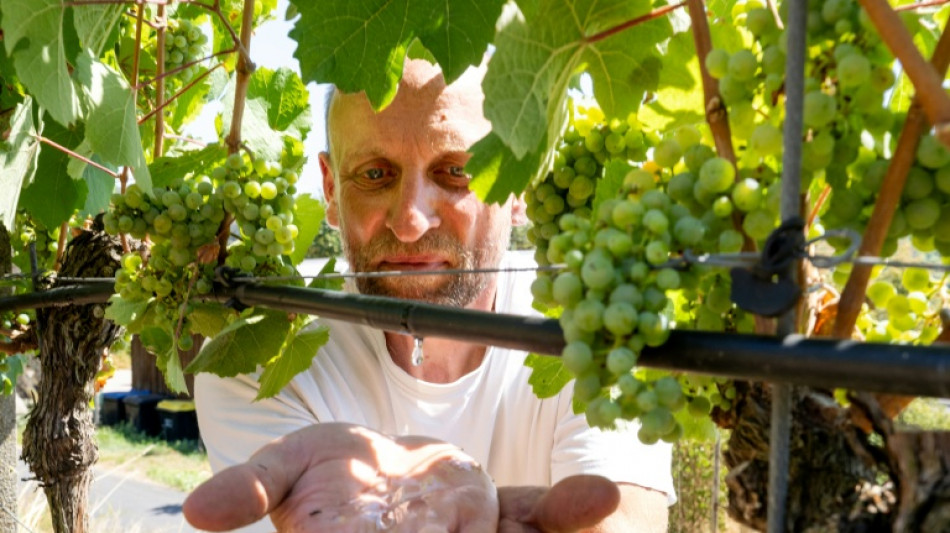
Heat is on as German winegrowers struggle to protect vines / Photo: Torsten Silz - afp/AFP
 Libya's pay strike rallies teachers across divided nation
 Four-member crew blasts off for International Space Station

 i-payout Expands True Local Payment Capabilities to Help Enterprises Pay Recipients Globally
 Botched US execution prompts global calls to scrap death penalty

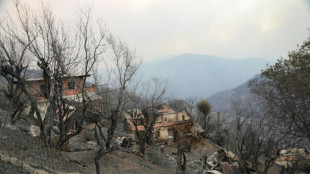 Algeria adopts law imposing death penalty on forest arsonists
 France unveils cost-cutting 2027 budget as borrowing costs rise

 Brazil court orders removal of fake posts amid patron saint election row
 Italy's firefighting planes return home after scorching summer

 How airlines try to make sure pilots are safe to fly
 Bolivia's attorney general arrested for alleged money laundering and drug trafficking

 Zverev beats Norrie to kick off Sinner-less China Open

 Wall Street stocks rise after bond yield spike eases

 Finland investigates suspected break-ins at MPs homes
 London's Bayeux Tapestry show to offer audio tour for blind people

 Smouldering bins, halted trams as French pupils protest

 Malone Life and Pensions Expands Internationally Beyond the European Union
 England paceman Archer rested for ODI tri-series
 Queiroz exits Ghana as Black Stars crisis deepens
 ALEX BODI VE ALMAN ŞİRKETLER GRUBUNDAN HALLE’DE 166 DAİREYE YATIRIM

 อเล็กซ์ โบดี และกลุ่มบริษัทจากเยอรมนีลงทุนในอพาร์ตเมนต์ 166 ยูนิตที่เมืองฮัลเลอ

 ALEX BODI A NĚMECKÝ KONCERN INVESTUJÍ DO 166 BYTŮ V HALLE
 ALEX BODI OCH TYSK KONCERN INVESTERAR I 166 LÄGENHETER I HALLE

 England forward Toney pleads not guilty to nightclub assault

 Tom Kim finishes marathon Asian Games second round under floodlights

 Work on migrant return hubs progressing well, EU countries say
As Europe bakes in yet another heatwave, German winegrower Florian Weingart has scattered straw on the ground to keep moisture trapped in the earth and protect his prized vines from extreme temperatures.
It is one of several measures that he is taking in a bid to ensure his small vineyard produces a decent crop despite a historically hot summer and low rainfall.
"The harvest is hanging by a thread," he told AFP from his vineyard in the village of Spay, looking out over the Rhine and hills scorched a deep brown by the heat. The river has fallen to record lows.
Climate change has had some advantages for Germany's winegrowers over the years, allowing them to experiment with grape varieties better suited to warmer climes and making cultivation possible in new areas.
But lengthier and more frequent periods of hot and dry weather are increasingly a challenge. They have left vineyards struggling to sufficiently irrigate their plants, and caused crop yields to dwindle.
"We are at a tipping point," said Weingart. He now feels that the dangers of climate change "are starting to outweigh the advantages".
The 53-year-old, who took over the vineyard from his parents three decades ago, has covered around a third of the six-hectare site with straw, which helps to create a protective layer that prevents water from evaporating.
But "it really is a lot of work", he said. "Over the last four weeks, I have transported 1,000 small straw bales from the fields and scattered it around".
- 'Lost' without irrigation -
Scattering straw between vines, known as mulching, is not new, but what has changed is its purpose: from improving general soil health to helping vineyards withstand a warming climate.
"This whole aspect of evaporation protection and the fact that (straw) actually offers advantages in dealing with these climate challenges is something we only realised later on," said Weingart.
Irrigation is another key measure at the vineyard, which makes mostly white Riesling -- Germany's signature wine variety -- as well as some red Spaetburgunder, and sells its produce locally.
The vineyard has a system of piping spread across 1.85 hectares of the vines, which steadily drips water onto the ground around the plants' roots, and is turned on every few days.
The system, which was installed in 2013, is especially important for young vines, whose roots are not as deep.
"Without irrigation, this area would basically be lost for the harvest," he said.
"I will no longer plant any young (vines) without irrigation, because otherwise I simply consider the risk far too great that they won't grow at all in the first three or four years."
Weingart also sees maintaining healthy soil, with limited weed growth competing for water, as an important way of helping vines cope with extreme heat and drought.
- Earlier harvests -
He expects the harvest to come in September, which is typical for recent years but far earlier than in the past when it was usually in October.
But he fears that, without some substantial rainfall, the crop will be poor after such a hot, dry summer.
The vineyard's harvests have already been shrinking over the years, dropping to around 5,000 litres -- enough for about 40,000 bottles -- compared to around 6,000 litres in the past.
Some winegrowers elsewhere in Germany already started harvesting in the second week of August, which is exceptionally early, industry group the German Wine Institute said this week.
"We're easily a good four weeks ahead of where things were maybe 30 or 40 years ago," the group's spokesman Ernst Buescher told AFP.
M.Thompson--AMWN